


Oversight in Action
OIAI Annual Report 2025
Supporting UNICEF to deliver better for children: OIAI 2025
UNICEF operates in some of the world’s most difficult places, delivering vaccines, nutrition, education, and protection to children in contexts where oversight is challenging and the stakes are high. UNICEF’s ability to deliver for children depends on the strength of the systems behind that work: the controls, partnerships, and financial management that make programmes possible.
The Office of Internal Audit and Investigations (OIAI) conducts audits to assess whether these systems are functioning effectively and to identify opportunities to strengthen them where needed, while also conducting investigations that promote integrity and accountability across the organization’s global operations.
OIAI in numbers | 2025
20 internal audit reports issued, plus six advisory engagements concluded.
1,837 investigation cases managed, up 32% from the prior year.
945 cases closed, more than double the 2024 figure.
$1.26M in established financial losses for UNICEF.
Our overall opinion
Based on the scope of assurance work undertaken by OIAI in 2025, the Office did not identify evidence that would lead it to conclude that UNICEF governance, risk management and control processes were overall inadequate or ineffective in supporting the achievement of the organization’s objectives.
The findings presented in this report highlight opportunities to further strengthen those systems and help UNICEF deliver even more effectively for children.
Why oversight matters
Think of the challenges UNICEF faces as a winding road, one the organization must travel as quickly as possible to reach the children who need help. Good risk management is the guardrail along that road: the rules, procedures, and controls that allow staff to act with confidence, manage uncertainty, and deliver results efficiently. Guardrails don’t slow UNICEF down. They are what make moving quickly possible.
Over time, however, those guardrails can develop gaps. Audits and investigations help identify where they are weakening and where action is needed, enabling UNICEF to address risks before they grow into larger problems.
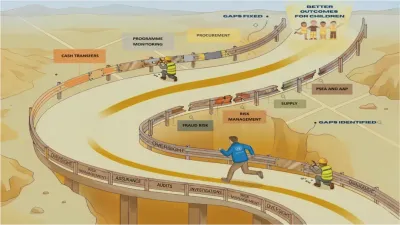
Where Risks Concentrate: Seven Themes from Across Our Work
Every audit report and investigation finding tells a specific story about a particular office, programme, or situation. But when you step back and look across them together, broader patterns begin to emerge.
This year, for the first time, we systematically analyzed findings from audit and investigation work conducted in 2024 and 2025. By mapping findings across offices and contexts, we identified where the same vulnerabilities continue to surface, regardless of geography or operating environment.
Seven themes emerged clearly. They are not the only issues we found. But they are the places where the guardrails most consistently need attention.
Risks Themes
Risk management is the system that helps UNICEF identify, assess, and respond to challenges before they become larger problems. It provides the foundation for informed decision-making, effective oversight, and accountability across all areas of the organization. When risk management and governance systems are not functioning effectively, emerging risks may go unaddressed for too long, limiting UNICEF’s ability to respond quickly, allocate resources effectively, and seek support when needed.
Audits found recurring weaknesses in risk identification, monitoring, escalation, and accountability. Risk registers were not always complete or regularly updated, mitigation measures were not consistently tracked, and significant risks were not always reviewed by senior management. Investigations also highlighted cases where unclear roles, decentralized responsibilities, or failures to act on warning signs contributed to losses and weakened oversight.
UNICEF relies on implementing partners to deliver programmes in many of the world’s most complex environments. Audits identified recurring weaknesses in the management of cash transfers, including delayed reporting, inconsistent application of assurance requirements, and limited follow-up on identified issues. These gaps can increase the risk that resources are not used as intended and reduce UNICEF’s ability to identify and address problems early.
Monitoring helps UNICEF understand whether programmes are reaching children and achieving intended results. Audits found that monitoring activities were inconsistent, with gaps in field verification, documentation, and follow-up. These weaknesses can make it harder to identify implementation challenges and take timely corrective action.
Procurement plays a critical role in delivering goods and services to children and communities. Audits identified recurring weaknesses in procurement planning, vendor selection, contract management, and oversight of supplier performance. These issues can reduce value for money, create delays, and increase exposure to fraud or collusion.
Audits found that many offices had not fully assessed fraud risks across all activities and that fraud prevention measures, awareness efforts, and reporting mechanisms were not always applied consistently. Investigations also highlighted challenges in detecting potential fraud early, particularly in programmes implemented through government partners. Together, these findings point to the need for stronger fraud risk management, improved anti-fraud capacity, and more effective mechanisms for identifying and addressing risks before losses occur.
From vaccines and nutrition products to emergency supplies, UNICEF’s work depends on getting the right items to the right place at the right time. Audits identified recurring weaknesses in supply planning, inventory management, logistics oversight, and monitoring of supplies after distribution. When these systems are not working effectively, supplies may be delayed, lost, wasted, or unavailable when needed, affecting UNICEF’s ability to deliver for children, particularly in emergency settings.
UNICEF requires all CSO partners to undergo a prevention of sexual exploitation and abuse assessment prior to entering into a partnership agreement. The assessment measures compliance with eight core standards, including requirements relating to human resources systems, investigative capacity and corrective action. Civil society organization partners assessed as having low or medium protection from sexual exploitation and abuse capacity may enter into time-limited partnerships of up to six months, subject to the development of an action plan to address identified gaps and the application of enhanced assurance measures.
In practice, the large volume of CSO partners and resource constraints, and reliance on self-reported information by partners, limit UNICEF ability to always ensure the accuracy of these assessments.
For government implementing partners, the lack of tools to fully assess, mitigate and respond to sexual exploitation and abuse present heightened risks. Government partners are not required to undergo any assessment, and the absence of related contractual terms and conditions with such partners also means that UNICEF has limited ability to respond to allegations of sexual exploitation and abuse.
Internal Audit
OIAI’s internal audit team conducts audits to assess how well UNICEF’s governance, risk management, and internal control systems are working and where improvements may be needed.
In 2025, OIAI issued 20 internal audit reports covering 17 country offices, one regional office and two thematic areas.
Audit Report Conclusions
The Office uses a four-tier scale for rating the conclusions in its internal audit reports, ranging from ‘satisfactory’ to ‘unsatisfactory.’ These ratings reflect the strength of UNICEF’s internal systems.
In 2025, 60% of audit conclusions fell within the top two rating categories.
Agreed Actions
As part of the audit process, OIAI works with relevant offices to agree on actions to address the issues identified. These actions are prioritized as high, medium, or low based on the potential impact of the risks. High and medium priority audit findings are tracked until resolved.
- As at December 31, 2025, 74% of agreed actions from 2022-2025 audits were implemented.
- 22 actions remained open for over 18 months, largely tied to complex thematic issues.
61% of country office audit findings in 2025 concentrated in three areas: programme management, cash transfers, and procurement.
Staying ahead of risks | OIAI's advisory work
In addition to formal audits, OIAI completed six advisory engagements in 2025. Advisory work does not result in a published report or formal conclusion, but it helps management identify and address emerging risks before they become audit findings. Some of the key engagements are highlighted below.
Supporting Operations in Complex Environments
OIAI provided advisory support to three country offices operating in particularly challenging environments: Afghanistan, the Syrian Arab Republic, and the Sudan. The reviews focused on strengthening risk management, oversight, and programme delivery in contexts shaped by conflict, instability, and humanitarian need. Key areas included partner risk management, cash transfer controls, accountability frameworks, staff coordination, and fraud risk management.
Improving Oversight of Pre-Positioned Supplies
UNICEF increasingly relies on supplies stored at implementing partner warehouses to support rapid emergency response. OIAI reviewed the monitoring and oversight of these supplies and identified opportunities to strengthen accountability, improve visibility once supplies leave UNICEF inventory systems, and enhance end-to-end tracking to the last mile.
Strengthening Fraud Risk Management
As UNICEF continues to operate in increasingly complex and high-risk environments, OIAI reviewed the organization’s fraud risk management arrangements. The engagement identified opportunities to strengthen oversight, improve fraud risk assessments, reinforce controls in high-risk areas, and expand the use of data analytics to support prevention and detection efforts.
Supporting Digital Transformation
With increased investment in digital solutions planned for 2026–2029, OIAI reviewed the governance arrangements supporting UNICEF’s digital transformation agenda. The engagement highlighted opportunities to strengthen accountability, risk management, funding oversight, and decision-making to help ensure that digital investments deliver value while managing associated risks.
Investigations
The OIAI investigations section assesses and investigates reports of possible misconduct and wrongdoing involving UNICEF resources, staff and affiliate personnel, implementing partners, institutional contractors, and other third parties.
A record caseload, and record closures
In 2025, the investigations section managed 1837 cases.
The number of closures increased by 107 per cent, with 945 cases closed by the end of 2025. In particular, significant progress was made in accelerating closures of cases of fraud and sexual exploitation and abuse.
The Office aims to complete assessments within 90 days and investigations within nine months. In 2025, 66% of investigations were completed within that time frame.
What people reported
Fraud and financial irregularities remained the largest category of allegations reported to OIAI, followed by other wrongdoing and sexual misconduct.
But within these broader categories, some notable shifts occurred:
- Cases of recruitment irregularities increased by 117%, likely reflecting reports related to the Future Focused Initiative restructuring.
- Cases of fraud by third parties and sexual exploitation and abuse both declined, but this could be due to reduction of country office posts responsible for safeguarding and fraud risk management.
The Office established financial losses to UNICEF from 47 cases of misconduct or wrongdoing amounting to $1.26 million.
How cases are resolved
Not every report received by OIAI results in a formal investigation. Depending on the information available, a case may be investigated, referred to another office, reviewed based on actions taken by a partner or vendor, or closed if there is insufficient information to proceed.
When misconduct by UNICEF personnel is substantiated, UNICEF management takes action to hold individuals accountable and protect the integrity of the organization. Similarly, when wrongdoing by implementing partners and suppliers is substantiated, UNICEF’s Implementing Partner Review Board (IPRB) and Vendor Review Committee (VRC) can sanction these parties.
In 2025, OIAI submitted 43 cases for possible disciplinary action and 11 cases for possible administrative sanctions against partners and suppliers. On its part, UNICEF management completed 25 disciplinary processes, which lead to 20 dismissals or separations from service.
A new framework for donor transparency
Transparency is essential to maintaining trust with UNICEF’s resource partners. In 2025, OIAI supported the rollout of UNICEF’s new Policy on Disclosure of Integrity-Related Information to Public Sector Resource Partners, which established a standardized framework for sharing information related to allegations of fraud, sexual exploitation and abuse, and other forms of misconduct. The policy helps ensure a more consistent and coordinated approach to donor engagement on integrity-related matters.
For the full text of the new policy, click here.
Looking ahead
OIAI Strategic Priorities 2026-2029:
Trusted Adviser and Trustee for Integrity
Strengthening OIAI’s role as an independent source of assurance, advice, and leadership on integrity-related matters.
Bridging the Assurance Gap
Expanding risk-based coverage to provide greater assurance over critical and emerging risks across the organization.
Investing in People and Performance
Strengthening skills, capabilities, and performance to ensure OIAI remains equipped to meet evolving oversight needs.
Leveraging Data, Analytics, and AI
Further embedding technology, data analytics, and artificial intelligence into oversight activities to enhance insight and efficiency.
Elevating Communications
Making oversight findings and lessons more accessible, timely, and relevant to decision-makers and stakeholders.

Focus areas for 2026
The Investigations Section will prioritize fraud and sexual misconduct cases, establish a dedicated sexual misconduct team, and expand the use of sanctions and remedial measures processes involving implementing partners and vendors.
The Internal Audit Section will expand its coverage of digital and information technology risks and strengthen assurance mapping to identify and address gaps in oversight coverage.
Across both functions, OIAI will continue to deepen collaboration, share insights, and identify opportunities to strengthen governance, risk management, and organizational accountability.