Bridging the Gap Between Young Voices and UNICEF’s Mission
How Two Days in Shkodër Helped Bridge the Distance Between Young People and UNICEF

For the past two years, I’ve been part of UNICEF Albania’s Adolescents Advisory Board, an experience that has not only shaped my activism, but also my deep connection to the community I call home– Shkodër. Most of what I do is rooted in this local community, whose energetic and lively spirit thrives through the work of some brilliant young people, friends and peers who care deeply about the same things I do: how to make our city safer, more inclusive and more open to the needs and ideas of young people.
So, when I was invited to help design the agenda for Ms. Edina Kozma, Deputy Representative of UNICEF Albania, during her visit to Shkodër, I was filled with excitement. This was a chance for us young people of Shkodër to showcase our real, grassroots engagement, how we are banding together to create solutions for the city, and how we are building platforms ourselves to amplify our voices rather than simply waiting for answers from above. It was also an opportunity to connect with UNICEF and its workers on a deeper level and bridge the gap between big institutions and the young people they work for, the mission of UNICEF and the voices of my peers.
Over two days, we toured Shkodër, where students, young leaders and activists shared their perspectives for the city and meaningful youth engagement, while important local stakeholders working for children and youth accompanied our discussions. One activity at a time– here’s a look at the tour!
Meeting with Student Body Presidents at “Atelie” Youth Center
Our journey began at the “Atelie” Youth Center, where we met with Student Body Presidents from high schools across the city. Joining us were representatives from our Youth Municipal Council, the youth center itself, the Local Education Office and even the Social Services Sector in the Municipality of Shkodër. In our discussion, my peers expressed issues related to career guidance and inclusivity in education, making sure youth from rural areas and vulnerable communities aren’t left behind. They advocated for the role of Student Body President to be taken seriously—empowered and supported to lead within the community. “We’re not just supposed to be leaders in our schools; we want to be active leaders in our city too.” - said Enisa, one of the participants from Oso Kuka High School.
We explored ideas for building a strong network among all actors involved in youth engagement in the city, discussing ways for school presidents, the Atelie Youth Center, the Youth Municipal Council, and UNICEF’s Adolescents Advisory Board to collaborate. Just a month after that conversation, the Student Body Presidents are following through. They’re organizing regular meetings with the youth center, where they’re now working together on coordinated actions to engage Shkodër’s youth through activities, training, and new opportunities.
Visit at the One Stop Center for Children Victims of Violence and Abuse and Child Support Hubs
From there, we visited the One Stop Center for Children Victims of Violence and Abuse and the Child Support Hubs, where we spoke directly with the professionals working to advance UNICEF’s goals in child protection. This visit was eye-opening; it made me confront a difficult reality—one that children in Shkodër sadly still face. But seeing the dedication of these professionals in creating safe spaces inspired me to think about how we, as young people, could play a part in this mission. To put it in the words of one of the professionals we met there: “You, young people, are a crucial part of this whole system of child protection.”
Our role can start with noticing when our peers might be going through difficult times, supporting their mental well-being, and encouraging them to seek help from school counselors or trusted adults who can guide them to safety. We can also learn more about child protection and advocate for the safety and well-being of every child.
Gamifying Shkodra Session
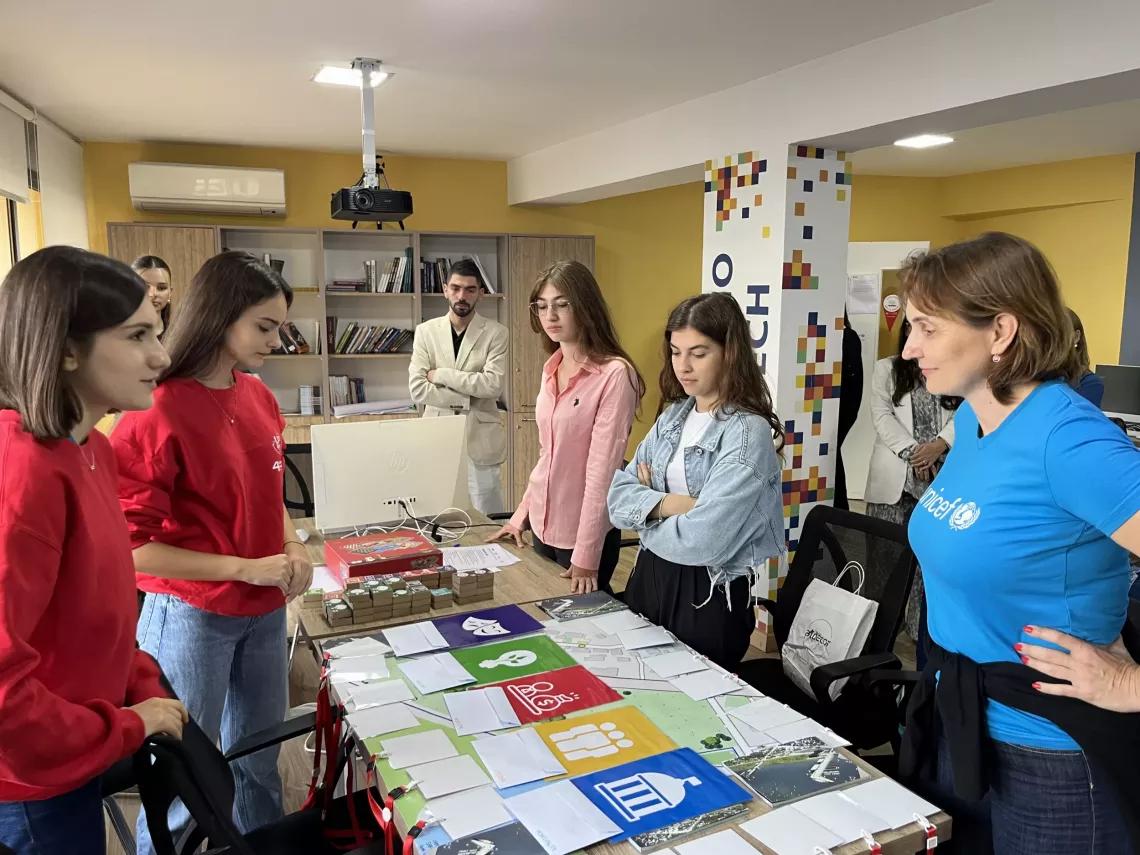
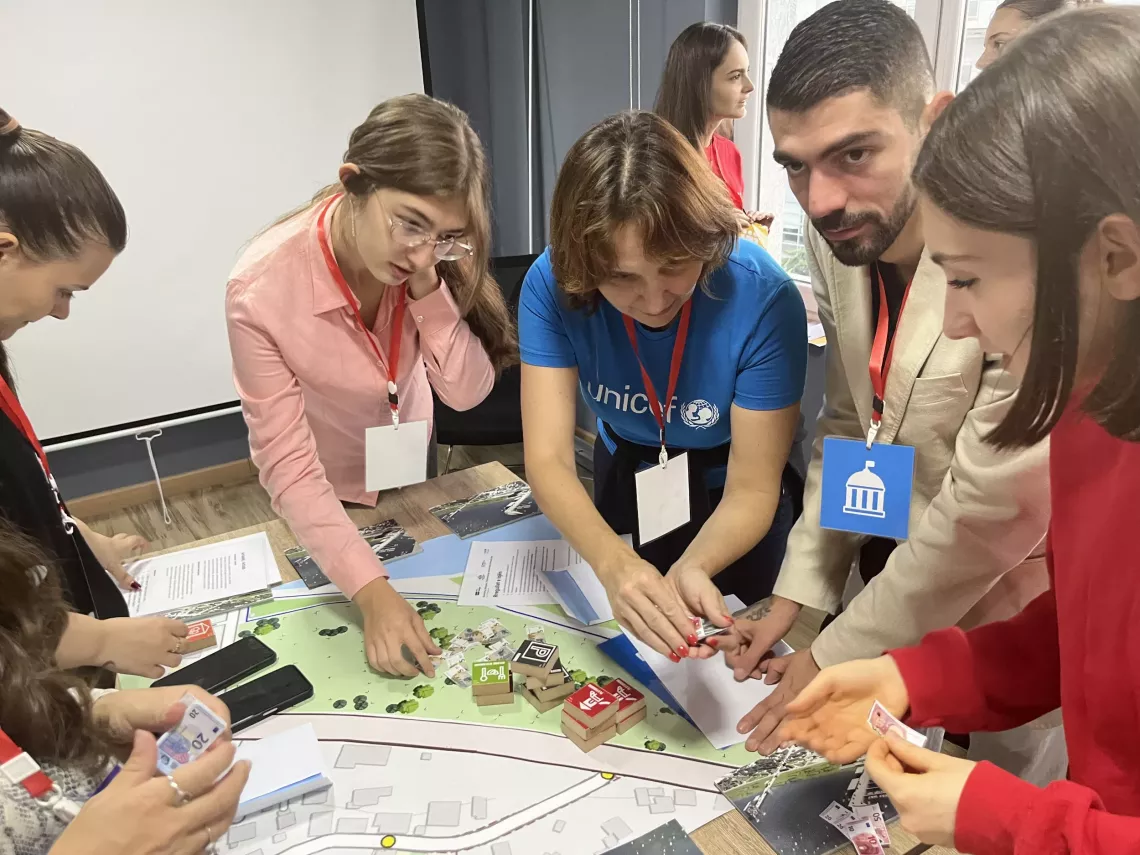
The day ended on a high note with “Gamifying Shkodra”, an initiative I developed with support from the UPSHIFT Programme and the Youth 4 Air Quality Project. In an engaging session, Ms. Kozma, UNICEF staff, and local youth came together to tackle our city’s urban challenges through a hands-on board game. Representatives from the Youth Municipal Council and the Youth and Social Services Sectors of the Municipality of Shkodër also joined in, making the experience even more dynamic.
The Monopoly-inspired game transformed complex issues like climate resilience and urban planning into something tangible and accessible. Most importantly, it gave young participants the chance to actively engage and collaborate with UNICEF representatives and key stakeholders in Shkodër.
I hold this initiative close to my heart. At its core, it’s about sparking real discussions for the city, building meaningful connections between participants, and bringing youth together with decision-makers. It’s not often that we see these diverse groups come together, and as I witnessed this collaborative spirit in action, I felt a deep sense of fulfillment—it was a vision and dream of mine finally coming true.
After the game, we carried that wonderful energy into a coffee chat with the brilliant leaders of the Youth Municipal Council. I continue to be inspired by their commitment to understand the needs of their peers in Shkodër, represent them before the mayor, and take bold steps to make those needs a reality.
Visit at “28 Nëntori” High School
On the second day, we welcomed Ms. Kozma to “28 Nëntori” High School, where students who’d participated in programs like UPSHIFT, Redebate, and BiblioTech shared their experiences. I felt incredibly proud to be representing my high school at the same time, accompanying Ms. Kozma in our one of a kind, school museum, sharing our stories and heritage, though old photographs, documents dating back to 1922. As we sat down at a roundtable in the school library, the discussion evolved to a deeper level and we explored how UNICEF in Albania can get closer to young people.
One student’s words, Adora’s, resonated deeply with me:
We are used to seeing UNICEF’s logo printed on banners in every activity we engage in, yet we aren’t aware of the work UNICEF truly does. It’s time for you to come speak to us directly, as you are doing right now... If you want to reach us young people, start by understanding what we are passionate about.
It was a reminder of the importance of connecting with youth on their own terms, through their own interests.
Meeting with the Girl Up 28 Club
We left the premises of the school to reach the Pedonale, the promenade nearby and participate in the annual march for Breast Cancer Awareness, organized by YWCA Albania, a moment of solidarity that brought together people from all corners of the city and beyond. This activity set the stage for a heartfelt discussion later that day, where we returned to my high school and met members of our Girl Up 28 Club there. With my co-founders Iris and Amanta, we opened the discussion by sharing what feminism and being a woman means to us, but it was not long before the girls of the club took the lead and sparked this wonderful exchange, where they stressed the importance of young women lifting each other up in every way possible, being unafraid of taking bold action and valuing their unique identities. Ms. Kozma’s words left a lasting impact, as she highlighted the word: SELF-AWARENESS– in the sense of knowing who you are, what matters to you, and what you’re willing to stand for. As she shared that, for her, feminism meant being self-aware and choosing your own path, we felt inspired to be listening to a strong female leader and amazing role model.


Reflecting on the tour, I felt a deep sense of pride in what we had achieved. I was determined to create a comfortable space for young people to express themselves, and they responded with honesty and passion, sharing their stories, ideas, and even their demands for change. The usual awkward silences in meetings of this sort were replaced with lively discussions where each person sought to explore new pathways for collaboration.
Hearing each young person speak up for themselves reminded me of the immense power that every individual voice holds. Often, the only thing standing between these voices and real impact is the absence of a space where they feel truly heard, supported, and respected. This is the kind of support I am particularly grateful to UNICEF for offering me ever since I joined the Adolescents Advisory Board—listening to my ideas, engaging with my perspectives, and empowering me to make a difference. It makes me thrilled to see that same support now spreading to more young people in our community, giving them the encouragement to lead and act with confidence.
This gives me the chance to thank Ms. Kozma—not only for joining us but for listening, connecting, and leaving us with thoughtful reflections. It’s not every day that someone in her position sits down and really listens.
And I’d be missing something important if I didn’t mention the three incredible UNICEF staff members who joined the tour: Brisida Jahaj, Keti Gjipali, and Ada Shkurtaj. Their energy, their openness, and the way they show up for young people—every single time—made a difference in every meeting, every conversation. They have a way of creating space where ideas flow freely, where nothing feels too small to be heard. That wasn’t only true during this visit; it’s true every time they connect with us. The honesty, the ease, the sense that you can speak your mind without second-guessing—that was, in large part, thanks to them.
Because at the end of the day, it’s not just about giving young people a platform to speak, rather about listening closely, respecting what they have to say, and being willing to act on it. It’s about celebrating their courage to stand up and their determination to shape a better future. And, as I watched these voices come together during the tour, I felt hopeful that this is only the beginning.