On your bike
To reach every last child with routine immunization, vaccinators in remote parts of Afghanistan are getting on their bikes - literally.

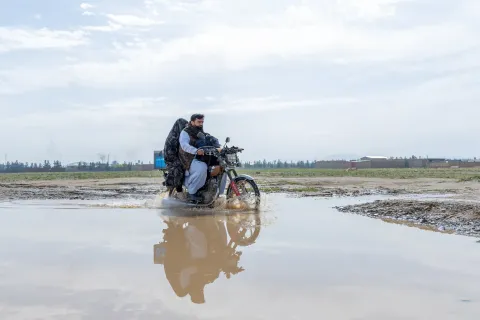
Seen from above, Payenda’s motorbike is a chrome ant crawling along the winding mountain road. Slung across his leather-clad back is a grey refrigerated box. In his carpet saddlebag is a register, where the vaccination histories of the children living in this part of Afghanistan’s remote northeast are meticulously recorded.
It’s early on a spring morning, and Payenda has the road almost to himself. In the valley the almond and apricot trees are blossoming. High above, the snow-capped peaks gleam in the sun. His first stop, Shaheed Mosleh health centre, where he will replenish his supplies, is another hour away. He sits back, and eases open the throttle.
Payenda is one of over 1,500 outreach vaccinators serving far-flung villages in every province of Afghanistan by motorbike. They’re making a marked difference in mountainous places like Badakhshan – so much so that 800 more will be deployed under the global, GAVI-funded “Big Catch Up” initiative, to close the gap on children left unvaccinated in the wake of the COVID-19 pandemic.
The refrigerated box on Payenda’s back contains the vaccines to protect the local children from a range of diseases - including measles, hepatitis B, polio, whooping cough, pneumonia and diphtheria - and to prevent pregnant women contracting tetanus.
Payenda’s patch covers the entirety of Khash district, directly south of Badakhshan’s provincial capital, Faizabad. High up in the mountains, the residents of Khash live in villages perched on south-facing flanks. Every day, Payenda leaves his house in the valley and travels up the winding mountain road to the health centre. Half his time is spent here, vaccinating the children and women who come to the clinic. Every other day he fills up his vaccine box, hops on his bike and heads out into the mountains, visiting the villages in strict rotation.

Like 70 percent of the Badakhshan population, the residents of Khash district live some distance from their nearest health facility. Shaheed Mosleh health centre caters to most of the 25,000 district residents. Once a day a minibus makes its way up the mountain from the valley floor, bringing patients to the health centre. Otherwise, people mostly rely on donkeys to get there, or come on foot.
The distance to the nearest health facility is the top reason given by Afghan parents for not vaccinating their children. Vaccination data tells a similar story - in provinces where a significant majority of the population live some distance from the nearest health facility, childhood immunization rates tend to be below the national average.

As one of the most remote provinces, you’d be forgiven in thinking Badakhshan’s vaccination rates are well below average - but you’d be wrong. Badakhshan is slightly below the national average for full childhood immunization, at a quarter of the children in the province (the national average is 37 percent). Oral polio vaccine coverage is higher, at 61 percent, against a national average of 59 percent. The proportion of zero dose children is four percentile points higher than the national average of 19 percent.
What makes Badakhshan stand out is the sheer number of motorbike vaccinators – 80 of them cover 26 districts. Three or four times a week they ride through the mountains to reach remote villages – some a day’s journey from the nearest health facility. The furthest village on Payenda’s beat is so far from the health centre he has to stay overnight. In the spring the roads turn to mud, and Payenda regularly abandons his bike to cover the last few miles on foot. It’s a hard job, but he is happy to do it.

“The people are why I do it,” says Payenda. “I’m from Khash – these are my people. I feel responsible to do what I can for my neighbours. It’s difficult work, but it’s worth it,” he continues, smiling.
Increased vaccination rates are directly linked to dropping mortality rates among children under 5 worldwide. In Afghanistan, the number of children dying from measles dropped almost fivefold since the millennium, while vaccination rates doubled - a success due in no small part to creative ways to reach every last child.[1]
The outreach vaccinator programme is seeing successes in reaching zero dose children in remote communities like Khash, and UNICEF had planned to expand it considerably. Recent changes in the global funding environment threaten this expansion – and the quest to achieve herd immunity for preventable childhood diseases like measles and polio. Without additional funds, the future of this programme - and the health of the children it reaches - hangs in the balance.