Water on tap! Through providing safe drinking water in homes UNICEF supports a pathway to education
The availability of safe drinking water at home paves a way for children in rural Afghanistan to more readily attend school

“When I was young, we had to walk for miles with a bucket on our head, one in hand and others placed on the donkey, as we fetched water for ourselves and our families,” says Safoora (57). Safoora is a mother of three children – two boys and a 10-year-old girl Zahra.
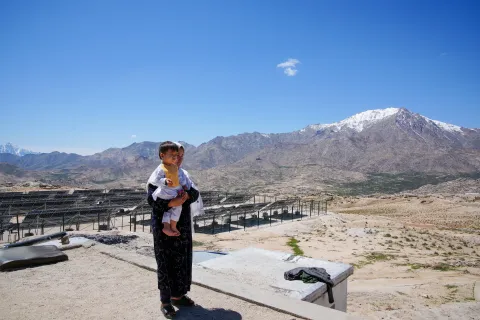
Living in the remote village of Qafila Bashi, in Bamyan district, Afghanistan, Safoora’s home sits high on a mountain, reached by a narrow road with mountain wall on one side, and a steep slope on the other. Safoora lives with her husband and brother-in-law, who runs a small-scale business of bee farming for honey production.
When Safoora sees her daughter Zahra return from school and fill a glass of water from the water tap in their home, Safoora’s eyes fill with affection and pride – as if a long-forgotten dream has come true.
“For us, going to school was not even an option. Our concern would always be planning the visit to the water stream with fellow women and deciding on a time that provides a window to walk all the way to the river and return while there is still some light,” recalls Safoora.

“Most of my time as a young mother was spent in guilt as I was too busy fetching the water, making my way through the snow, and eventually missing feeding my children myself, or making sure their beds are warm and comfortable enough. I could never catch up. It felt like I was never present for them. My only prayer would be for life to be kinder to my children, at least, if not for me,” says Safoora.
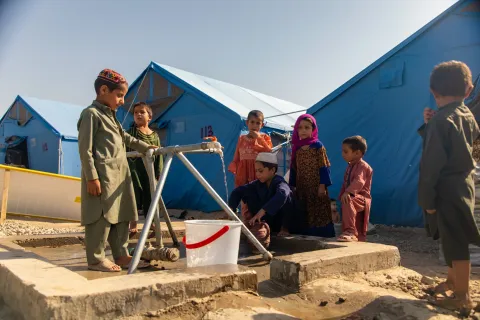
Years later, life has indeed taken a positive turn for Safoora and other women of her community, as UNICEF reached the valleys of Bamyan through a water supply project. This included installing a water reservoir for 130 households, with taps in homes, each serving four-five families, as well as providing safe drinking water and suitable toilets for the children at the local Qafila Bashi Primary School. The dream of going to school and getting an education, materialised for her children – Abdul Ahad (12), and Zahra (10). Abdul Ahad and Zahra are both enrolled at Qafila Bashi primary school and can learn without worrying about helping their family to fetch water or wash clothes by the river stream – located four kilometres away, at the foot of the mountain.

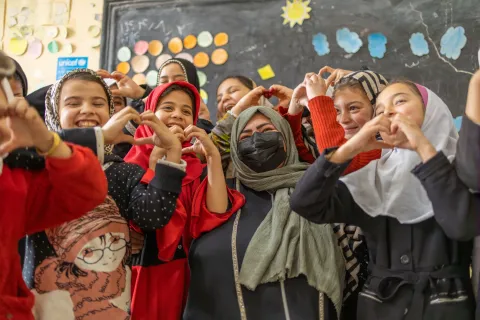
“Earlier, it was always a struggle to maintain the class attendance,” says Tahir Mohammady, head teacher Qafila Bashi primary school. “With water now available at home, and safe drinking water accessible to both the community and children at school, we have seen not only a significant decrease in waterborne diseases, but also an increase in children, particularly girls, now able to attend school more regularly. The children no longer need to spend their time fetching water. Today, I have 98 per cent regular attendance at my school”, adds Tahir.
“I have some class fellows who come from afar, and their siblings are still unable to attend the school on some days as they have to fetch water,” says Zahra (10). I have a water tap at my house, so we can drink water whenever we want. The thought of fetching water from the river scares me. There are strangers, and sometimes even foxes and wild dogs out there,” she adds.
The water reservoir and tap system in Qafila Bashi village of Bamyan were installed by UNICEF around eight years ago. While the project brought huge relief to the community, reducing the occurrence of water-borne diseases, and most importantly paving a way for children to attend school. However, with a growing population and increasing water demand, the community is once again facing the threat of water scarcity. The number of households consuming the water through the reservoir was once 130, but is now 408, three times the amount. While families continue to try and balance their demand and use of water, they fear falling back to old times and being forced to return to fetching water from the river once again. This would impact children’s attendance at school and limit their access to education.
“We have dry mountains, but with the provision of our water reservoir, we can also grow trees and vegetables in our homes. With no health facility in our village, or even nearby, the slow decrease in water worries me. I do not want my children to fall sick or drop out of school. They deserve a better and healthy life, and should not struggle the way I had to,” says Safoora, as she moves between hope for a better life for her children, and the fear of returning to the old ways of obtaining water and the impact this would have on her family once again.