From tremors to recovery
Safe water brings hope to families in Afghanistan

When the earth shook across eastern Afghanistan, families in Nangarhar, Kunar and Laghman lost far more than their homes. Water sources cracked, wells collapsed, and even the most basic daily routine of finding potable water suddenly became a struggle for survival.
Three months later, thousands of families are still living in temporary camps, hesitant to return to their damaged houses and fearful of the aftershocks. Sharifa is one of the mothers who lost everything. Like many mothers in the camp, her day begins before sunrise with the same worry—how to secure safe water for her family.
“Every morning, I worried about where to get water,” says Sharifa, who used to fetch it from a nearby well. “With the destruction caused by the earthquake, getting clean water became a daily struggle.”
Before the response began, many families relied on unsafe water sources. The earthquake destroyed more than 130 water points, and as open defecation became widespread, the risk of cholera and other waterborne diseases rose rapidly. However, with the provision of water services, safe water has become a lifeline for displaced families living in crowded conditions.

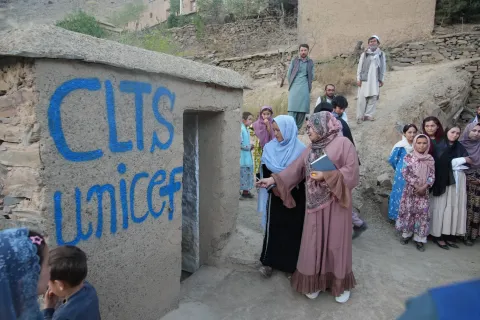
Across seven camps and more than 50 affected communities, UNICEF’s Polio Programme and partners have been working to restore one of life’s most essential services. Today, over 20,000 people are receiving water, sanitation and hygiene (WASH) support, helping families move from crisis towards recovery while reducing the risk of deadly waterborne diseases.
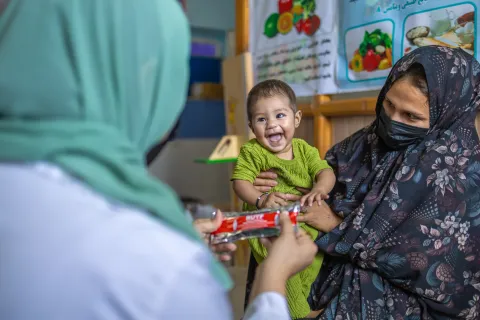
“The earthquake in Kunar province of Afghanistan disrupted essential services like immunization and water systems,” says Dr Godwin Mindra, UNICEF Chief of Immunization." UNICEF deployed social mobilizers to promote health education, hygiene, and sanitation—helping prevent disease outbreaks, including polio, as communities recover.”
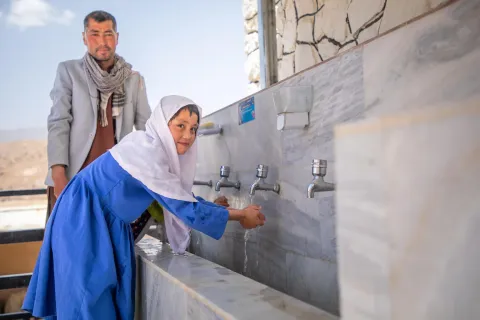
In Khas Kunar camp, change is already visible. A new water supply network with a production capacity of 120,000 liters per day, now serves families who once depended entirely on water trucks.
Across six camps, more than 15,500 people now have continuous access to safe water. Water trucking ensures immediate relief, while longer-term systems are being installed to provide reliable, sustainable supply. The completion of the durable water system in Khas Kunar has already reduced daily water trucking by more than half.

In total, 76 water reservoirs and 188 tap stands are now serving families, and more than 11,000 jerry cans have been distributed to help households safely collect and store drinking water.
“With water back in our community, we feel alive again. It gives us hope that we can recover and rebuild,” says Sharifa.
Work continues in Satarwal and Zeri Baba camps, where additional water systems will soon reach thousands more people. At the same time, efforts have begun to rehabilitate damaged water systems in affected communities, helping families rebuild their lives closer to home.
For families who lost everything, the sound of water flowing from a tap represents more than infrastructure. It signals safety, dignity, and the first steps toward recovery. Returning to their villages remains a challenge as aftershocks continue, but progress is steady.
“Water brings life back to our community. It gives us hope and strength to rebuild our homes,” says Sharifa.
With continued support from the United States, Centre for Disease Control and Prevention (CDC), Central Emergency Response Fund (CERF), UNICEF Polio Programme has moved from emergency response to durable solutions that strengthen communities to become more resilient and withstand future shocks.