UNICEF Regional Director for South Asia visits Afghanistan
where she witnessed firsthand the challenges children face; results achieved for, and with them, through UNICEF-supported programmes and partnerships; as well as the aspirations and dreams children have.

Herat, Afghanistan, 31 May 2018 - “Afghanistan has achieved good strides in several fields, and this is very encouraging,” says the Regional Director. When comparing with 1990 data, the under-five mortality rate is almost halved, from 179 to 97 per 1,000 live births in 20151. Maternal mortality ratio is one-third what it used to be in 1990, dropping from 1,200 to 400 per 100,000 live births in 20152.
“Yet, some challenges remain, such as Polio, out-of-school children, early marriage to name a few, making UNICEF’s mandate more relevant and critical than ever,” adds Gough.
Maintaining hope in difficult times
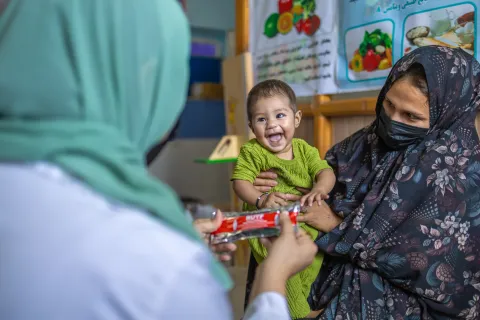
In Herat, the Regional Director visited a health clinic, and an accelerated learning centre for girls. At the clinic, Gough interacted with health workers; mothers and infants who benefited from a comprehensive mother, newborn, and child health package.
She met 8-month Atefa who was severely malnourished and benefitted from UNICEF’s nutrition interventions.
“My 8-month old Atefa was weak and frail,“ says Atefa’s mother. “Thanks to UNICEF, my baby has completely recovered,” she adds.
At the accelerated learning centre, Gough was greeted by a group of enthusiastic young girls participating in class, completing grades 4 and 5 in one year. All students wanted to demonstrate with pride what they had learned.
At the centre, 11-year old Farzana says: "I am very happy that I could catch up with other girls of my age, and be able to go to school.” “I want to continue my education to become a teacher, and teach children who did not have a chance to go to school,” she adds.

Supported by UNICEF, the centre enables out of school children to learn and catch up with their peers, so that they are reintegrated into the schooling system. Alternative education opportunities such as this centre have enabled more than 176,000 girls to go back to learning.
During her visit to Herat, the Regional Director met with Mr Asef Rahimi, Herat Provincial Governor, where she acknowledged their efforts in advancing children’s agenda, especially in polio. “We highly appreciate the tremendous efforts of Herat Governor and the Health Department towards polio eradication," says Gough.
Making a difference in children’s lives
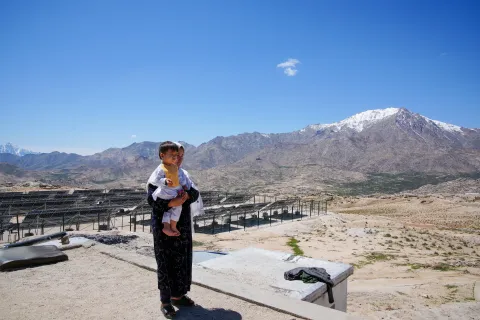
In northwestern Afghanistan, in Injil district, Gough visited a solar water supply network that benefits 1,260 internally-displaced people from Badghis and Ghor.
“We witnessed a huge decrease in illnesses among our people,” says 43 year-old Abdul Hamid. As an internally displaced person from Badghis, Abdul Hamid and his family currently live in Qalai Mukhtar, a village in Herat suburbs which benefits from a UNICEF water project. “Now we have access to safe and clean drinking water,” he adds with satisfaction.
For children in the area, life has become somewhat easier. Sardar, a 5th grade student has to walk a long distance to get to school. Yet, he is happy because he no longer has to spend time fetching water from the well.
“I am very proud to see the impact of UNICEF work on the ground, especially that it benefits the most marginalized children and their families, like Abdul Hamid and Sardar,’ says Gough.

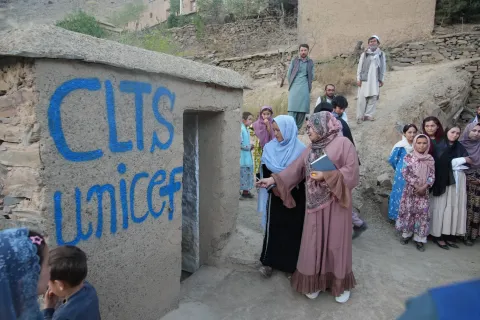
The Regional Director visited Gozargah transit centre, one of UNICEF-supported transit facilities in the western region. As a safe haven for unaccompanied children on the move who passed through Islam Qala crossing, bordering with Iran, the facility provides the needed care and referral. It accommodates unaccompanied and separated children, who are at high risk of abuse, exploitation and trafficking, and reunifies them with their family.
At the centre Ms. Gough engaged with adolescents, and listened to their experiences. “I am really impressed by the level of resilience and hope that these most vulnerable adolescents portray.” “Listening and engaging with these young people, who are the future of Afghanistan, drives me to work harder to protect their rights,” she adds.
During her visit, the Regional Director met officials in the field, and donors including Ambassadors of Canada, Korea and the United Kingdom. She also met with staff, and a wide range of UNICEF’s partners in Afghanistan, including from government line ministries, civil society, and sister UN agencies.