Delivering love and light to mothers in Afghanistan
As skilled midwife, Fahima believes every child deserves the chance to thrive – starting with a healthy pregnancy and a safe birth

Fahima is a midwife and a mother who rejoices after every delivery.
“A mother’s love should not be limited to their own children,” she says.
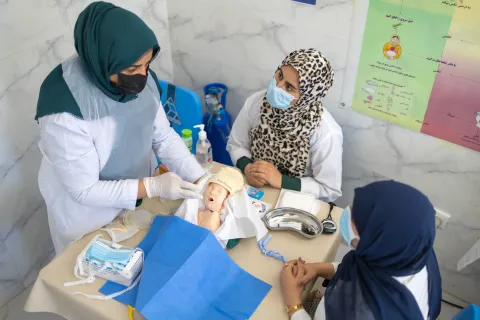
As the only midwife at the UNICEF-supported Noor-e-Khoda Health Clinic, tucked into the northernmost area of Mazar-i-Sharif city, Fahima offers a full range of antenatal care: check-ups for pregnant women to measure their blood pressure and the fetal heartbeat; laboratory tests to check their iron levels; vaccinations and nutrition advice.
After delivering the baby, Fahima continues supporting mothers with post-natal care for 42 days after the birth, providing educational sessions on maternal and infant nutrition, family planning and breastfeeding.

Only one-third of expectant mothers in Afghanistan have all four antenatal care visits before giving birth. Just over 67 per cent of births are attended by a skilled professional.
Unfortunately, not every mother gives birth under Fahima’s attentive care.
In Afghanistan, one-third of women give birth outside of a health facility. Just over 67 per cent of births are attended by a skilled health professional, like Fahima. Although expectant mothers should have at least four antenatal visits with a skilled provider before giving birth, only one-third of women in Afghanistan do.
When mothers give birth outside a health facility, or without a healthcare professional to assist them, the mother’s life is at serious risk. If she has a birth complication, such as haemorrhage or fetal distress, there is little chance for a medical professional to intervene.
“Many of the mothers who come to see me experienced excessive bleeding when they gave birth at home in the past,” says Fahima. She says more do not understand how to provide adequately health meals for themselves to ensure a smooth pregnancy.

When Fahima opens the clinic doors at seven in the morning, some women have already been waiting to see her for an hour or more. Each day, Fahima sees about 80 patients.
“Many women come from distant parts of the city to see me,” she says, checking a mother’s blood pressure. The 26-year-old is expecting her first child.
“They are beginning to understand the importance of antenatal care.”
Fahima also runs educational sessions for mothers every day, displaying visual lessons on good nutrition and hygiene practices, such as preparing healthy meals and how to wash your hands properly with soap. She especially focuses on breastfeeding, and the importance of nourishing foods for pregnant and breastfeeding mothers.
By imparting her knowledge onto the mothers she cares for, Fahima hopes to reduce the number of deaths in the delivery room – both mother and child.

“Healthy mothers bring healthy children into the world,” Fahima says, “and continue nurturing them after they are born.”
Fahima has been working as a midwife for almost 18 years. She has assisted thousands of births, but she knows that some women find their first pregnancy a little scary.
“I always try and assure them that they and their child will be healthy. I support them emotionally and tell them, ‘I am your sister and your family member, and I will be by your side to support you and take care of you and your baby.’”

UNICEF, through partnership with the World Bank and Asian Development Bank, support over 27,000 health workers in Afghanistan. This support pays salaries for Fahima and other health workers, ensures health facilities are stocked with medicines and the supplies Fahima needs to do her work.
UNICEF also ensures that for these 2,500 supported facilities, the lights are always on and the water is always running.
Although her shifts are often long, Fahima is determined to stay positive.
“We receive many patients into the night,” she says. “Who are usually mothers in labor. But after finishing my shift, I try to boost the morale of my colleagues, because we must work these night shifts several times a week.”
“But hearing the fetal heartbeat alleviates all my work fatigue.”