Afghanistan’s Education System Facing Deepening Crisis for Both Girls and Boys, Warn UNICEF and UNESCO
Over 90% of 10-year-olds cannot read a simple text, signaling a profound crisis of ‘schooling without learning’, analysis finds

Kabul, 8 October 2025 – Afghanistan’s education system stands at a critical crossroads. Mounting pressures from restrictive policies, chronic underinvestment, and recurring humanitarian crises are jeopardizing the future of an entire generation and are putting the country’s development at risk.
According to the new Afghanistan Education Situation Report 2025 by UNICEF and UNESCO, more than 2.13 million primary school-aged children remain out of school as of 2024, while the majority of those who attend are learning too little. The analysis from 2022 finds that learning poverty remains at unprecedented levels, with more than 90 per cent of 10-year-olds unable to read even a simple text.
Severe teacher shortages, especially among women, along with limited materials and uncertainties on curriculum changes, weak oversight, and poor infrastructure, continue to erode quality. Nearly half of schools lack clean water, sanitation, or heating, and over 1,000 remain closed due to damage from years of conflict or natural disasters.
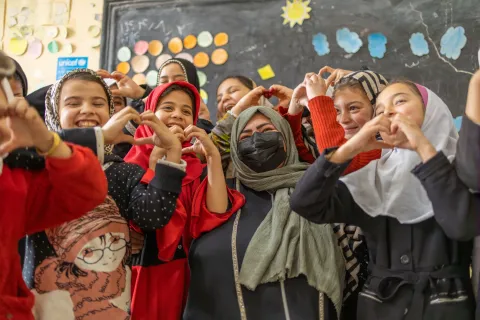
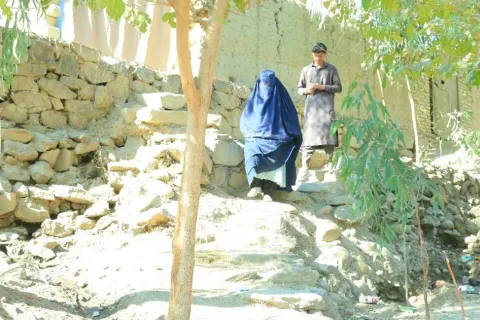
While the ban on girls’ secondary education has already excluded around 2.2 million adolescent girls, boys’ enrolment in secondary education is stagnant and their enrolment in higher education has also dropped by 40 per cent between 2019 and 2024, which is turning this segment into one of the system’s most fragile links.
Education is synonymous with hope - the hope for stability, dignity and opportunity for every child. However, in today’s Afghanistan, that hope is fading for too many.
Continued, predictable investment in primary education and foundational numeracy and literacy is essential to protect Afghanistan’s fragile gains and secure its future. Without it, children and young people risk losing the skills needed for higher education, vocational training, and future employability. While skills training plays a vital role in building young people’s agency, resilience, and participation in society, it depends on strong foundations in reading, writing, and numeracy. Afghanistan’s national literacy rate in 2021 was 37 per cent (52 per cent for men and 27 per cent for women), one of the lowest globally.
Beyond policy and funding challenges, Afghanistan’s education sector is under severe pressure from overlapping humanitarian shocks. In 2025, an estimated 8.9 million children, including 888,000 with disabilities, will require emergency education support. At the same time, mass returns from Iran and Pakistan have brought back 2.7 million people since 2023, 60 per cent of them children and youth.
Despite enormous challenges, opportunities to rebuild remain. This requires continued investment in primary and foundational learning, supporting teachers with training, expanding early learning through community models, and improving school environments so children can stay and learn. For adolescent girls, alternative pathways such as online and distance learning, skills training and community-supported learning remain essential. Boys also need continued opportunities, especially at secondary level. In the face of poverty and hardship, more Afghans have turned to Technical and Vocation Education and Training (TVET) and non-formal skills development and literacy learning. While female enrolment in formal TVET almost collapsed to approximately 1,000 in 2024 due to the ban, male enrolment grew by 32%. Long-term investments in TVET, tertiary education and job skills will only succeed if built on a strong foundation of literacy and numeracy.
UNICEF and UNESCO urge the de facto authorities to immediately lift the ban on girls’ and women’s secondary and tertiary education and to allow every girl and woman in Afghanistan to return to the classroom. If the ban persists, UNICEF estimates that by 2030 nearly four million girls will be denied the chance to pursue secondary education, also excluding them from any chance to engage in tertiary education – this will have profound consequences for the country’s future as inaction in, and de-prioritization of, education has high socio-economic costs. UNESCO warns that the suspension of women’s higher education in Afghanistan may lead to potential losses of $9.6 billion by 2066, representing about two-thirds of the current national GDP.
The UN agencies also call for sustained and predictable investment in education to prevent irreversible setbacks. Afghan children, families, and teachers have held on to hope through years of crisis, but hope alone is not enough. Only bold, long-term investment can turn hope into lasting progress. UNICEF and UNESCO urge governments, multilateral institutions, donors, and partners to stand with Afghanistan now and safeguard its future by supporting education as the foundation for peace, progress, and prosperity.
For more information please contact:
UNICEF:
Daniel Timme, UNICEF Afghanistan, +93 79 998 7110, [email protected]
UNESCO:
Zameer Safi, UNESCO Kabul, + 93783804343, [email protected]
Media contacts
Additional resources

About UNICEF
UNICEF works in some of the world’s toughest places, to reach the world’s most disadvantaged children. Across 190 countries and territories, we work for every child, everywhere, to build a better world for everyone.
UNICEF has been in Afghanistan for over 70 years. For more information about UNICEF and its work for children in Afghanistan, visit https://www.unicef.org/afghanistan/ or follow us on X, Facebook, Instagram or subscribe to our YouTube channel.
About UNESCO
With 194 Member States, the United Nations Educational, Scientific and Cultural Organization contributes to peace and security by leading multilateral cooperation on education, science, culture, communication and information. Headquartered in Paris, UNESCO has offices in 54 countries and employs over 2300 people.
“Since wars begin in the minds of women and men, it is in the minds of women and men that the defenses of peace must be constructed” – UNESCO Constitution, 1945.
For more information on UNESCO’s work to protect the right to education for all Afghans, please visit: https://www.unesco.org/en/emergencies/education/afghanistan