Tool: Setting goals for adolescents’ development and use of competencies
Competency monitoring and evaluation tools

As you consider goals for your work with the Adolescent Kit, remember that the activities and approaches in the Adolescent Kit support adolescent girls and boys to develop competencies – knowledge, attitudes and skills – that can help them to cope with stressful circumstances, build healthy relationships, learn new skills and engage positively with their communities. Consult with parents, community members, programme staff, and especially adolescents to agree on goals for knowledge, attitudes and skills that are most relevant for adolescents in
your programming context.
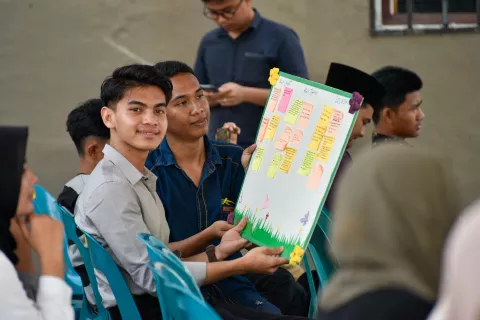
Note: The Setting group Goals activity and the Setting competency goals tool can be used to support a participatory goal-setting process with adolescents who are already participating in activities.
Sample questions for participatory goal-setting, monitoring and evaluation
Integrate the following questions into your consultations as you plan and set goals for your programme, and into participatory processes for monitoring and assessing programmes’ effectiveness and impact on adolescents’ development and use of those competencies.
Sample questions for participatory goal-setting, monitoring and evaluation
Setting goals:
- What knowledge/attitudes/skills is/are important for adolescents who want to have a positive impact on their community? Their family? Their own future?
Monitoring and evaluating progress:
- What knowledge/skills did you gain during this programme? Did you learn anything new?
- How has the programme changed your beliefs and attitudes? How has it changed the beliefs and attitudes of other participants? Can you give examples?
- Has the programme changed your thinking about the conflict/situation? How? Has your thinking about other people (from diverse groups or conflict parties) changed? How?
Setting goals:
- What knowledge/attitudes/skills is/are important for adolescents who want to have a positive impact on their community? Their family? Their own future?
Monitoring and evaluating progress:
- Has the programme changed the way that adolescents think about the conflict/situation? How? Has their thinking about other people (from diverse groups, conflict parties) changed? How?
- Have you seen any changes in (the beliefs & attitudes of) the participants as a result of the programme? Can you give examples? What do you think caused these changes? Are changes related to some particular parts of the programme. or to specific methods used?
Setting goals:
- What knowledge/attitudes/skills is/are important for adolescents who want to have a positive impact on their community? Their family? Their own future?
Monitoring and evaluating progress:
- Has the programme changed the way that your children/participants think about the conflict/situation? How? Has their thinking about other people (from diverse groups, conflict parties) changed? How?
- Have you seen any changes in (the beliefs & attitudes of) your children/participants as a result of the programme? Can you give examples? What do you think caused these changes? Are changes related to some particular parts of the programme?
- Do the adolescents discuss their experiences from programme activities with you? What do they find good or bad about the programme? What knowledge and ideas have they shared with you? Do they have new skills?
Competency outcome mapping worksheet
Use the mapping matrix below to document your discussion points and goals as you consult with parents, community members, programme staff and volunteers, and especially adolescents to set goals for knowledge, attitudes and skills in relation to the competencies that your programme will address.
Competency Domain Name:
| Personal | Interpersonal | Community | |
|---|---|---|---|
| Knowledge | |||
| Attitudes | |||
| Skills |
Examples of potential goals for competency domains
Use these examples of potential goals for adolescents’ development and use of competency domains to support consultations and participatory planning as you collaborate with parents, community members, programme staff and especially adolescents to set goals for the competencies that your programme will address.
General overview of potential goals:
General overview of potential goals
- Listening; observing communication styles and patterns
- Usage of creative, artistic and cultural methods of expression
- Assertiveness; using speech to calm others or de-escalate conflict
- Using communication and expression to transform conflict and build peace
- Healthy exploration of self and identity; caring for self and others
- Understanding self and others; influences to identity
- Developing self esteem and confidence; anti-bullying
- Expressing gratitude and appreciation; simplicity
- Understanding leadership styles
- Strategies for influencing others in a positive way
- Trust building; taking initiative
- Being a positive influence on family, friends and community
- Information gathering and conflict analysis
- Reframing and finding ‘win-win’ solutions
- Negotiation and mediation; containing and de-escalating conflict
- Dialogue facilitation and consensus building
- Understanding emotions of self and others
- Managing negative emotions in self and others
- Ability to calm self and others; healing from trauma or distress
- Forgiveness and reconciliation; repairing damaged relationships
- Awareness of marginalised and excluded groups; social responsibility
- Inclusion of others; cooperative problem solving
- Community building, community organizing and coalition building
- Usage of participatory methods and group facilitation
- Mutual understanding; appreciation of ideas, opinions, challenges and struggles of others
- Recognising and respecting the feelings and needs of others
- Consoling, counseling and comforting others
- Giving one’s time in service to others; caring for others
- Planning, organization and time management
- Envisioning alternatives; imagining a better future
- Developing an action plan
- Setting goals and task achievement
- Critical analysis of stereotypes, prejudice, discrimination, racism, sexism, ageism and ethnocentrism
- Awareness of bias; awareness of factors that influence perceptions
- Doubting, questioning, inquiring, analysing, testing and concluding
- Analysis of multiple sources of information; making decisions
- Patience and intuition
- Healthy risk taking, experimenting, taking chances
- Brainstorming and idea generation
- Imagining preferred futures
Examples for formalizing learning goals
Competency goals can be set individually, by an Adolescent Circle, or by all adolescents participating in a programme. Goals can be formalized, written and documented so that they can be used in the future for monitoring and evaluation purposes. Use the examples below of formally written learning goals as a reference when collaborating with parents, community members, programme staff and volunteers, and adolescents to set and document learning goals for a programme or intervention.
Examples of formally written learning goals by competency domain
Participants can…
Communication and expression: … listen to the ideas and opinions of others without interrupting; assert their ideas and opinions within peer groups as appropriate / …explain which style of communication they most often use and identify other styles of communication observed in others/ …express themselves using creative, artistic and cultural activities/ …communicate calmly and effectively in challenging situations
Identity and self esteem: …engage in activities that help them learn about themselves/ …explain a range of influences to their identity and the identity of others/ …respectfully engage in activities together and speak out against bullying/ …express gratitude and appreciation to
other peers
Leadership and influence: …describe multiple styles of leadership and leadership styles of others/ …influence family, friends and peers in positive and constructive ways/ …build trust with persons who they don’t know or with persons who have been hurt by conflict/ …take initiative to transform conflict in positive ways (or build peace) in family, friend and peer groups, or within the community
Problem solving and managing conflict: …gather and analyse information from a range of sources/ …reframe negative views of conflict towards more positive ones; find ‘win-win’ solutions to conflicts in family, friend and peer groups, or in the community/ …intervene and de-escalate conflict; negotiate between persons or parties in conflict/ …facilitate dialogue in groups and build consensus around shared issues
Coping with stress and managing emotions: …identify and describe a range of emotions felt by oneself and others involved in reference to a specific situation or event/ …explain practical techniques one can employ to deal with negative emotions/ …exhibit calm behavior in challenging situations; help others to feel calm or heal from traumatic experiences/ …forgive those who have caused hurt or pain; rebuild damaged relationships for oneself and support others to do the same
Cooperation and teamwork: …identify persons who feel excluded in groups and describe a diverse array of groups who are marginalized in the community/ …include others who have been excluded in cooperative activities; solve problems cooperatively/ …engage in activities that support a feeling of community; organize events and activities in the community; bring diverse persons and groups together/ …use participatory methods and facilitate cooperative activities in groups
Empathy and respect: …appreciate the ideas and opinions of others; understand the challenges struggles of others/ …recognize and explain the feeling of others and reasons behind certain feelings/ …console, counsel or comfort others who have experienced hurt or pain/ …engage in activities that serve the community and care for others
Hope for the future and goal setting: …plan and organize activities; manage time towards the achievement of a goal/ …describe alternatives to violence and conflict; describe what the future would look like with no conflict or violence/ …describe the steps needed to achieve a goal
Critical thinking and decision making: …identify stereotypes of family, friends and peers; describe common stereotypes, prejudicial behavior, racism, sexism, etc. seen in the community/ …describe the influences to one’s own opinions and the factors that influence the opinions of others/ …doubt, question, inquire, analyze, test and make conclusions when presented with unreliable information/ …analyze multiple sources of information and make sound decisions
Creativity and innovation: …see opportunities when they arise and take them/ …take healthy risks and experiment with alternative approaches to find the best possible solutions to problems/ …brainstorm with others in groups and generate new ideas/ …imagine creative alternatives to the present conflict or humanitarian situation.
For evaluation purposes, the phrase ‘Participants can…’ may be replaced by ‘Can participants…?’. Learning goals can further be transformed into indicators by assigning a number or percentage to statements.
Setting indicators
Once you have agreed to the overall goals in relation to competencies that your programme or intervention will address, collaborate with parents, community members, programme staff and volunteers, and especially adolescents to set indicators for how you will measure adolescents’ development and use of those competencies. Below are examples of indicators for reference in this process, which correspond to the examples of formalized learning goals in the tool above.
Examples of competency indicators / key questions
To develop an indicator, state: ‘(percentage/number) of target participants can…’
To develop a key question, state: ‘Can target participants…?’
Communication and expression: … listen to the ideas and opinions of others without interrupting; assert their ideas and opinions within peer groups as appropriate/ …explain which style of communication they most often use and identify other styles of communication observed in others/ …express themselves using creative, artistic and cultural activities/ …communicate calmly and effectively in challenging situations
Identity and self esteem: …engage in activities that help them learn about themselves/ …explain a range of influences to their identity and the identity of others/ …respectfully engage in activities together and speak out against bullying/ …express gratitude and appreciation to other peers
Leadership and influence: …describe multiple styles of leadership and leadership styles of others/ …influence family, friends and peers in positive and constructive ways/ …build trust with persons who they don’t know or with persons who have been hurt by conflict/ …take initiative to transform conflict in positive ways (or build peace) in family, friend and peer groups, or within the community
Problem solving and managing conflict: …gather and analyze information from a range of sources/ …reframe negative views of conflict toward more positive ones; find ‘win-win’ solutions to conflicts in family, friend and peer groups, or in the community/ …intervene and de-escalate conflict; negotiate between persons or parties in conflict/ …facilitate dialogue in groups and build consensus around shared issues
Coping with stress and managing emotions: …identify and describe a range of emotions felt by oneself and others involved in reference to a specific situation or event/ …explain practical techniques one can employ to deal with negative emotions/ …exhibit calm behavior in challenging situations; help others to feel calm or heal from traumatic experiences/ …forgive those who have caused hurt or pain; rebuild damaged relationships for oneself and support
others to do the same
Cooperation and teamwork: …identify persons who feel excluded in groups and describe a diverse array of groups who are marginalized in the community/ …include others who have been excluded in cooperative activities; solve problems cooperatively/ …engage in activities that support a feeling of community; organize events and activities in the community; bring diverse persons and groups together/ …use participatory methods and facilitate cooperative activities in groups
Empathy and respect: …appreciate the ideas and opinions of others; understand the challenges and struggles of others/ …recognize & explain the feeling of others and reasons behind why one may have a certain feeling/ …console, counsel or comfort others who have experienced hurt or pain/ …engage in activities that serve the community and care for others
Hope for the future and goal setting: …plan and organize activities; manage time toward the achievement of a goal/ …describe alternatives to violence and conflict; describe what the future would look like with no conflict or violence/ …describe the steps needed to achieve a goal
Critical thinking and decision making: …identify stereotypes of family, friends and peers; describe common stereotypes, prejudice behavior, racism, sexism, etc. seen in the community/ …describe the influences to one’s own opinions and the factors that influence the opinions of others/ …doubt, question, inquire, analyze, test and make conclusions when presented with unreliable information/ …analyze multiple sources of information and make sound decisions
Creativity and innovation: …see opportunities when they arise and take them/ …take healthy risks and experiment with alternative approaches to find the best possible solutions to problems/ …brainstorm with others in groups and generate new ideas/ …imagine creative alternatives to the present conflict or humanitarian situation
* this is associated with Examples for formalizing learning goals.
Highlights
As you consider goals for your work with the Adolescent Kit, remember that the activities and approaches in the Adolescent Kit support adolescent girls and boys to develop competencies – knowledge, attitudes and skills – that can help them to cope with stressful circumstances, build healthy relationships, learn new skills and engage positively with their communities. Consult with parents, community members, programme staff, and especially adolescents to agree on goals for knowledge, attitudes and skills that are most relevant for adolescents in
your programming context.
Note: The Setting group Goals activity and the Setting competency goals tool can be used to support a participatory goal-setting process with adolescents who are already participating in activities.