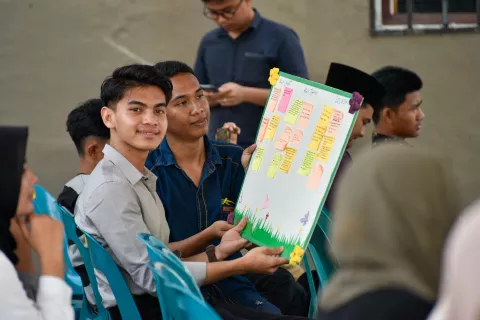
Guide: Adolescents and participation
The activities and approaches in the Adolescent Kit support adolescent girls and boys to express themselves, participate in decisions that affect them and achieve change in their families and communities.

Adolescents’ right to participation
According to the United Nations Convention on the Rights of the Child, children of all ages, including adolescents, have the right to participate in any matter concerning them and to have their opinions taken into account. Yet in reality, adolescents are often treated as though their views don’t matter.
Adolescents have the right to participate in decisions that affect their lives, their communities and the larger society in which they live. Giving adolescents a voice not only contributes to their personal development, but it also empowers them to protect themselves, stand up for their rights and to learn how to be active and responsible citizens.
Participation is about adolescents having the opportunity to express their views, influence decision-making and achieve change.
Adolescents’ participation in humanitarian situations
Adolescents are directly affected by conflict and other humanitarian crises and have the right to be actively engaged in efforts to rebuild their communities and contribute to building peace.
Supporting adolescents’ meaningful participation during times of humanitarian crisis can make a difference in their own lives, as well as to their communities. It can help adolescents to develop important skills, gain confidence and to speak up about their rights and needs. It can also empower them as social actors (rather than passive recipients) who can and do play an important role in supporting their families and communities and contributing to humanitarian response initiatives.
Engaging adolescents can lead to more effective programmes for adolescent girls and boys in humanitarian situations – as they are best placed to decide what interventions and activities will address their needs, to reach out to their peers and to figure out what works and doesn’t work. Adolescents can also serve as valuable resources within humanitarian response efforts, by participating in emergency assessments and forming initiatives to protect children and helping with reconstruction and supporting peacebuilding processes.
Supporting adolescents’ participation with the Adolescent Kit
The Adolescent Kit supports adolescents to participate more actively in areas of their lives that matter to them – in their homes, at school, with friends, at work and in the community. It does so by helping adolescent girls and boys to develop key competencies – knowledge, skills and attitudes – which are critical to promoting their participation.
Adolescents are given opportunities to practice these competencies, first within their Adolescent Circles, and then within the wider community.
The Adolescent Kit supports adolescents’ participation by:
- Providing a safe, welcoming space for all adolescents where they are encouraged to express themselves and participate in decisions, discussions and activities;
- Building adolescents’ communication skills, confidence, and belief in their ability to positively influence their lives;
- Helping adolescents to recognize their own abilities and strengths, and the ways that they contribute to their families and communities;
- Providing adolescents with information about their rights and issues that affect their lives;
- Supporting adolescents to build or strengthen relationships with adults and encouraging their collaboration;
- Helping adolescent girls and boys to carry out meaningful projects or initiatives in support
of their communities; and - Encouraging adolescents to participate in or set up youth committees, clubs, steering groups, peacebuilding initiatives and other decision-making structures.
Participation as a process for working with and for adolescents
The approaches and activities in the Adolescent Kit reflect a view of participation as process for working with and for adolescents - rather than a once off activity). This involves opening up space for adolescents to focus on their own priorities, to decide what activities and projects they want to work on – and which issues they want to take action on. When adolescents come up with ideas for activities or projects that surprise you, or want to take action on issues that you aren’t even aware of, those are signs that participation is working! It is important to adolescents take initiative themselves, rather than to push them to take action.
Adolescent participation should be inclusive and voluntary. That means that activities and approaches with the Adolescent Kit should be flexible enough to encourage participation of adolescent girls and boys from all backgrounds, cultures, religions, ages and those with disabilities.
Adolescent girls and boys should also be well informed about what they are doing, and why, so that they can decide whether or not they want to participate in different activities or initiatives, and to what extent.
As much as possible, adults should also be involved in efforts to promote adolescents’ participation. This may involve encouraging parents, teachers, religious leaders and government officials to take adolescents’ views seriously (and to act upon them), to work together collaboratively, and to be accountable for meeting adolescents’ rights. This is particularly important in contexts where adolescents’ right to express their views or participate in decisions are not recognized or supported by others. Most of all, it is important to try to find a balance between encouraging adolescents to become active agents in their own lives and ensuring that they are protected from any potential risks or harm that increased participation could bring.
Highlights
Adolescents’ right to participation
According to the United Nations Convention on the Rights of the Child, children of all ages, including adolescents, have the right to participate in any matter concerning them and to have their opinions taken into account. Yet in reality, adolescents are often treated as though their views don’t matter.
Adolescents have the right to participate in decisions that affect their lives, their communities and the larger society in which they live. Giving adolescents a voice not only contributes to their personal development, it empowers them to protect themselves, stand up for their rights and to learn how to be active and responsible citizens.