Guide: Adolescents and life skills education
The Adolescent Kit empowers adolescent girls and boys with life skills that can help them to cope with the challenges of humanitarian situations and build their resilience.

Life skills are cognitive, personal and interpersonal skills and abilities that can help adolescent girls and boys to adapt to change, and to meet the demands and challenges of humanitarian situations in constructive ways. Life skills can help adolescents to think critically, solve problems, communicate effectively, build healthy relationships, empathise with others and to develop a sense of self-worth.
Life skills in humanitarian situations
Life skills are particularly important for adolescents in humanitarian situations, where they often face considerable challenges, such as separation from their families, disruption to their education and displacement from their communities. Without adequate resources to deal with these difficulties, adolescent girls and boys risk resorting to negative ways of coping, including isolating themselves, taking out their frustration and anger on others, or abusing alcohol and drugs.
UNICEF defines life skills as abilities for adaptive and positive behaviour that enable individuals to deal effectively with the demands and challenges of everyday life.
Life skills education can help adolescents to develop more constructive ways of responding to their problems, supporting them to make more healthy choices and resist negative pressures – and to build on their existing strengths and resilience.
Building life skills through the Adolescent Kit
The Adolescent Kit supports adolescents to develop key competencies - knowledge, attitudes and skills. Essentially the same as life skills, these competencies help adolescents to cope effectively in areas of their lives that matter to them most. For many adolescent girls and boys, this may involve navigating relationships or concerns related to family, friends, school, work, safety, sex, money, food and health.
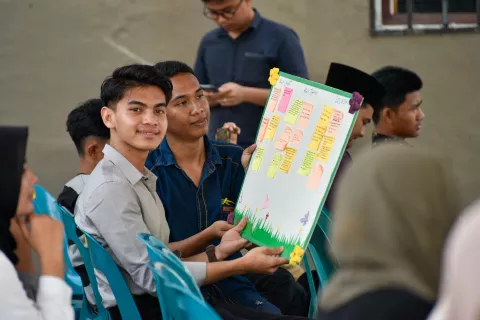
The Adolescent Kit uses interactive and participatory methods to nurture life skills in adolescent girls and boys through activities such as role plays, group exercises, creative projects and brainstorming. This involves supporting adolescents to learn through doing, practicing and reflecting, rather than lecturing or preaching to them. Adolescents are then given opportunities to practice these life skills within their Adolescent Circles and supported to use them more widely in their lives through interactions with their families, friends and communities.
The Adolescent Kit helps to build life skills by supporting adolescents to:
- Learn how to be part of a group;
- Cope with overwhelming emotions, stress and change;
- Develop empathy, tolerance and respect for others, particularly those with different backgrounds and cultures;
- Communicate effectively, cooperate and solve conflicts peacefully;
- Plan how to solve problems and make decisions;
- Find ways to avoid danger and to protect themselves;
- Advocate for their rights, and the rights of others;
- Develop personal awareness, confidence and self-worth;
- Set realistic goals for the future;
- Strengthen relationships with their family, friends and others; and
- Engage constructively with their community.
These skills can be applied across different areas of adolescents’ lives, helping them to meet challenges as they grow and develop. However, it is important to look carefully at the needs and challenges of adolescent girls and boys of different ages, cultures, backgrounds, abilities and language - and to avoid grouping them all together as the same. Certain life skills will be more relevant to some adolescents than others. Activities with the Adolescent Kit should be tailored to meet those different needs, so that adolescents learn skills for coping with the issues that really affect them.
Life skills education is not just about getting adolescents through times of humanitarian crisis. It is about giving adolescent girls and boys skills for life - equipping them with ways to protect themselves, manage challenges and deal constructively with whatever life throws at them.
Highlights
Life skills are cognitive, personal and interpersonal skills and abilities that can help adolescent girls and boys to adapt to change, and to meet the demands and challenges of humanitarian situations in constructive ways. Life skills can help adolescents to think critically, solve problems, communicate effectively, build healthy relationships, empathise with others and to develop a sense of self-worth.