Guide: Adolescents and innovation
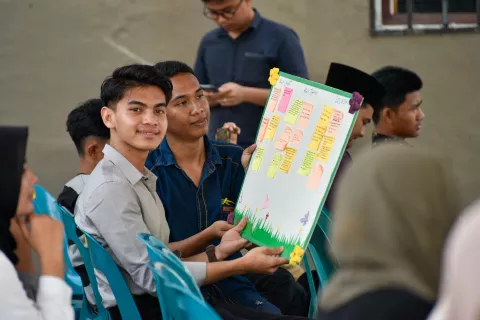
The Adolescent Kit encourages innovation as a way to help adolescents to improve their wellbeing, learn new skills and connect with their communities.

Adolescents have a special capacity for innovation. As they grow and develop between the ages of 10-17, their brains undergo a burst of neurological progress that opens them up to more advanced thoughts, emotions and behaviours. This allows them to analyze the world in different ways, and to use new abstract and reasoning skills to solve problems and explore complex ideas. It is no surprise then, that girls and boys bring new energy and curiosity to their lives as they become adolescents, and are ready to question and
challenge.
Adolescents need to innovate – experiment, solve problems, and explore new ideas, so that their minds can develop in healthy ways. This is particularly important in humanitarian situations, where adolescents’ cognitive development may be disrupted by the stresses and emotional impact of conflict or disaster, and opportunities to reflect, imagine and invent are often limited.
Why innovation?
For adolescents, the benefit of working as innovators is what they learn through the process of innovation. By creating inventions, brainstorming solutions and collaborating on creative projects, adolescents can develop important competencies - knowledge, attitudes and skills - that are important to their wellbeing.
Supporting adolescents to become innovators means providing them with opportunities to think creatively, explore challenges, come up with ideas, and find solutions to problems. This allows them to learn constructive ways of responding to their own problems and difficulties, to take advantage of opportunities around them, and to find ways to positively influence areas of their lives that matter to them. Collaborating on innovative projects also teaches adolescents how to work with others to plan, make decisions and find solutions cooperatively. This can help them to build healthy relationships, and prepare them for active participation in their community as they grow into adulthood.
By working on innovative projects and creating inventions, adolescents can practice experimenting and exploring different strategies for reaching goals. This allows them to learn patience and perseverance, and to practice overcoming setbacks. They learn how to make mistakes, to fail and to give up – and then to learn from their experiences and to move on.
Working as innovators also gives adolescents space to express themselves and to use their imaginations. Through different inventions and creations, adolescents can find new ways to express their ideas, and to interpret what they see and hear around them. They can connect with their communities and take positive action through projects that work to support humanitarian response efforts or development initiatives.
Supporting adolescents to become innovators means encouraging them to take advantage of what they have – rather than what they don’t have. It means helping them to see what they can achieve even when resources are limited and conditions are challenging – and how they can come up with their own solutions and creative ideas for improving their lives.
The Adolescent Kit supports adolescents to become innovators in their lives, through activities such as:
- Planning and carrying out creative projects;
- Experimenting and working on inventions;
- Collaborating on innovative tasks, games and exercises;
- Exploring new ideas and concepts;
- Collecting and analysing information; and
- Brainstorming solutions to problems and challenges.
Highlights
Adolescents have a special capacity for innovation. As they grow and develop between the ages of 10-17, their brains undergo a burst of neurological progress that opens them up to more advanced thoughts, emotions and behaviours. This allows them to analyze the world in different ways, and to use new abstract and reasoning skills to solve problems and explore complex ideas. It is no surprise then, that girls and boys bring new energy and curiosity to their lives as they become adolescents, and are ready to question and
challenge.