![]() |
| © UNICEF/2006/Taylor |
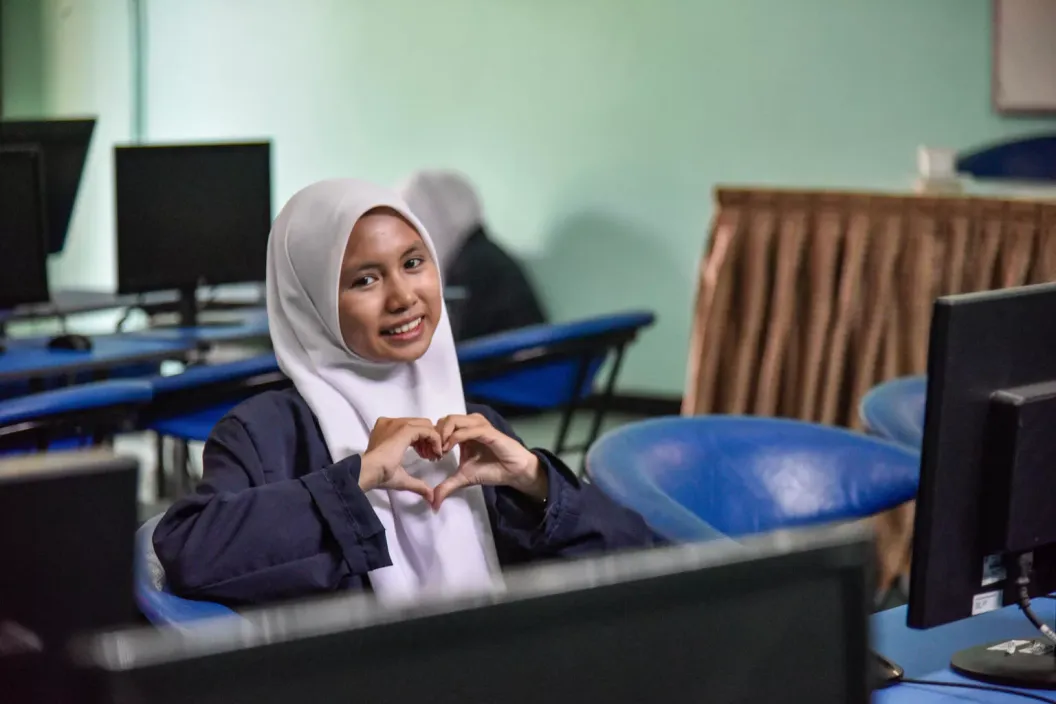
| Abdula, the Headmaster of the Atoll Education Centre on Nilandhoo, is as excited about the new technology as the students. In the background is the Google Earth website he has just been demonstrating. |
Digital Island
by Bronwyn Curran
Nilandhoo Island, The Maldives, Nov 7: Before the Indian Ocean tsunami struck the Maldives, killing 86 people and causing losses worth 62 percent of GDP, classes were fairly dull for 16-year-old Aishath and her schoolfellows. Teachers read lessons out to students, and pupils learnt by rote.
School enrolment was nearly 100 percent across the Maldives, but education quality suffered from lack of teacher training and participatory learning.
Two years on, learning at the Atoll Education Centre for 1st to 10th graders on Nilandhoo, one of the Maldives’ 200 inhabited islands, is being revolutionized. Online education is bringing advanced participatory learning to the 1,000 kilometre-long chain of islands, and broadband interconnectivity is linking far-flung isles to an unprecedented level.
As UNICEF strives to ‘build back better’ in its post-tsunami rehabilitation effort in the Maldives, it’s tackling poor quality education through the introduction of hi-tech broadband-enabled Teacher Resource Centres (TRCs).
Blackboards and chalk are nearly history in some classrooms on Nilandhoo, 300 kilometres south of the capital Male’. Aishath and her classmates have just started interacting with the ‘Smart Board’, a key feature of the TRCs.
From a large touch-sensitive net-connected screen beams a biology lesson via www.skoool.ie. Headmaster Abdullah invites Aishath to place chest organs in their correct place and name them.
She approaches the board, places a hand over an image of a lung, and glides it across to a chest diagram. With a special pen she writes ‘lungs’ on the screen. The headmaster touches a space at the top of the screen and Aishath’s scribble is transformed into arial font.
“It’s not like normal class. This is far more interesting. We get to interact with the Smart Board,” says Aishath, a 16 year old in the 10th grade, who dreams of becoming a teacher.
“Before the Smart Board, there wasn’t much interactivity and classes weren’t much fun. The teacher used to just give us a lesson and we’d write it down. Me and my classmates are more excited about the Smart Board.”
Nilandhoo’s ‘Smart Board’ is the first to be installed in Maldivian schools. Soon each of the 20 atolls that make up the Maldives will have a Smart Board, as UNICEF rolls out digitally-equipped Teacher Resource Centres for each atoll.
“Land is a scarcity here. People are so scattered. This is the type of place where people can really benefit from e-learning,” says UNICEF Representative for the Maldives, Ken Maskall.
“The internet learning initiative costs barely 50 dollars per student. For the cost of a luxury massage on one of these island resorts, you’re providing on-line participatory learning.”
The first TRC opened on Nilandhoo, the capital of Faafu Atoll, in October. Just under 5,000 people live on five of Faafu Atoll’s 26 islands, including 1,655 on Nilandhoo.
“For the very first time it is becoming possible for teachers and students at island level to communicate with their peers right around the country,” says Maskall.
Child-participatory learning methods at Nilandhoo’s Atoll Education Centre drew teacher Ali, 28, to move over from Bileydhoo Island where he had taught for nine years.
He wants his son Maish, 5, to join the ‘child-friendly’ classes.
The TRC on Nilandhoo means Ali benefits as a teacher, as well as a father. Like many teachers in the outer islands, Ali never underwent training before he took up teaching.
Now he has a trove of modern online teaching tools at the touch of his fingertips, through a bank of 24 broadband connected computers.
“I came to this school because I wanted my son to get child-friendly teaching,” Ali says.
“Now I use the TRC. It teaches me to be a child-friendly teacher. I get lesson plans each day by email. We can also get a lot of information online about our subjects and teaching techniques.”
The tsunami bypassed Nilandhoo, but it’s being targeted for development as one of the government-designated ‘Safe Islands’. The concept is part of government regionalization schemes, pre-dating the tsunami, to concentrate resources in selected islands and combat the high costs of servicing scattered islands.
“It’s all about planning of infrastructure which, it is hoped, will ultimately lead to voluntary population resettlement,” says UNICEF’s Maskall.
Nilandhoo is also one of four islands where UNICEF is revolutionizing sewerage systems. For over a decade, groundwater on the islands has been contaminated by sewerage from septic tanks installed in the early 1990s.
Islanders complain of foul-smelling, sulphurous water in their wells.
“Sometimes the water looks like a milkshake,” says Zahoora, 19, a Nilandhoo school graduate already married and nursing a baby son.
“When we draw lots of water from the well it becomes cloudy. The smell is really bad. Before we got the septic tank we used to drink water from the well.”
Zahoora’s family now use their new rainwater storage tank for drinking and cooking. But for bathing they use the odorous groundwater.
“We have nothing else for bathing, so we have to use the groundwater,” she says.
![]() |
| Shahufa Khaleel (8) stands in a garden farm on the island of Nilandhoo. She now benefits from the variety of fresh produce that comes from their garden and that gives her valuable vitamins and minerals that were previously not there. |
UNICEF is introducing a network of pipes that will channel sewerage away from homes to a treatment plant, which will convert raw waste into natural fertilizer. The fertilizer will then be used to enrich the sandy arid soil of experimental market gardens, so that the islands can start producing their own fresh fruit and vegetables.
Islanders live mainly on tuna and bread. The lack of fresh produce has left a legacy of child malnutrition.
In the Maldives 24.8 percent of children under 5 are stunted, 30.4 percent are underweight, and 13.2 percent are wasted, according to the UNICEF Report Card on Nutrition.
Fifteen minutes from Nilandhoo by speedboat, the island of Meedhoo is desperate for the eco-sewerage plant. Meedhoo was hit hard by the tsunami. Less than a kilometre wide and half a kilometre long, it was submerged by two metres of water.
No-one died but 146 houses were ruined, the only school and health centre were damaged, and saltwater invaded the water table’s freshwater lens.
“The new sanitation system from UNICEF is very important for our island,” says Meedhoo chief Shideeq Ali.
“For over 10 years the groundwater hasn’t been good because of leakage from septic tanks. After the tsunami it became salty and even smellier.”
The Dhaalu Atoll School, the only school for Meedhoo island’s 1,200 people, was upgraded by UNICEF with new furniture and a new block of six extra classrooms.
Most significantly, UNICEF has helped the school convert from double-shift teaching to single-shift. It is now one of only a few schools in the Maldives to hold one shift of classes. Most other schools still hold two separate shifts – morning classes for higher grades, and afternoon classes for early grades. The double shift is a strain on teachers and leaves little time for lesson planning and extra-curricular activities.
Younger students like Aysha, a nine-year old in the 3rd grade, now come to school at the same time as all the other grades.
“I prefer the single session because it means I go to school in the mornings and in the afternoons I can play,” she says. Like most of the island’s children, Aysha survived the tsunami by climbing the palm tree in her backyard.
“The single shift is more effective because it gives us time for extra-curricular activities. We can also help pupils who are weak with remedial classes, and provide enrichment classes for students who want to excel,” says teacher Fatu.
“The children also get time to play, many can go to the mosque, or they can take extra classes if they want to get over 80 percent,” says headmaster K.P. Venkitachalam.
Life on Meedhoo is better since the tsunami, says island chief Ali.
“UNICEF built us a pre-school. Before we had nowhere for little kids to learn. The main school has six new classrooms and 10 toilets. Everyone has clean drinking water due to rainwater tanks. People, especially the poor, now have adequate facilities.”
Tsunami two-year update : Maldives