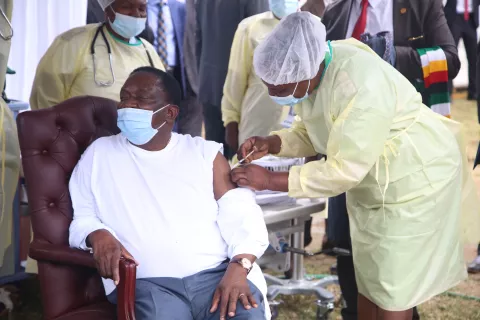
Zimbabwe receives nearly one million COVID-19 vaccine doses from COVAX

01 October 2021, Harare, Zimbabwe – Zimbabwe has received 943,200 COVID-19 vaccine doses from the global COVAX Facility to complement ongoing national vaccine deployment.
The vaccines have been received in tranches where the first batch arrived on 29th September and the second batch today, 01 October 2021.
In a handover ceremony held this afternoon, Dr John Mangwiro, Deputy Minister of Health and Child Care said, “We are grateful to all partners for their support in facilitating the arrival of the vaccines in our country.”
The COVAX Facility is a global partnership comprised of the Coalition for Epidemic Preparedness Innovations (CEPI), Gavi, the Vaccine Alliance, UNICEF and WHO, established to facilitate equitable access to COVID-19 vaccines for all countries.
The COVID-19 vaccines through the COVAX Facility are made possible thanks to the generous contributions from over 20 countries. The top seven countries that made donations to the COVAX Facility are: United States of America, Germany, United Kingdom, European Union, Sweden, Canada, and Saudi Arabia.
“We are delighted to see the arrival of COVID-19 vaccines in Zimbabwe through the COVAX Facility” said UN Resident Coordinator Maria Ribeiro. “This is an important and tangible act of solidarity from the international community and will bolster the admirable national COVID-19 vaccination rollout by Government of Zimbabwe.”
To date, Zimbabwe has procured over 12 million doses and accompanying injection safety materials using its own local resources.
As of 27 September 2021, a total of 3,051,371 eligible people in Zimbabwe had received their first dose of the COVID-19 vaccine and 2,211,880 their second across the country. This translates to a national coverage of 35.7% for the first dose and 25.8% for the second dose.
Zimbabwe launched its COVID-19 vaccination campaign on 22nd February 2021, targeting health workers and essential services providers. With the availability of more doses, the vaccination was opened to everyone and is provided on a voluntary basis and free of charge.
While COVID-19 vaccination will allow countries to open their economic activities, continued adherence to preventive measures to avoid the spread of the virus by wearing face masks, washing hands and respecting social distancing remain critical.
The United Nations will continue working with the Government of Zimbabwe in fighting the COVID-19 pandemic and ensuring continued provision of essential services including routine immunizations.
Note to Editor
Why do we need COVAX?
Developing a vaccine against COVID-19 is the most pressing challenge of our time - and nobody wins the race until everyone wins.
The global pandemic has already caused the loss of hundreds of thousands of lives and disrupted the lives of billions more. As well as reducing the tragic loss of life and helping to get the pandemic under control, introduction of a vaccine will prevent the loss of US$ 375 billion to the global economy every month. Global equitable access to a vaccine, particularly protecting health care workers and those most-at-risk is the only way to mitigate the public health and economic impact of the pandemic.
COVAX Offers
- Doses for at least 20% of countries' populations
- Diverse and actively managed portfolio of vaccines
- Vaccines delivered as soon as they are available
- End the acute phase of the pandemic
- Rebuild economies
For more information, please contact:
- Vivian Mugarisi, WHO Communications Specialist, Mob# +263 779215630, [email protected]
- James Maiden, UNICEF Chief of Communications, Mob# 263 772124268, [email protected]
- Sirak Gebrehiwot, UN Communications Specialist in Zimbabwe on sirak.gebrehiwot@one.un.org, Mob# 0772 198 036
Media contacts
About UNICEF
UNICEF promotes the rights and wellbeing of every child, in everything we do. Together with our partners, we work in 190 countries and territories to translate that commitment into practical action, focusing special effort on reaching the most vulnerable and excluded children, to the benefit of all children, everywhere.
For more information about UNICEF and its work for children, visit www.unicef.org.