A child’s progress, a teacher’s pride
How UNICEF supported Catch-Up programme transformed one learner's life in Chembe

CHEMBE district, Luapula province, Zambia, November 2025 --- The fresh air drifts gently across the open land surrounding Lupili primary School, where small houses and scattered trees stretch under the afternoon sun. The branches sway softly, offering little relief from the heat. Above Chembe district, the sky feels wide, quiet, and endless. Yet in this remote corner of Zambia’s Luapula province, the vast landscape contrasts sharply with the narrow future that once faced children like 11-year-old Patrick Mukuma.

When Patrick first walked into Lupili primary School in 2023, he was not the curious, confident child he is today. Then, he was quiet, withdrawn, and uncertain. He was still adjusting to life in a new district, far from the place he once called home. Originally from Zambezi district of North-western province, Patrick had grown up speaking Luvale. But here in Chembe, everything was different: the language, the routines, even the way children played during break. At school, classes were taught in Bemba, a language he barely understood.
He was placed in Grade 3, but academically, Patrick struggled. He could not read the lessons written on the chalkboard. He couldn’t understand the storybooks his classmates laughed at. Counting beyond ten felt like climbing a steep hill with no summit in sight. He watched others raise their hands, answer questions and take pride in reading aloud. For Patrick, school became a daily reminder of what he could not do.
And so, he began to pull away.
I didn’t enjoy school, I used to feel like I didn’t belong in class.

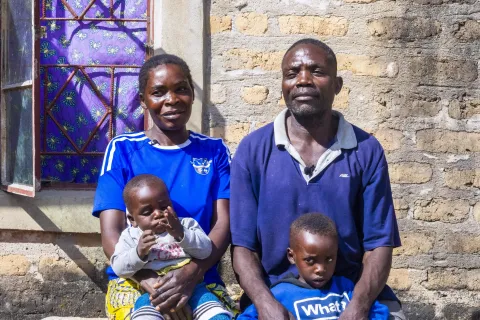
Finess Chilongo, a single-parent to Patrick, noticed the change. A mother of four, Finess supported her family by selling fritas, a local fried snack, in the village. Life in Chembe had not been easy since they moved. Resources were tight, and the emotional toll of uprooting her family from Zambezi weighed heavily on her. Seeing her son come home discouraged each day added to her quiet worry.
In early 2024, everything began to shift.
Patrick’s teacher introduced him to something new: the Catch-Up programme – supported by the Hempel Foundation, which was introduced at their school. Designed to support learners in Grades 3 to 5 who are lagging in reading and numeracy, Catch-Up focuses on foundational skills, using practical, learner-friendly methods to help children re-engage with learning at their own level.

At first, Patrick didn’t understand what was different about these new lessons. The activities were simpler, more interactive. He was grouped with learners at a similar skill level, and slowly, he began to participate in class activities and to answer questions without fear of getting them wrong. There were no long lectures or complicated words, just steps, small ones, that helped him catch up.
As the months passed, something remarkable began to happen. For the first time, Patrick could read simple paragraphs and graduated to story level and can also do numeracy. With a shy smile that quickly grows into a grin, Patrick says:
I never knew how to read, but now I can read stories and count numbers.

I couldn’t believe it, I was so happy. I told him from that day, I will always support his learning and every time he comes home from school, I’ll cook him a big Nshima.
At first, she had been unsure about the programme. Patrick was staying longer at school, and she didn’t understand why. But once she learned that he was attending Catch-Up sessions, not playing, her skepticism turned into support. Now, she speaks about the programme with warmth and gratitude.
This programme has brought so much joy. When we moved here, Patrick couldn’t read. Now he reads books. He’s different. He’s more alive.

Behind Patrick’s success stands Susan Dorphne Mulema, a dedicated teacher who has worked in Chembe district since 2016. With a background in literacy initiatives and a passion for helping children learn to read, Susan saw the Catch-Up programme as more than just a curriculum, it was an opportunity to reshape how struggling learners see themselves.
“In the beginning, it was difficult,” Susan admits. “Many children were hesitant. They felt embarrassed to be in a different group, especially the grade 5 being in the same group with grade 3 and 4 learners. But once some learners started improving, moving from level 1 to level 2, then level 3 reading levels, it encouraged the rest.”
Susan has seen transformative changes in her learners. Children who once couldn’t read numbers correctly now understand and articulate even complex figures. Learners who once brought her books to read for them now sit quietly in class and Catch-Up sessions, flipping pages, reading independently, eyes scanning with confidence.
“The progress is tremendous,” she says. “And not just for the learners. It’s changed the way we teach, too. I feel more motivated to come to work. Knowing that the children are improving gives me energy. It gives me purpose.”
The Catch-Up programme, which now spans nine provinces and reaches over 900,000 learners across Zambia, is more than an academic intervention. It is a chance for a second beginning, for dignity, for children to believe in themselves again.
For Patrick, it’s become a window into the future.
No longer silent at the back of the class, he now sits up front, eager to participate. His favourite subject is numeracy. He laughs more. He reads for pleasure. And most of all, he dreams of one day becoming a teacher.
I want to help other children. I want to teach like my teachers and help others to read.
From a boy who once felt invisible to a child who now leads in class, Patrick’s story is a reflection of what becomes possible when children are given the support, tools, and time they need to learn. UNICEF Zambia is proud to share this story #ForEveryChild, and extends heartfelt thanks to the Hempel Foundation for its unwavering support in giving children like Patrick a second chance at learning and a future filled with hope.
###