The Best Start Begins at the Breast
A mother’s journey to giving her baby the best start in life

LUSAKA, Zambia, August 2026 --- "When my baby was placed on my chest, I knew I wanted to do everything possible to give him the best start in life. But I quickly realised that breastfeeding is not something a mother should do alone," shared Nancy Naliti, a mother of seven-month-old Alinaswe.
Nancy Naliti is a mother of three, including seven-month-old Alinaswe, who is thriving on breastmilk. Having delivered all her children in health facilities, Nancy says the counselling and encouragement she received from healthcare workers gave her the confidence to start breastfeeding from the very beginning. Healthcare workers also provided her with counselling on proper attachment and positioning, which significantly supported her breastfeeding journey.
When my baby was born, the nurses immediately placed him on my chest for skin-to-skin contact," she recalls. "They patiently guided me and encouraged me not to give up until he latched on. Their support made all the difference and helped me build that first connection with my baby.
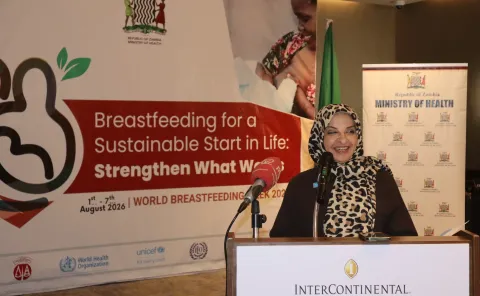
For many mothers across Zambia, breastfeeding is a deeply personal journey shaped by the support of healthcare workers, families and communities. This World Breastfeeding Week, under the theme “Breastfeeding for a Sustainable Start in Life: Strengthen What Works,” UNICEF, the Government of the Republic of Zambia and partners are spotlighting how skilled counselling, Baby-Friendly health services and supportive communities help mothers overcome challenges and give every child the healthiest possible start.
Recent evidence shows that exclusive breastfeeding among infants aged 0-5 months declined from 73 per cent in 2013-14 to 64 per cent in 2024, while early initiation of breastfeeding also declined between the 2018 and 2024 [1].

While many mothers can exclusively breastfeed their babies for the recommended six months of life, others face significant barriers that make this difficult. Workplace policies, limited maternity leave and the absence of supportive environments often force mothers to introduce complementary feeding before the six months of the child’s age or by introducing the fatal bottle feeding as an alternative.
Nancy's experience reflects this reality. A teacher at a private school, she was entitled to just 13 weeks of maternity leave. When she returned to work, her full-time schedule required her to leave home at 7:00 a.m. and return around 4:00 p.m. Without the time or workplace support needed to continue breastfeeding, maintaining exclusive breastfeeding became increasingly difficult. “I still wanted to breastfeed my baby after work but would always find him full of alternative foods,” shared Nancy remorsefully.
Due to her work schedule, Nancy found it difficult to exclusively breastfeed Alinaswe for the recommended first six months of life. By the time he was five months old, she had begun introducing complementary feeding.
Nancy, who lost her husband when Alinaswe was only four months old, says while she misses the care and support of her husband, she appreciates the support from extended family including her mother.
I made the right decision to move in with my daughter to give her all the support she needs, and I am happy that things are working out for her and her children.
Nancy understands the value of breastfeeding and the lifelong benefits it offers both mothers and their babies. She says that if her workplace had provided a more supportive environment, she would have chosen to exclusively breastfeed all of her children for the recommended first six months of life.

Breastfeeding reduces the number of illnesses a child experiences and helps them grow healthy and strong,” she says. “I encourage all mothers to continue breastfeeding, as it strengthens the bond with their babies. They should also seek and accept support from family members to make their breastfeeding journey easier.
The experiences of mothers and healthcare workers demonstrate that progress is possible when quality maternal and newborn services and supportive policies are sustained and expanded. The media also plays an important role in dispelling myths and misinformation and promoting greater male involvement and family support. Together, these efforts can help create an enabling environment where mothers can breastfeed successfully and give their children the healthiest possible start in life.
UNICEF Zambia extends its gratitude to the partnership of Irish Aid, whose support helps the Government of the Republic of Zambia strengthen and deliver essential health and nutrition services for children under five across the country.
Every mother who receives timely counselling, every health worker equipped with the right skills and every family that chooses to support breastfeeding contributes to healthier children, stronger communities and a brighter future for Zambia. Because when mothers are supported to breastfeed successfully, every child has a greater opportunity not only to survive, but to thrive.
[1] Zambia Statistics Agency (ZamStats), Ministry of Health (MoH) and ICF (2025). Zambia Demographic and Health Survey 2024. Lusaka, Zambia, and Rockville, MD, USA: ZamStats, MoH and ICF.
###