From Learning to Listening
Teachers Strengthening Mental Health Support for Children

- English
- Tiếng Việt
For four consecutive days, Nguyen Truong Sinh, a teacher from a rural commune in Gia Lai Province, woke before dawn and travelled more than an hour by motorbike each way to attend a training on adolescent mental health in Quy Nhon, a central coastal city of Viet Nam.
The journey was long and rain often accompanied him along the winding roads. Yet for Sinh, missing a session was never an option. He believed that the knowledge gained from the training could help him better support the students who often turn to him for guidance.
Sinh was among 75 educators from Gia Lai Province, including teachers, school leaders and staff responsible for student counselling and psychosocial support, who took part in a Training of Trainers course jointly organized by UNICEF and the Ministry of Education and Training. The training used the adapted Helping Adolescents Thrive (HAT) package, which equips educators and caregivers with practical skills to support children's and adolescents' mental health and psychosocial well-being.
As the teacher responsible for psychological support at his school, Sinh knew how urgently students needed help navigating the pressures they face today. "I found every session useful," he said. "We are often assigned to support students' mental well-being, but many of us have never received professional training. Many of us struggle to support students facing increasingly complex challenges, from conflicts in the digital world to difficulties communicating with parents. These situations were discussed during the course. The training is both timely and relevant to our work.”
For most participants, the training came at one of the busiest times of the year. Deputy Principals Le Thi Thanh Nga and Hoang Thi Thanh Thuy had to rearrange packed schedules as schools were just beginning a new academic year. Some evenings, they worked late to resolve school matters before returning to the training the next morning. Despite the workload, both stayed for every session.
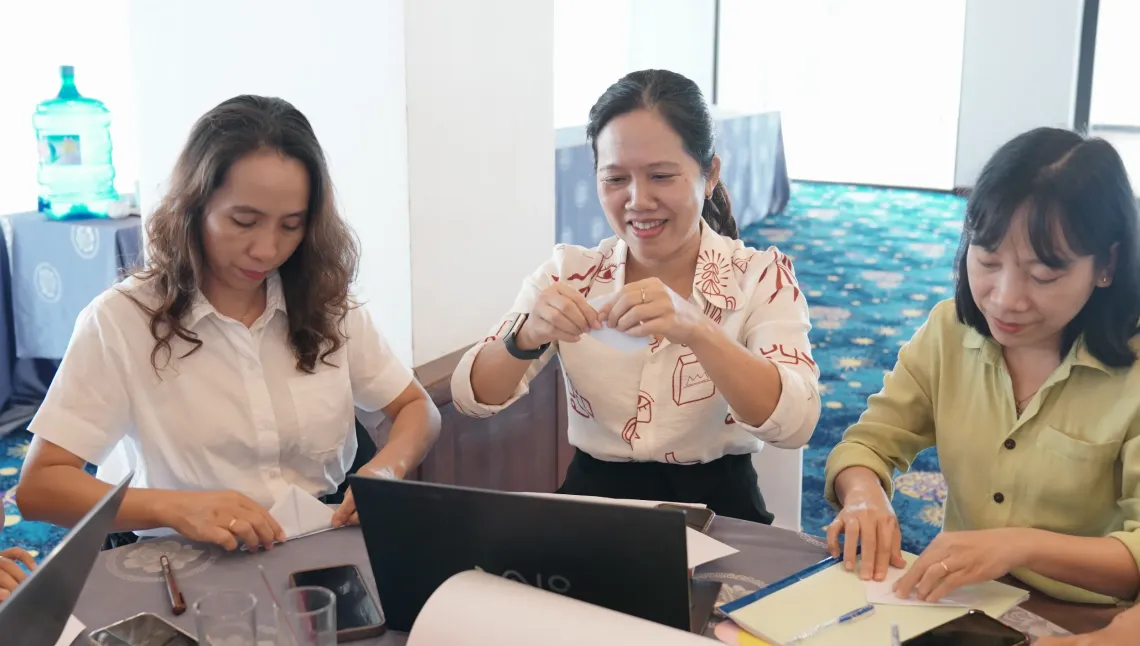
For Thuy, who is also the mother of two teenagers, one session stood out. "For a long time, we focused only on children," she reflected. "This training reminded us that caregivers also need to take care of their own mental health and well-being. When parents and teachers are emotionally healthy, they are in a better position to support young people."
Simple techniques introduced during the training, such as breathing exercises and stress-management practices, were eye-opening for many participants. They offered practical tools that educators could use not only with students, but also in their own daily lives.
The training's interactive approach also left a strong impression. Through role plays, group discussions and visual tools such as an "emotion thermometer", teachers practiced ways of helping children identify and express their feelings. "The emotion thermometer is such a simple idea, but very powerful," said Nga. "It helps children talk about how they feel. If more teachers use methods like this, it will strengthen relationships with students and help us understand them better."
Participants particularly appreciated how the role-play scenarios reflected real-life situations faced by families and adolescents. "These scenarios mirror situations that many parents and caregivers face in real life. They immediately spark discussion and encourage people to share their own experiences," said Sinh. Inspired by the approach, he is already considering involving students in future training sessions. "Students understand their own realities very well," Sinh said with a smile. "They can help us make the scenarios more authentic and relatable."
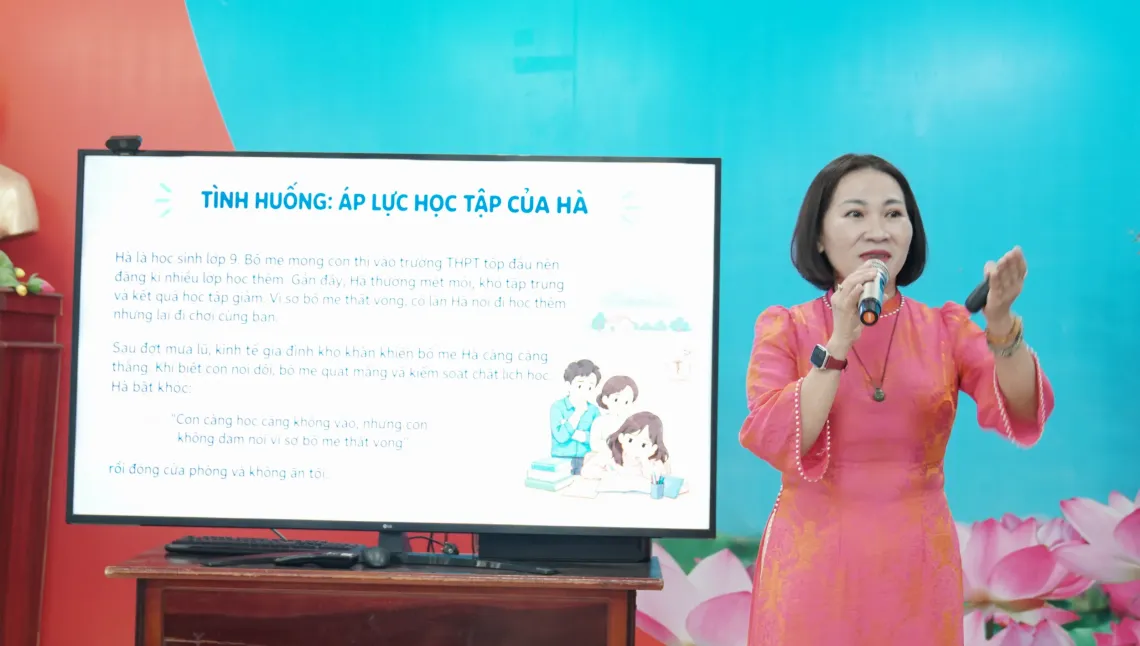
After two intensive days of learning, participants moved from theory to practice. As part of the Training of Trainers course, they were asked to facilitate a practice session with a group of parents from the local community while being observed by trainers and peers. The exercise helped participants build confidence before delivering similar sessions in their own schools.
The real test, however, comes after the training. As part of the course, participants will return to their schools and conduct sessions for other teachers, particularly those responsible for student counselling and psychosocial support. Each teacher has also developed a plan to expand the training within their own school. One common agreement is that all teachers, especially homeroom teachers, should receive this kind of training. “Homeroom teachers are often the first to notice when a student is struggling. They are also among the school staff who have the closest relationships with parents and caregivers. I believe that they should all be equipped with practical skills to support mental well-being, so they can effectively support parents and students when they need it the most,” said Nga.

As for Nguyen Thanh Quang, the father of a ninth grader who participated in one of the parent practice sessions conducted during the training, he was reassured to learn that teachers were receiving professional training on mental health and psychosocial support. “As children enter adolescence, they face challenges that many parents do not always know how to address. It is reassuring to know that teachers are receiving professional training so they can better understand students and provide timely support when needed.”
“This training is not just about building individual skills. It is about building a sustainable system of support. Through the training-of-trainers approach, the knowledge and confidence gained by one teacher can reach many more teachers, caregivers and ultimately thousands of children across Viet Nam,” said Tara O’Connell, Chief of Education at UNICEF Viet Nam.
With the support of the Z Zurich Foundation, UNICEF and its partners are helping teachers and caregivers create safer and more supportive environments where children and adolescents can thrive.
About the Z Zurich Foundation-UNICEF partnership
Launched in September 2021, the “Thriving Together” partnership between the Z Zurich Foundation and UNICEF strives to promote young people’s mental health and well-being worldwide. Employing a systems-change approach, the partnership focuses on strengthening mental health and well-being capacities at the government, community and individual levels. The partnership is currently active in 15 programme countries, including Viet Nam. Learn more about the partnership: https://www.unicef.org/partnerships/z-zurich-foundation