Hope in Action
UNICEF’s 2024 Impact in Viet Nam
- English
- Tiếng Việt
2024 was a year of change, progress, and resilience for children across Viet Nam.
It brought policy reforms that are advancing children’s rights, and partnerships that support the most vulnerable, all against the backdrop of climate change, digital transformation, and demographic shifts.
UNICEF helped strengthen systems and policies for children by generating evidence, building capacity, and providing international-expertise support. On the ground, we modelled programmes, facilitated their scale-up plans, and provided essential aid in emergency situations.
These achievements were made possible thanks to the leadership of the Government of Viet Nam for the progress of child rights, and unwavering joint efforts with donors, partners, communities, and children. 2024 results reflect what is possible when we come together in support of every child.
Challenges children continue to face
Viet Nam is one of the fastest-growing economies in the region and the world. While growth comes with remarkable progress for children, key challenges remain to ensure no child is left behind.
For over 50 years, UNICEF has supported the Government of Viet Nam in advancing children’s rights. Together with all partners, we deliver life-changing results for children, reaching the most vulnerable.
Our impact in 2024
In 2024, UNICEF and our partners contributed to strengthening policies, systems and services for children in Viet Nam. Here are some key highlights.
Results in details
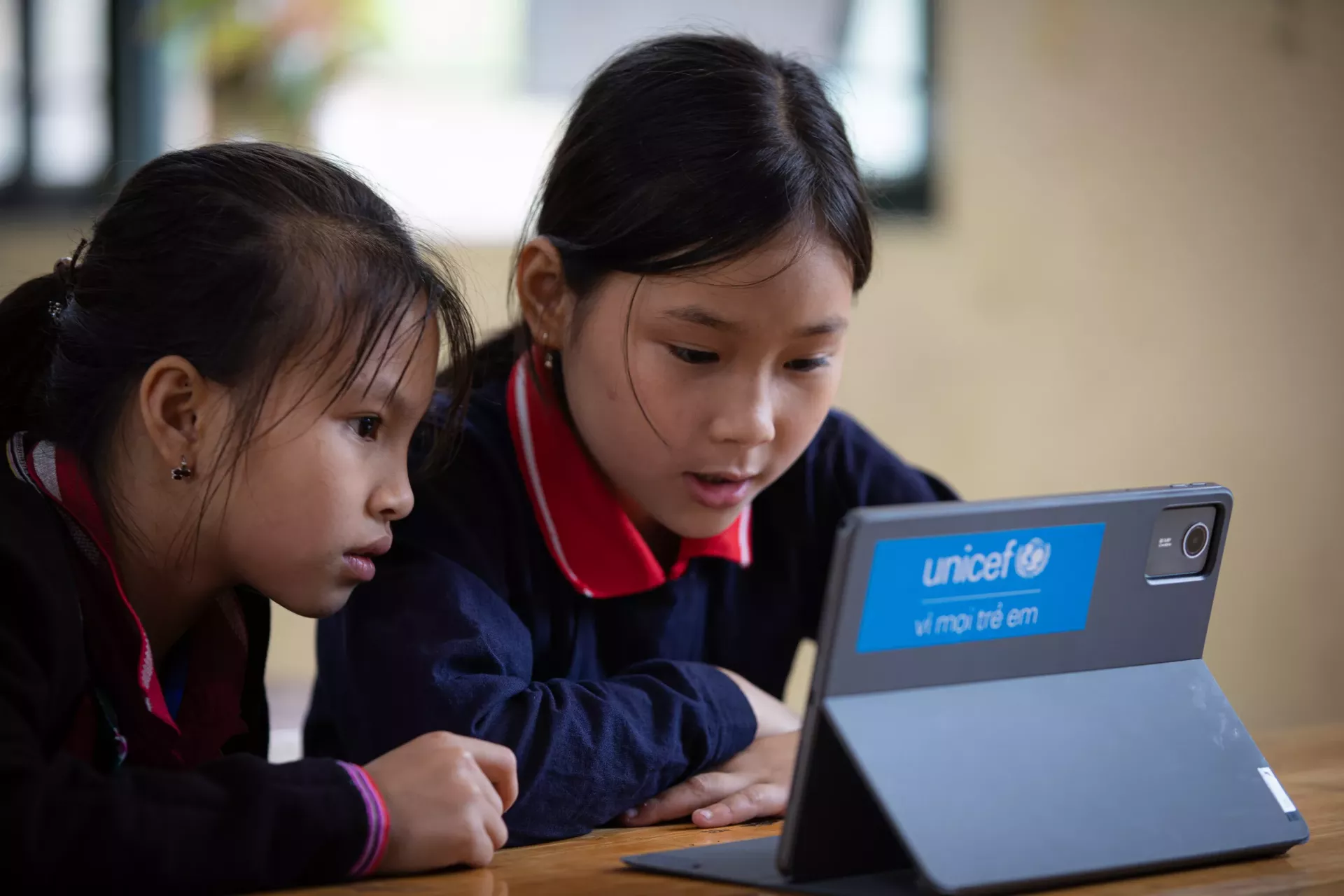
- UNICEF supported the Ministry of Education and Training (MOET) to develop Viet Nam’s first national frameworks for Digital and Artificial Intelligence Competencies, a pathway for accelerated and impactful learning for Viet Nam’s 23 million students.
- Our initiatives supporting STEAM (Science, Technology, Engineering, Art and Mathematics), transferable and green skills reached over 672,000 students.
- UNICEF helped improve early learning standards and supported a national plan to fund the new early childhood education curriculum, reaching four million preschool children.
- In response to Typhoon Yagi, UNICEF provided learning kits to over 19,000 primary school children and distributed early education kits to kindergartens, helping more than 16,000 preschoolers replace essential learning and play materials.
- With UNICEF’s support, the Law on Justice for Minors was adopted, prioritizing alternatives to detention for minors in conflict with the better protecting child victims and witnesses in a child and gender-sensitive manner.
- Following UNICEF’s advocacy, a decree on social work was approved. This is strong legal framework to strengthen the child protection workforce.
- Nearly 25,000 child protection staff, social workers, health workers, school managers, and counsellors received training in social work, child protection, mental health, online safety, and child-sensitive forensic practices.
- UNICEF supported the training of over 2,250 justice and law enforcement officers on child justice.
- Awareness campaigns on preventing violence and child labour reached over ten million students.
- In communities affected by Typhoon Yagi, UNICEF distributed 11,000 child protection kits, and shared information on mental health support and prevention of sexual exploitation and abuse reaching 78,400 people.
- Using human-centered design, UNICEF developed affordable, climate-resilient sanitation solutions for hard-to-reach communities in the Mekong Delta and Central Highlands. The Ministry of Health has approved these solutions for replication.
- UNICEF directly provided climate-resilient WASH services, like sanitation models and rainwater harvesting, to over 140,600 people, including 89,200 children.
- More than 3,350 WASH officials and teachers were trained on climate-resilient WASH for schools, and around 30,000 children across 63 provinces participated in menstrual hygiene awareness campaigns.
- During the Yagi response, UNICEF reached 49,300 people with life-saving WASH supplies such as water tanks, drinking bottles, ceramic filters, purification tablets, hand sanitizers, and soap.
- In support of Viet Nam’s digital transformation, UNICEF funded the development, hardware, and training for the Maternal, Child, and Reproductive Health Information System (e-MCH), managed by the Ministry of Health (MOH). The system was launched in December 2024 and is now running in seven provinces, home to about 5.6 million people.
- As we support scale-up efforts, over 81,000 mothers received skilled birth attendance, and more than 74,500 newborns received essential early care from health workers trained at UNICEF-supported activities.
- In remote areas, where maternal and neonatal mortality rates are higher, 1,200 village midwives trained by UNICEF are serving 1,200 communities, directly assisting more than 18,600 pregnant women and 10,200 newborns.
- Dien Bien and Gia Lai provinces are scaling up UNICEF’s nutrition support in over 200 communes. In 2024, nearly 9,800 pregnant women received micronutrient supplements, 5,600 children got micronutrient powder, and more than 500 were treated for severe acute malnutrition.
- Over 100,000 children affected by Typhoon Yagi were screened for malnutrition - 5,300 were referred for treatment. UNICEF provided 12 tons of therapeutic products to treat malnutrition in typhoon-affected provinces.
- To support the government’s rapid response to the measles outbreak, UNICEF collaborated with UN partners and the Ministry of Education and Training to deliver communication materials and guidance for schools and communities.
- UNICEF worked with the Ministry of Health to strengthen routine immunization systems, leading to over one million children being fully immunized by October 2024.
- UNICEF contributed to the review of national social assistance, which led to a new decree that expands cash support to 3.8 million people.
- We conducted our first cash distribution in Viet Nam, helping over 5,100 families affected by Typhoon Yagi meet urgent needs.
- To help build climate resilience, over 480,000 adolescents and young people were engaged through UNICEF-led youth platforms.
- UNICEF partnered with the Ministry of Agriculture and Rural Development (MARD) to conduct research and analysis of disaster risk management (DRM) laws, policies and systems, strengthening DRM for the 100 million people living in Viet Nam.
- We trained 38 provincial officials from 13 Mekong Delta provinces—home to over 17 million people— on international standards for disaster prevention and response.
- In schools, UNICEF assessed the potential for rooftop solar panels and modelled a net-zero toilet that turns wastewater into clean water using solar energy. There are plans to scale up these solutions in the coming years.
- UNICEF worked with the Ministry of Education and Training to bring climate change and disaster risk reduction into classrooms. Training and learning materials on these topics were provided to preschools, primary and secondary schools, and pedagogical universities.
- Just days after Typhoon Yagi struck northern Viet Nam, UNICEF’s response teams were on the ground, working with the government and partners to deliver humanitarian assistance in 11 of the hardest hit provinces. Our emergency response programme reached almost 230,000 people.
- In partnership with the private sector, 215 companies championed UNICEF’s Child-focussed Sustainable Business to prevent child labour, and promote child-responsive Environmental, Social, and Governance (ESG) guidelines.
- UNICEF hosted the Bridging the Gap: Business and Social Impact Forum 2024 to raise awareness of child rights among foreign businesses based in Viet Nam.
Highlights
This report highlights UNICEF Viet Nam's key achievements in 2024.