Families in Ukraine continue to flee home after two years of war
UNICEF and partners are helping families in Ukraine’s Sumska region who have been forced to flee devastating shelling.

- Українська
- English
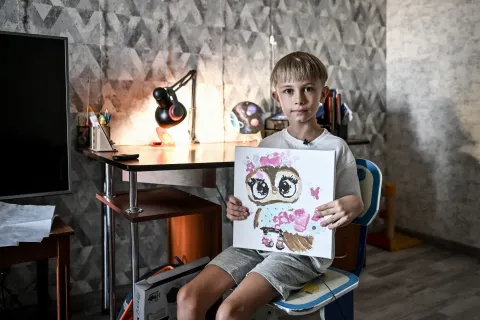
Seven-year-old Hlib paints a picture of the sun, with yellow rays, happy eyes and a smile. But he has not been smiling much lately – the scar on his head still hurts.
In early March of this year, his village in Ukraine’s Sumska region came under fire, and the intense shelling destroyed the family home. Both Hlib and his four-year-old sister Marharyta were injured, and the family had little choice but to flee.
"Some people called an ambulance, took us to another town and provided us with treatment,” recalls Hlib, holding his painting. “Then we moved here. But I want to go home.”

“The children are still scared”
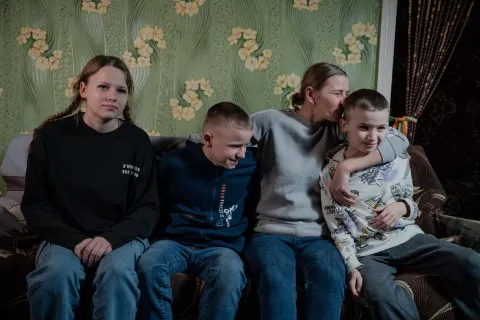
Today, in a safer part of the Sumska region, Hlib and his sisters attend art therapy sessions run by the mobile team specialists from the United Nations Children’s Fund (UNICEF) to help them overcome their trauma. Like many displaced people who have fled, the family have found shelter in a hostel. But they can never shake their fear of shelling, even after two years of war.
"The shelling lasts for several hours,” says Svitlana, Hlib’s grandmother. “Even if it gets quieter, you don't know what's going to happen next. Children have been wounded. The village is ruined completely, the whole centre has been destroyed, some people are dead.”
Svitlana worries about her grandchildren’s mental health.

"The children are still scared and too quiet,” she says, sadly. “Now, they have slowly started to heal, both mentally and physically, but at the beginning we were very afraid. So we came here to these art therapy sessions to give them a little distraction.”
UNICEF’s mobile teams have been actively assisting internally displaced people (IDPs) since the first day of mass displacement from the border areas of the Sumska region.
"We visit the communities in the Sumska region that are hosting families with children and give them art therapy and first aid classes,” says Inna, a social worker with the mobile team. “The children have experienced huge trauma. We have found that even young children of five to six years old realise that their homes have been destroyed and that they have no place to go back to. And we are very careful when we talk to them about this.”

Inna, psychologist Anna and health worker Anastasia are running today’s art therapy session, teaching children how to make salt paintings, and encouraging them to take part in exercises and games. But the sessions are not just about creative development – they are also about socialising, improving their mental health and helping them to get to know each other.
"The children who just arrived have suffered trauma,” says Anna. “They're still hurt. At the beginning of the day, we measure the children's mood with special stickers, then we talk about emotions and evaluate their mental state through the colours they use to paint. At the end, we measure their mood once again and for many of them the final results are better.”

"Daddy, I want to live!"
The displacement from Hlib’s community continues.
"Fifty-four children still remain in the community,” says Volodymyr Leonov, secretary of the village council. “People are leaving every day. The intensity of the shelling is even greater.”
Many families who flee the shelling are left with nothing and urgently need help. UNICEF is providing hygiene kits to the displaced and working with organisations that help people to flee.
"[As a result of the violence], the displaced need both psychological and financial help,” says Inna. “Often they come with just one bag and have no belongings, no hygiene products, no clothes.”
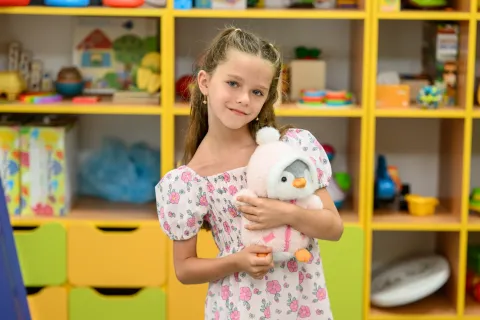
Svetlana, Konstantin and their eight-year-old daughter Alyona are among the scores of families that have fled with nothing. They fled the shelling a few days ago and are now living with dozens of other displaced people in a kindergarten, which serves as a temporary shelter. The only thing Alyona was able to bring was her favourite toy, Motya the rabbit.

"Motya is always with me,” says the girl. “He is seven years old, and I am only one year older than him. I sleep with him, he is my favourite and I took him with me. But I really miss my cats. My grandfather goes to feed them. But I miss them and want to pet them very much.”
Her father Konstantin does not know when, or if, the family will be able to return home. So the folding beds in the kindergarten will be their home for at least the next two weeks.
"We don't know where to go next," says Konstantin, sighing. "But we couldn't stay there either. My daughter said, ‘Daddy, I want to live!’ So we left."