Board game project unites children with disabilities in Ukraine
One young UPSHIFT participant is making board games accessible to children with visual impairments.

- Українська
- English
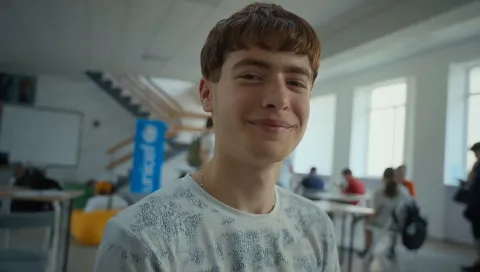
The war in Ukraine has cost 15-year-old Yaroslav his home twice. First, it was his home in Donetsk in 2014. Then, he and his mother were forced to flee the Mykolaiv region.
“At first, it was just a planned vacation by the sea,” recalls Yaroslav. “T-shirts and shorts were all we had with us. We thought we would be able to return in a month or two. But our journey dragged on and became the length of my life.”
Today, Yaroslav and his mother live in Odesa, where they are once again rebuilding their lives from scratch amid the ongoing war. Yaroslav, who has speech and motor skills impairments, studies remotely as part of a specialised programme.
When the opportunity arose to take part in UNICEF’s UPSHIFT youth innovation programme, he was determined to make a difference to the lives of other young children like himself. He received training, mentoring and resources to create a new initiative.


“I know from my own experience how difficult it is for teenagers with disabilities to find friends,” he says. “This problem became more acute during distance learning. So I came up with the idea to create a tabletop club where sighted and blind children could spend time together.”
Yaroslav participated in the program with like-minded peers but implemented the project on his own, overcoming challenges with the unwavering support of his mother, Nataliia. Together, they developed a board game called ‘The Vault’. Along with six other popular board games, it was adapted for use by visually impaired people.
“For each of the games, we developed our own tools – textured materials, different contours, cords, magnetic vinyl, braille stickers, and introduced audio versions of the characters. We came up with a life hack to make a convex font on a dice so that we wouldn't have to buy a similar one at a higher price.”
Yaroslav also organized a training session for teenagers to help them create these adaptive game elements for visually impaired people themselves. Participants learned how to make Braille inscriptions and place textured stickers correctly using stencils. Then, with their eyes closed, the teenagers explored how it feels to perceive the world through touch or, as Yaroslav says, “realized what superpowers blind people have.”


“We consulted with a teenager who is visually impaired and found out that there are many factors to consider,” says Nataliia, Yaroslav’s mother, who helped her son with the project. “For example, it is important that the cards are laid out on a table, because it is easier to read them than by hand. Textured elements should be attached in the centre of the card to make it easier to distinguish them.”
Yaroslav and Nataliia are open to cooperation with public organizations and centres that provide assistance to people with visual impairments. They are ready to share their experience and hacks on how to make board games accessible to everyone.
This summer, Yaroslav presented ‘The Vault’ at a camp for teenagers. His peers liked the idea so much they have started working on a computer game together.
“I can see how Yaroslav managed to learn new skills in this project,” says Nataliia. “When it came to creating a presentation, he learned how to use Powerpoint. In order to create a budget, he researched Excel. Yaroslav used the business writing style he learned at school to write letters to centres that support people with visual impairments. He also learned how to create videos, the basics of marketing – all of which will help him in his adult life.”
“At all the educational training sessions I have attended, there was not a single child with a disability,” says Yaroslav. “Now I appeal to parents – if your child is able, do not hide him or her, or go only to events for people with disabilities".
"The world needs to see its diversity, and let it be one of its norms. We exist. And we are useful to the world!”