Medical students transform recyclables into anatomical models
Young people from Poltava are addressing the risks of microplastics and the shortage of educational materials by creating a 3D laboratory that produces medical equipment

- Українська
- English

Nineteen-year-old Anastasiia has been passionate about biology since childhood. At school, she not only excelled academically but also developed a strong interest in the subject, which later shaped her career choice. In her final year, she decided to take the biology exam and apply to a medical university in Poltava, in hopes of pursuing her goal to be a doctor while remaining close to her family during the war.
“I was supposed to participate in the national biology Olympiad, but the full-scale war began and the trip was cancelled. Even then, I did not give up and continued preparing for university,” she recalls.
Now a third-year medical student, Anastasiia balances her studies with active involvement in student self-governance and youth initiatives. During an internship at a local youth centre, she learned about UPSHIFT Start, an initiative under UNICEF’s broader UPSHIFT youth programme that offers workshops designed to help young people develop their skills and ideas. Anastasiia later became a facilitator and encouraged other medical students to participate.
“Medical students often stay within a very narrow circle, and that concerns me. I want to challenge the stereotype that studying medicine limits opportunities. You just need to look for them. I invited other students, and they saw firsthand that creating something new is entirely possible,” she says.
How the project idea emerged
After attending a series of workshops, Anastasiia decided to launch a social project with her fellow medical students Olha, Myroslava, Anna, and another Anastasiia. They named their team Alium and joined the main UPSHIFT programme, which provides focused support to youth teams who want to address issues and needs in their communities through innovative projects. After completing the training and receiving mentorship and resources, they began shaping their initiative and joined an UPSHIFT cohort in Poltava region focusing on environmental issues.
“As medical students, we increasingly see evidence that microplastics play a significant role in the development of many diseases. People often don’t notice it or pay attention to it. But illnesses linked to microplastics are far more common than most people think,” says Anastasiia.
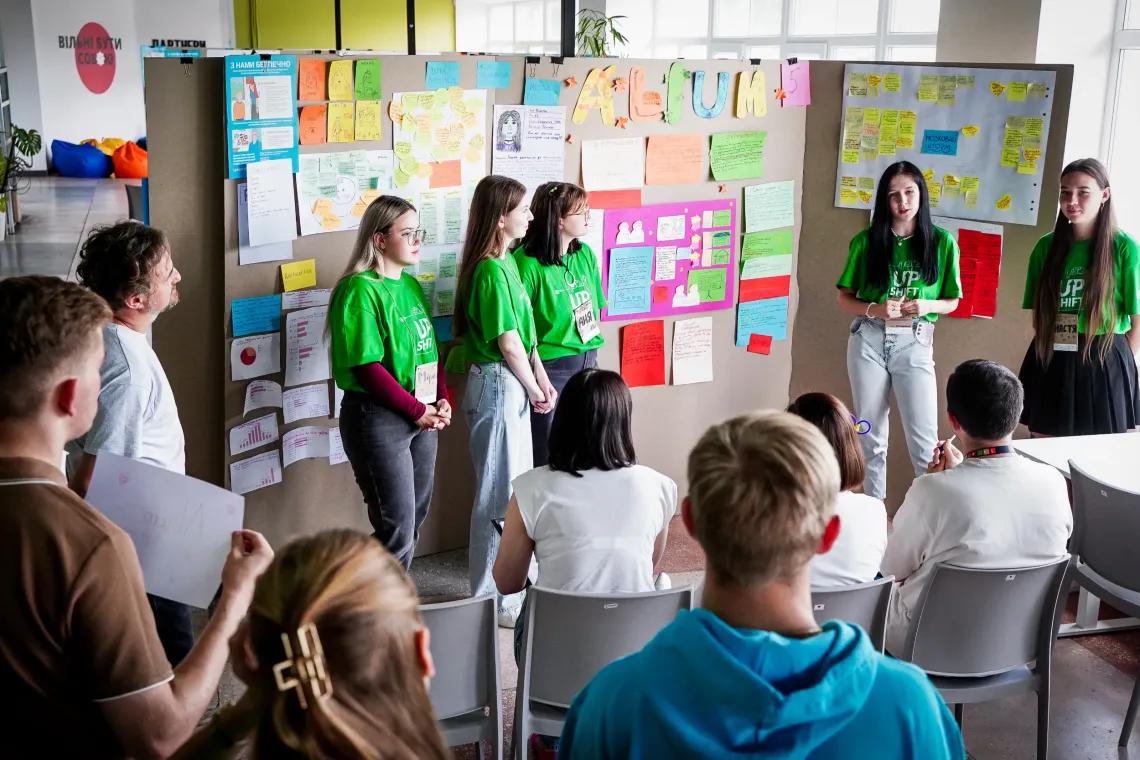
While researching the issue, the team learned that people rarely sort their waste, partly because they have never seen how recycling actually works. This makes it harder to understand how it affects the environment. So the students divided their project into several stages, beginning with an educational campaign.
“We run simple lessons for school and university students about waste sorting, what it is, why it matters, and how it works. The numbers surprise them the most. When we ask how many landfills they think are in Poltava region, they usually say two or three. And we tell them there are 524. That’s when the importance of sorting becomes clear,” explains Anastasiia.
The team held eight sessions for 150 participants, covering different types of plastic and using interactive memes to explain complex ideas in a simple and engaging way.

Creating the laboratory
Over time, the team realised that raising awareness alone was not enough; they also needed to demonstrate how plastic could be given a second life. They visited several educational spaces, where they learned how to work with 3D printers and saw how recycled materials can be transformed into useful items. They also studied how filament, the plastic thread used for 3D printing, is produced. After returning to Poltava, they purchased equipment, set up their team’s laboratory, and began experimenting with this technology.
“We’ve already printed parts for a centrifuge and a lamp. We’ve also created components for a microscope that can be used for research. And now we’re working on anatomical bone models,” says Anastasiia.
The team also produces dental training blocks that dental students use to practise tooth preparation. All of these items are made from recycled plastic, which is particularly important because it is currently difficult to get high-quality anatomical models in Ukraine. Factory-made models are expensive, wear out quickly, and are not always precise. 3D printing allows students to create affordable educational materials that are also accurate.

“We work with PET bottles. They have special markings, usually on the bottom or side. Most of them are water or soda bottles. We already have a collection point in our dormitory, and students are happy to bring them,” she adds.
Interest in her team’s project continues to grow. Several university departments have expressed interest in setting up their own waste-sorting stations to collect plastic that can later be used to print equipment for university laboratories.
Scaling the initiative
The project has also gained attention from other universities. Dental associations from Ivano-Frankivsk and Chernivtsi have reached out to Alium. Meanwhile, Alium’s 3D printing laboratory is gradually becoming an autonomous space for creativity, innovation, and student networking to support and complement their medical education.

Anastasiia dreams of expanding the initiative nationwide, creating a network where students from different cities send plastic, exchange 3D models, and build environmental awareness together. And that dream no longer feels out of reach.
“I am driven by the desire to influence the environment I live in. I don’t believe the phrase that circumstances simply happen. I want to shape those circumstances myself. Projects and research work are my way of making real change possible,” she said.
* * *
Since 2018, UNICEF’s UPSHIFT programme in Ukraine has empowered more than 1000 youth teams by equipping them with the skills, knowledge, and resources to help them address issues in their communities and support their peers through innovative youth-led projects. The UPSHIFT cohort that Anastasiia’s team participated in was supported with funding from the Federal Ministry for Economic Cooperation and Development of Germany through the German State Development Bank KfW.