Young children, adolescents find a ‘Buddy’ for psychosocial support.
“Hello. I’m Buddy. I’m really pleased to connect with you…I’m here to support you with information on mental health and many other issues that many young people are worried about.”

“Hello.”
“Hello. I’m Buddy. I’m really pleased to connect with you…I’m here to support you with information on mental health and many other issues that many young people are worried about.”
That is Buddy’s introduction when a young person engages with the Chatbot. The chat can then be steered to the specific needs of the young person, from relationships to mental health, stress, and anxiety.
“I have used the chatbot for some time,” says 17-year-old Arthur Awamami. He is grateful that the chatbot has instilled confidence in him and his peers that they can chat about the mental health issues they face.
Awamani is a mental health champion at Mount Olives Secondary School, having received training that equipped him to be able to recognise when a peer is struggling with stress and anxiety. Some of these indications include students who cannot speak up in class, those who find it hard to concentrate in class and never finish assignments.
“We did not know that these were associated with mental health,” says Shalom Nakakaawa, 18, another mental health champion at the same school.
“Our peers are going to embrace this (chatbot) because they love technology and it is even confidential,” Nakakaawa says.
She adds that previously, their peers would not open up to them because they were skeptical that their information might be shared and would have to face the stigma associated with mental health.
“The chatbot is confidential, it is fast, and the language is friendly and welcoming. I am sure it is going to help a lot of children. Children face challenges but with this, their lives are going to improve,” says Nakakaawa.
As a mental health champion, Awamani and Nakakaawa can identify peers in school who have mental health challenges and guide them on how to find solutions or refer them to professionals who can give them professional support.
“In the beginning, my peers had no confidence in telling us their challenges because I was just like them. “I was ignorant about mental health and would laugh when someone said they are having mental health challenges,” Awamani says. “After receiving training and being given more knowledge about mental health, I now understand that I can give “first aid” on mental health challenges.”

Buddy offers anonymity to young people, allowing them to have confidence in sharing their challenges. Where the situation needs more than just a chat with Buddy, a trigger word like ‘rape’, defilement, or violence will cause the chatbot to immediately link a young person to a professional counsellor at the Sauti-116 call centre.
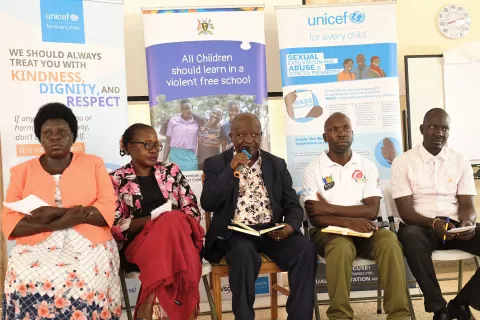
Awamani and Nakakaawa were speaking at the launch of the Mental Health and Psychosocial Support (MHPSS) Chatbot for the Sauti 116 helpline. The MHPSS Chatbot Project is a regional project supported by UNICEF Uganda, Kenya, and Tanzania under the coordination of the UNICEF East and Southern Africa Regional office based in Nairobi, Kenya. The Ministry of Gender, Labour and Social Development is the implementing partner.
When it comes to seeking help for mental challenges, young people and adolescents are often unable to access services because of financial constraints. Buddy addresses that challenge, being accessible to anyone, anywhere, and always.
“The chatbot has been designed to ensure zero cost to children facing mental health challenges,” says John Mugisha, the National Director of the Sauti 116 Child helpline.
The toll-free helpline was established by the Ministry of Gender, Labour, and Social Development in 2013. The helpline links children in need of care and protection, offering a confidential mechanism through which children and adults can report Violence against Children (VAC), and abuse and access supportive services like counselling, rescue, health, referral, and justice services.
“Through keywords, a user who requires immediate psychosocial support is linked to a counsellor at the Sauti 116 call centre to speak with a trained counsellor,” Mugisha adds. This, he said, has improved psychosocial support to children.”
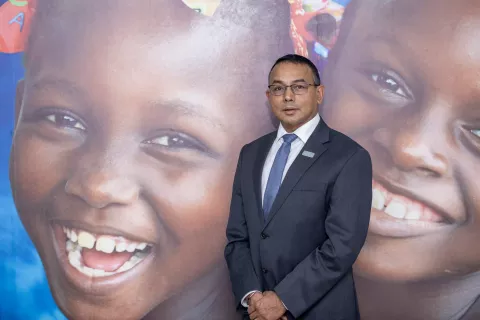
Reaffirming the central role of the Sauti 116 call centre, UNICEF Country Representative, Dr. Munir Safieldin says,” Sauti has been an important, useful platform in responding to children who are facing violence. I am so happy about this initiative to utilise Artificial Intelligence to make sure that young people who are facing mental health challenges can access these services.”

“Mental health problems are prevalent, not only in Uganda, but globally,” says Dr. Munir. “The World Health Organization tells us that between 10 and 20% of children and young people globally are facing issues related to mental health. In Uganda, a recent survey showed that 21% of primary students and 26% of campus students have been facing mental health issues. They face stress, anxiety, and family-related issues. We have many families that are breaking or on the verge of breaking. This puts pressure on these young people.”
He also cited bullying, including cyberbullying, as another challenge, and young people in schools falling prey to addictions like drugs and alcohol. The Sauti-116 helpline data shows that mental health is an increasingly growing concern. In 2021 during the height of the COVID-19 2 Pandemic, 4,133 cases were reported. In 2022, 7,333 cases of violence against children were reported through the Uganda Child Helpline. Mental health and psychosocial support are therefore essential for improving the well-being of children.
Officially launching the MHPSS Chatbot, the Minister of State for Youth and Children Affairs, thanked all the stakeholders and partners for their contribution to making Buddy active. “I believe Buddy will provide children with helpful self-care and supportive advice and information, identify those who require psychosocial support, and ensure an immediate and empathetic response.”
He added that with the automated service, more children could be reached, in addition to filling the gap where the ministry may be understaffed. He pledged continued support from the Ministry to continue to improve the lives of children in Uganda.
“It is important now to have this platform (chatbot). If not checked now, their mental health challenges can become more severe as they grow into adulthood,” Dr. Munir added. He thanked all the partners both in and outside Uganda for their part in this giant milestone as part of the journey to improve the lives of young people in Uganda.
“Growing up, I was always told about my physical health and how important it is, but what about mental health? Many students like me know nothing about mental health. As a mental health champion, I provide peer-to-peer support to my fellow students at school. We are now able to tell them that mental health is just as important as physical health because everything we do starts with the mind,” says Nakakaawa.
The greatest advantage that the chatbot has is that it is accessible through all types of phones, therefore leaving no child behind. The Mental Health Chatbot can be accessed by sending a text or SMS to 116 or via Telegram https://t.me/MHPSSBot, at no cost, and will be fully operational on WhatsApp by the end of 2024.