Call for more efforts towards curbing Violence Against Children in Karamoja
“More than half of children experienced at least one form of violence over their lifetime while the females were more affected compared to males."

Every child has the right to live free from violence, exploitation and abuse but findings by the United Nations Children’s Fund (UNICEF) and partners continue to show that children experience insidious forms of violence, exploitation and abuse. Globally, it is estimated that half of children experience violence in their lifetime with the best estimate of 1 billion children affected annually.
A recent baseline study conducted by AfriChild Centre, a multi-disciplinary research institution dedicated to improving the lives of children across Africa, indicates that physical violence was the most common type of violence and sexual violence is the least commonly reported.
Titled ‘Violence Against Children in Schools (VACiS)’, the baseline study was carried out in nine districts of the Karamoja Sub-Region. AfriChild was supported to undertake the study by UNICEF with funding from the Government of Ireland through Irish Aid.
According to the findings, the common places where physical violence occurred in schools included the classroom, school compound, and school playground. Though schools are considered protective social spaces against child abuse, available evidence indicates that violence in schools is still prevalent.

Violence against children in school is perpetrated by teachers, non-teaching staff, fellow students or other children resident around the schools. “More than half of children experienced at least one form of violence over their lifetime while the females were more affected compared to males,” Timothy Opobo, Executive Director (ED) of AfriChild Centre stated from the study.
At a two-day validation workshop organized by Ministry of Gender, Labour and Social Development, Ministry of Education and Sports, and UNICEF held in Soroti, Eastern Uganda, stakeholders provided feedback about the baseline survey. In attendance were representatives of the community-based service departments like the Judiciary, Uganda Police Force, Uganda Prisons Service, government through the Ministry of Education & Sports, among other entities which deal with community engagement and several community-related aspects.
Irene Oluka, a Chief Protection Officer- Justice for Children at UNICEF Uganda noted that the findings of the survey indicate that there is low reporting of cases of violence against children.
“There is fear by children, teachers and even some of the school administrators to report cases of violence against children. We want to work with a system that will provide confidentiality to encourage many people to report because if they are reporting anonymously, then they know that they are protected,” Oluka explains.
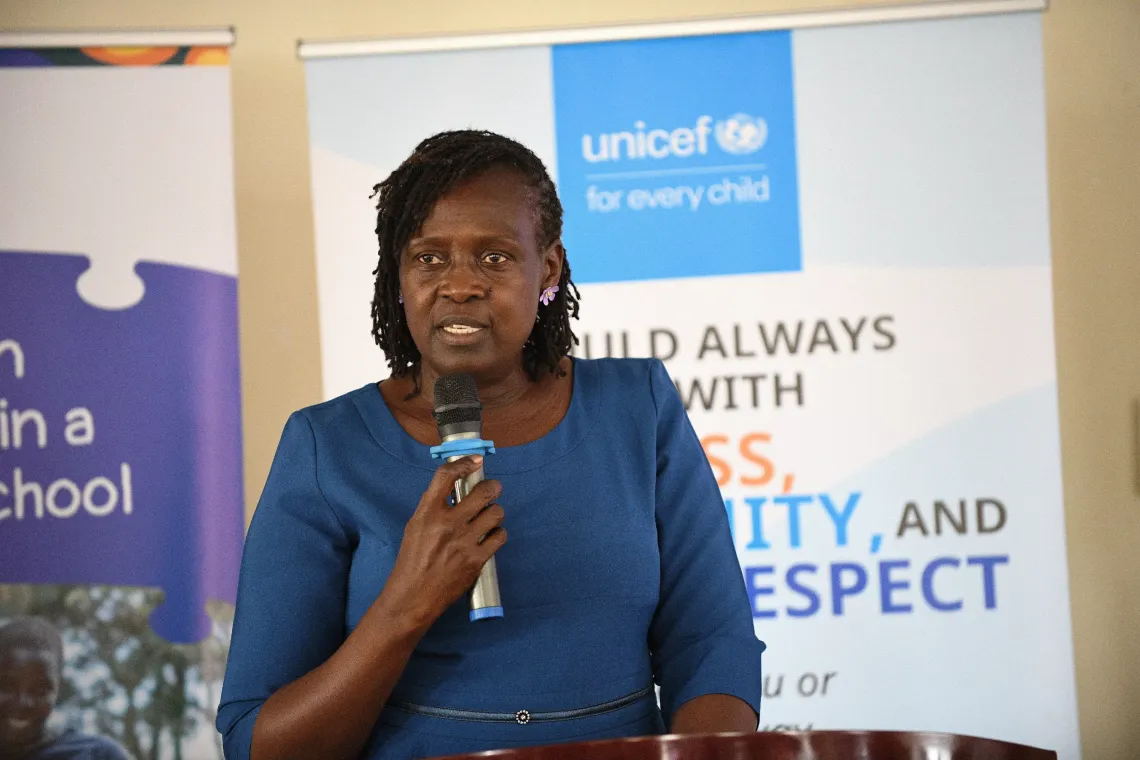

She adds, “We expect to strengthen that linkage with the school system so that when cases are identified in the school, there should be an avenue to report anonymously and be addressed.”
Joyce Nakoya, the District Education Officer (DEO) of Napak District Local Government observed that the baseline study touched on the core areas that affect education, and the prevalence of violence against children in school being major.
However, she felt the study did not clearly articulate certain types of violence, suggesting this requires stakeholders to investigate further. This, in her view, highlights the necessity for her role as DEO to develop strategies for supervising teachers and observing how children are managed within the school environment.
According to the study, learners are aware of the different VACiS reporting structures within their schools and outside the school as attributed to popularization of reporting structures and increased awareness of child rights among the learners.
In Karamoja and other parts of the country, UNICEF is supporting school-based programs through the Reporting, Tracking, Referral and Response (RTRR) guidelines implementation, aimed at preventing school-based violence against children, facilitate reporting of cases of violence where violence occurs, strengthen capacity of school structures to ensure cases of violence against children are referred to relevant competent service providers and that, the service providers provide adequate and timely response to cases when referred.