Vibrant School Management Committees in Moroto support learning in primary schools
Creating safe environments for pupils to learn

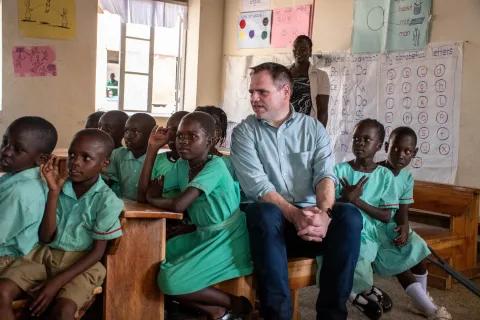
During the third lesson of the day, primary two pupils of Moroto Demonstration school, are enjoying their English lesson. They read with the teacher and sometimes on their own. The lesson is conducted in both the local language – Ngakarimojong but also partly in English.
Sitting at the back of the class is Nicholas Okello, 64, a National Volunteer with Voluntary Overseas Organization (VSO), UNICEF’s implementing partner. He is conducting support supervision for teachers of the lower primary classes (P1-P3) at the school. He is assessing their teaching methods to ensure they are child friendly, participatory, child-centred and support effective learning of the young ones.
Okello is welcomed with a song.
“You are welcome visitor. This is P2 class of 2018 and our class motto is education is life,” they all chorus.
Okello finds a seat at the back of the class taking notes as he observes the teaching style, pupil involvement and interaction, learner assessment, and much more, during the 30-minute classroom session.
This is part of what the School Management Committee (SMC) members of this school and other schools benefiting from the Irish Aid programme through UNICEF and its partners, have been trained to do to improve the learning of pupils.
Okello confirms that VSO with support from UNICEF and financial assistance from Irish Aid, has trained and continues to mentor SMC members on several areas that are aimed at improving the school environment, learning outcomes of the pupils and effective teaching. So far 468 SMC members from 117 schools in the seven districts of Karamoja sub-region, have benefitted from the trainings.
The SMCs membership includes members of the school foundation body, representatives from the old boys and old girls, parents, town or municipal council, teaching staff, pupils and the head teacher, making a total of 13 members.
The trainings focused on sensitizing the members about their roles and responsibilities as stakeholders of the school and what they need to do to improve the learning outcomes of the pupils. For the first time, the members learnt how to develop school improvement plans which are based on four pillars – the pupils, teachers, management and the community and addresses issues like late coming, absenteeism, violence against children, parent involvement, discipline among pupils, curriculum delivery, school environment, teaching methods, support supervision, among others. They meet every term to draft the plans but occasionally review progress to identify gaps as well as celebrate the achievements.
Daniel Engwau, the Head Teacher and a beneficiary of the support, mentions that before the UNICEF-supported trainings, the committees were just gambling. “We didn’t know what to do. But today, we sit together and plan for the school, pupils and we are all responsible for the outcomes.”
The members were also taught how to create safe schools, sensitized on alternatives to corporal punishments and prevention of violence among children in schools and in the communities.
“Today, we don’t have any canning in this school. It is violence free and the children know where to report when any violence happens,” Engwau says, before telling a story of a pupil who reported a new student teacher to an SMC member when she was canned.
The skills attained after the trainings have enabled them celebrate several achievements. For instance, SMC members have been empowered to follow up on school drop outs and many have been supported to return to school, members conduct random teacher support supervisions and lesson monitoring and provide feedback for better learning and teaching – they know what to look out for, members are part of planning for the school, guide and hold school administration accountable and are involved in drafting school rules and regulations. In addition, the SMC members are supporting menstrual hygiene management in the schools and educate pupils about how to make reusable pads, a skill they acquired from the UNICEF-supported trainings.
The SMCs have also been instrumental in stopping early marriages in the community. An example is a pupil who was rescued before marriage by SMC members, on realizing she had dropped out of school. The case was reported through the national Child Helpline 116 and the girl has since returned to school, currently attending primary seven.
“This is a unique approach! The VSO trainings gave us light and our pupils are learning well and in a good school environment,” Engwau asserts.
As a result, the school has attracted many more pupils, with a current enrolment of 635 pupils– 368 girls and 267 boys.
The trainings have greatly strengthened the school management committees where all stakeholders work together towards improvement of the school environment that supports learning. “We have the duty to track pupils’ and teachers’ performance, ensure our school is violence free, all this and more, we monitor,” boasts Engwau.
Moroto Demonstration School today has a clean school environment, teacher absenteeism has been curbed with an effective tracking system, pupils interact freely with teachers and are part of decisions made, school gardens are available to supplement the meals provided, violence is no more and planning for the school is participatory, thanks to the UNICEF support.