Back to the classroom
Empowering adolescent girls, child mothers and refugee learners through courage, compassion and community support
A school that never gives up
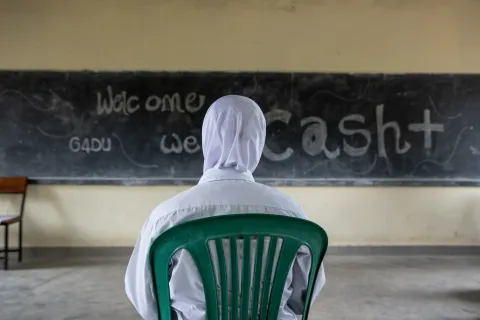
At Unna Primary School in Pachara Sub-county, Adjumani District, learning never stops. Despite a shortage of teachers, with over 130 pupils per teacher, dedicated educators conduct lessons, nurture life skills clubs and support vulnerable learners. Unna Primary School is one of the 140 schools in Northern Uganda implementing the UNICEF-supported and EU-funded Gender for Development Uganda (G4DU) programme.
Head Teacher Dominica Edea explains, “We have enrolled school dropouts, child mothers, and learners with disabilities. We support them with feeding and scholastic materials. Our aim is to see them through the primary cycle.”
The school garden, part of the G4DU initiative, feeds over 300 pupils daily while also teaching children agricultural skills. Life skills clubs empower girls to make reusable sanitary pads, baking and other small-scale projects.

Jane’s fight back
At just 16, Jane (not her real name) nearly had her dreams derailed by early pregnancy. “The first thing that came into my mind was to abort… because I wanted to continue with school,” she says.
Through the G4DU programme, Jane received counselling, meals and support from the Senior Woman Teacher Alice Madrara. Negotiations with her family and the boy’s family ensured her return to school, even as she prepares to welcome her baby in April 2026.

Jane and other child mothers under the UNICEF-supported and EU-funded C4DU programme are now learning skills in various clubs among the 140 schools under the programme. They are making sanitary pads, bread and mandazi, among other skills, with renewed dreams. “…my dream is to become a bank manager. I will leave the baby with my mother and continue with school,” Jane explains.

Government, community, parents and leaders: A united front
Success at Unna Primary is not only about individual learners. The School Management Committee (SMC), Parent-Teacher Association (PTA), Local Council (LC1) members, and parents are actively mobilized to ensure vulnerable learners return to school.
Geoffrey Chandiga, PTA Chairperson, shares, “We determine the location of vulnerable children, link them with the school and encourage parents to express challenges so that the child is helped.”
SMC Vice Chairperson, Angelo Drani Au, emphasizes that girls are increasingly taking on leadership roles, and parental contributions of UGX 2,000-4,000 support school meals and projects.

According to Musa Birungi, Senior Education Officer at the Ministry of Education and Sports, the G4DU programme is strengthening national education systems in lasting ways. “G4DU aligns with our national strategies on gender in education and the prevention of violence against children,” he explains. “We are already discussing reforms to integrate these approaches into Universal Primary Education (UPE) and Universal Secondary Education (USE) so that even after the programme ends, schools continue supporting girls, child mothers and other vulnerable learners. Strengthening monitoring and parental engagement, and working closely with partner ministries, is essential for sustaining these gains.”
Refugee girls reclaiming education
At Zoka Central Primary School, refugees from South Sudan are learning alongside Ugandan children. Out of 2,788 learners, 2,496 are refugees, including 12 child mothers and 37 learners with disabilities.
Head Teacher Stephen Vuzara explains, “We provide feeding, exemption from school fees and a caretaker for babies while child mothers attend lessons. The SMC and PTA monitor attendance and work with community leaders to mobilize learners.”

Christine (not her real name), 18, a Nuer refugee, returned to school after giving birth. She is inspired by peers benefiting from G4DU. “In the future, I want to become a doctor. Education is my way to help others,” she says.
Angelina Muon, Christine’s aunt, supports her niece by ensuring her baby is cared for while Christine attends school. “We communicate with teachers and the programme to support her learning,” she explains.

Life skills transforming futures
At Kitgum Matidi Primary School and Lagotcugu Primary School, the UNICEF-supported G4DU programme emphasizes life skills, competency-based assessment, and parental engagement.
Teachers trained at the Kitgum PTC cascade knowledge to learners through life skills clubs, teaching boys and girls skills such as baking, making reusable sanitary pads, taking care of the environment and practising agriculture. Florence Grace Lowila, Head Teacher, Kitgum Matidi Primary School, notes: "We trained teachers at the PTC, and they cascade life skills to learners through clubs. Boys and girls now learn baking, making reusable sanitary pads, agriculture, and environmental stewardship. They are more confident and responsible."
Anne (not her real name), 17, a young mother, shares: “I felt guilty and worried about my future. But the teachers welcomed me back to school. Now, I confidently make sanitary pads and mandazi, selling them to support myself and my baby. I dream of becoming a doctor.”

Parents, like Everest Anywar, observe positive changes in behaviour and initiative: children participate in chores at home, care for the environment, and support siblings. “My nine-year-old kid who is in P4 has participated in maize planting; and I have noticed that when she is at home on weekends, she wants to do agricultural work. She has also shown more self-drive for cleanliness. In the morning, she sweeps the compound without being told, unlike before when I had to remind her. She is also teaching her seven-year-old younger sister to support her in doing this work or going to fetch water.”

Empowering young minds for healthy families
As part of the G4DU programme’s focus on life skills, health education plays a vital role in empowering learners. For instance, at Lagotcugu Primary School, pupils from P4 to P7 are sensitized on the three essential food groups: energy-giving, body-building, and protective foods. Pamela Amony, Health Assistant covering Mucwini Sub-county, Kitgum District, noted: “We want the children to know, at least, about the three food groups. When we sensitize the children, they can cascade the information in the community and educate parents. We want them to be healthy and be able to learn well. Families should consume good food and not just produce food for sale.” This approach helps children stay healthy, learn effectively and influence positive nutrition practices in their communities.

Amplifying voices
U-Reporters like Pauline Biyinzika and Joseph Kasule Medi play a pivotal role in connecting learners, parents, teachers, and programme implementers. They ensure feedback loops for school safety, SRHR, mental health and child protection.
Pauline highlights: “I have observed significant positive changes, including increased awareness of SRHR and child protection among learners. Many students now feel more confident to speak up about issues affecting them, such as mental health challenges, school safety concerns and gender-based violence.”

Seeds of hope
Across Adjumani and Kitgum, the EU-funded and UNICEF-supported G4DU programme is doing more than just improving school enrolment. It is transforming lives, empowering girls and child mothers, strengthening community support and enhancing education quality.
As the programme continues, these schools serve as beacons of hope, showing that with support, dedication and empowerment, vulnerable children can reclaim their right to education and build a brighter future.