UNICEF interventions strengthen service delivery for pregnant women at Kawempe Referral Hospital
Addressing maternal health complications to save mothers and babies

About 200 women, some evidently pregnant and a few men are cramped on benches at the reception area of a storied building near Uganda’s capital, Kampala. Some are drinking bottled water or soda while others are eating roast ground nuts. Most sit quietly while some look tired and resigned.
Once one of the women is called, she moves to the desk at the front where the nurses take client measurements of the upper arm using a tape measure and blood pressure readings using what looks like a very modern monitor while her colleague makes recordings in the file. The women are then sent to another area inside the building. Every space that is vacated on the waiting bench is immediately filled up by another. This is the Kawempe National Referral Hospital where pregnant women, newborn babies and children are attended to. While the facility offers a broad range of services for women and children, including primary health care, Kawempe is a tertiary hospital. Tertiary hospitals are expected to provide specialized care including managing complicated cases that are referred from general hospitals and lower health facilities.
Previously a Health Centre IV, Kawempe National Referral Hospital was upgraded into a national referral hospital less than five years ago and is designated to cater for the needs of pregnant women, newborns and children only.
The sheer number of women frequenting this hospital is an indication of how relevant this government investment is for the women and children of Kampala and surrounding districts by improving access to essential care like antenatal care services.
Government investment in Kawempe is part of an effort to reduce delays that contribute to poor pregnancy outcomes. The World Health Organization (WHO) describes three delays that lead to maternal and newborn deaths. Delays one, two and three represent delays in: decision to seek care, to reach the health facility and receive timely care respectively. During the COVID-19 pandemic, more than ever before, these delays were pronounced leading to complications and sometimes even loss of life.
UNICEF Uganda with funding from the Swedish International Development Cooperation Agency (SIDA) intervened in Kawempe to support government in ensuring availability of appropriate care, especially when women and newborns experience complications. The support provided included refurbishing and equipping labor wards, a theatre and a high dependence unit for mothers. UNICEF has also supported capacity building efforts in the hospital. This has been done through the Support to Emergency Response and Continuity of Essential Maternal, Newborn, Child and Adolescent Health Services in the Context of COVID-19 in Uganda initiative.
“Until April 2021, we didn’t have an Intensive Care Unit (ICU) so we always referred women in need of such critical care to the Women’s Hospital in Mulago,”
“UNICEF Uganda has supported the setup of this ICU for us and we can now take care of these mothers who arrive here in need of critical care instead of referring them to Mulago,” he further reveals with his eyes beaming with joy. “We have seven beds here and all the equipment that we need,” he adds. More than 140 patients have since been admitted to this ICU since April 2021.
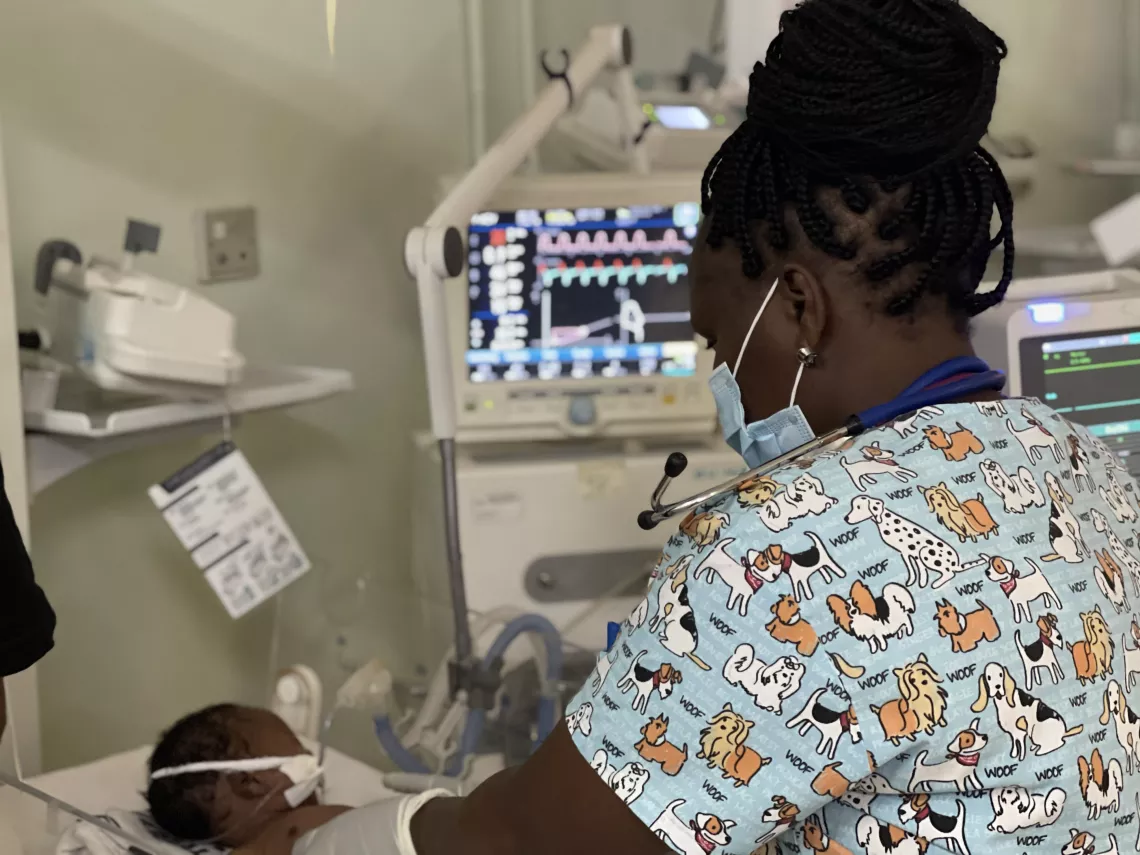
It is not just the ICU for mothers that UNICEF and its partners have worked on. Like its tagline ‘For every child’ reads, UNICEF Uganda has also supported the setup of a Neonatal Intensive Care Unit (NICU) at Kawempe Hospital that can handle on average 80-90 children at a time. That way every child that needs critical care can get it.
“We had nothing here to look after children that needed critical care. Our job was to refer them elsewhere. We didn’t have ventilators, monitors and even cots,” reveals Dr. Geraldine Basanyukira, a pediatrician at the hospital. “When we got this NICU, the mortality rate went down. Children are no longer infected because of crowding. UNICEF didn’t only provide equipment, they trained us as well.”
Kawempe Hospital records approximately 80 births every single day. On the day of the visit, 17 pregnant mothers needed emergency surgeries. Dr. Amina Najjemba, a specialist obstetrician observes that unlike in the past, today, health workers can quickly identify a pregnant woman in need of emergency surgery in time, thanks to the advanced monitoring equipment.
“Our theatres have been refurbished by UNICEF, but we need more space as the number is overwhelming,” she says before quickly helping a nurse push a pregnant mother due for surgery into the theatre.
To identify women that need that kind of emergency care, UNICEF and partners installed monitoring equipment in the S-PET Ward where women with severe pre-eclampsia (severe pregnancy induced blood pressure), a leading cause of death among pregnant women and their unborn babies, are being monitored.

“I came here two days ago but I am feeling much better. I was referred here from Kisenyi Health Centre and feared for my life,” says 22-year-old Vanessa Maria Nakakeeto as a nurse administers some drugs on her right-hand shoulder. “I am improving now. I am being monitored all the time,” she says smilingly.
The refurbishment and equipment of hospitals has also seen the installation of flowmeters to enable piped oxygen to be used in the labour wards, high dependence units, high risk wards, NICU and ICU. Additional oxygen cylinders have also been provided to supplement piped oxygen.
“There are mainly three delays that lead to maternal and child deaths. Delays at home to seek treatment, delays during transportation to health facilities and delays while at hospitals. What UNICEF Uganda and partners have done is to reduce on delays at hospitals and strengthen service delivery at these facilities,” explains Dr. Eve Nakabembe, a senior obstetrician and gynaecologist supporting UNICEF interventions at the Kawempe Hospital.
Strengthening service delivery has also meant infrastructural upgrades such as replacing aging doors on bathrooms, installing electrical sockets so health workers can easily plug in vital equipment such as monitors nearer to beds where parents are, and creating a conducive environment for workers. “We have installed air conditioning in some places, improved the lighting and ensured that doors and other furniture are working,” says Constant Sanya, a technician with a UNICEF Uganda contractor.
Although Uganda is many miles away from the global target of 70 maternal deaths per 100,000 births, such interventions at least point to a positive trajectory towards that goal.