Uganda’s youngest children hold the key to national prosperity
"For every 1-shilling Uganda invests in quality Early Childhood Development, it can gain up to 16 shillings in returns."

According to the Uganda Demographic and Health Survey (2023/2024), only 35 per cent of children aged 48-59 months are developmentally on track, meaning nearly two-thirds of Uganda's youngest citizens approaching school age are unprepared for the learning journey that will determine their future.
This stark reality brought Uganda's policymakers to Kampala Sheraton Hotel in Kampala where they confronted an uncomfortable truth about nurturing the nation's most vulnerable population.
Early Childhood Development (ECD) is not a standalone program – it is a shared goal that demands coordinated, multi-sectoral action across health, nutrition, education, protection, and childcare sectors for children from conception to age eight, grounded in the Nurturing Care Framework.
Uganda has achieved remarkable progress in child survival indicators. Under-five mortality has declined from 64 to 52 deaths per 1,000 live births over the past five years, while infant mortality stands at 36 deaths per 1,000 live births. Stunting among children under five has reduced from 29 per cent to 25 per cent since 2016, and maternal mortality has decreased to 189 deaths per 100,000 live births, reflecting improved health interventions and 74 per cent of births now attended to by skilled providers.

While noting the progress that has been made, the meeting revealed a troubling developmental regression: while 75 per cent of children aged 24-35 months are on track, this drops to 56 per cent for those aged 36-47 months, and plummets to just 35 per cent for children aged 48-59 months. Disparities are equally stark across economic lines with 55 per cent of children in the wealthiest households attending pre-primary, compared to just 11 per cent in the poorest families. This was further underscored by Oliver Petrovic, Regional Advisor for ECD at the UNICEF Eastern and Southern Africa Regional Office who noted that the world is facing a learning crisis with 7 out of 10 children in the region missing out on early learning opportunities and less than 2 per cent of the overall education budget allocated to the pre-primary sector.
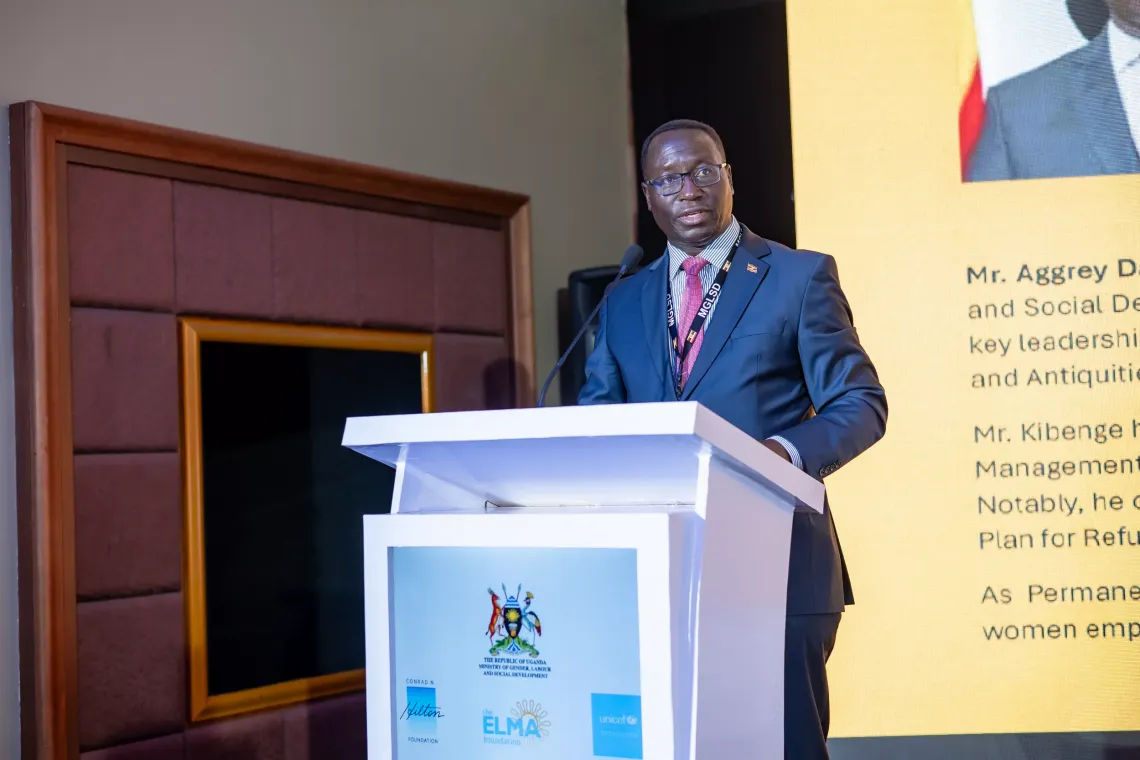
Aggrey David Kibenge, Permanent Secretary of the Ministry of Gender, Labour and Social Development, acknowledged persistent challenges, including COVID-19's effects, high teenage pregnancy rates, developmental regression in children, and funding shortfalls. "These realities demand a stronger policy response and renewed investment in early learning and care systems," he emphasized, calling for his ministry's "full commitment to leading this work with urgency, equity, and accountability."
However, hidden within these troubling development statistics lies an extraordinary economic opportunity.
UNICEF's Representative in Uganda, delivered a compelling economic argument:

"For every 1-shilling Uganda invests in quality Early Childhood Development, it can gain up to 16 shillings (US$0.0044) in returns."
A comprehensive 2023 ECD cost-benefit analysis revealed that strategic investments could yield returns between 8.9 and 16.3 times the initial investment, create over 50,000 new jobs by 2030, and boost lifetime earnings. On the contrary, the lack of action could cost Uganda between 82 trillion and 210 trillion Uganda shillings in lost human capital by 2063.
The meeting called on the government to commit to providing at least one year of universal pre-primary education for all children and establish dedicated budget lines for ECD across all sectors to enable proper tracking and measurement of investments. Currently, 71 per cent of children aged 3-5 do not attend early childhood education, with only 41 per cent of pre-primary schools licensed as of 2019.
Officials stressed that, with robust policies already in place, including the National Integrated Early Childhood Development Policy and the newly finalized costed ECD Strategy, Uganda will see improvement.
As the Member of Parliament for Bunya East Constituency, Hon. James Kubeketerya noted, "ECD is not a luxury, it's a necessity for national progress and equity."
The event was attended by the Permanent Secretary at the Ministry of Education and Sports, officials from the United Nations and Ministry of Health, members of parliament, civil society organisations, academia and the media.