Teenage girls in Amudat District feel safer at school than at home
2019 go back to school campaigns yielded results

In every corner at Pokot Secondary School’s dry compound in Amudat District, North-eastern Uganda is a signpost “this is a safe space.” The school also created a “safe room” where adolescent girls meet with the senior woman and the matron in confidence to discuss personal issues in detail.
“Most of the girl students at this school have either run away from a forced marriage or were a few days away from being sent into one by their own parents, says Irene Adokorach, the Senior Woman.
Jeniffer Ariato, for example, a Senior Four student who turned 17 years on January 12, 2021 is already a mother of a two-year-old boy. Her father collected 30 cows and 12 goats as her dowry and married her off at 15 years. At first, Ariato had accepted her fate, but her mother hadn’t.
When a team from the Trailblazers Mentoring Foundation (TMF) with support from UNICEF and Irish Aid conducted a ‘Go Back to School Campaign’ in their village, Ariato saw an opportunity. She joined Pokot Secondary School in 2017 and is about to complete O-Level. She plans to study further and become a nurse.
At Kalas Girls Primary School is Chemutai Everline, a 13-year-old born of Achorichor village in Loroo Sub-County. When her family married off her elder sister two years ago, they sent her along to do house chores for the newlyweds. But her in-law would turn into a nightmare!
Not only was he married before marrying Chemutai’s sister, but he also wanted to add her to his polygamous collection.
“When they went to sleep, I decided to escape. I walked from Loroo (about 68 kilometres) to Amudat town where Kalas Girls Primary School,”
The school is currently being used by Amudat District as a rescue centre for girls escaping child marriages and female genital mutilation. Chemutai is now in Primary Six and has “no plans of going back home any time soon.”
According to district enrolment figures, over 800 students joined school as a result of the ‘Go Back to School Campaign’ conducted in December 2019.
“Worth noting is that the gender equality ratio of schoolchildren that was 80:20 for boys to girls five years ago now stands at 60:40 respectively,” according to Anthony Kapsawani, TMF’s Project Manager in Amudat District.
Pokot Girls Seed School in Karita Sub-County, for example, had a student population of 264 students before closing due to COVID-19 compared to the 108 in 2017 and is been averaging a completion rate of 70 per cent compared to 45 per cent in 2017.
According to the District Education Officer (DEO), Benton Luke Logiel, the upsurge can be attributed to the improvement of infrastructure in schools, creation of safe spaces, availability of the appropriate teaching and learning materials and building of the school management’s capacity to assess and monitor learning outcomes.
While organizations like UNICEF, Irish Aid through TMF are excelling at empowering both girls and boys to know their rights, resist early marriages and engage in extra-curricular activities such as making reusable sanitary pads, some schools are still grappling with logistical challenges to perform optimally.

David Kissa, the Head Teacher of Pokot Girls’ Seed School said that while the school has registered increased enrolment, retention of students keeps fluctuating due to tuition challenges. Head Teachers occasionally have to source from their own pockets to pay school fees for defaulting students who are unable to continue.
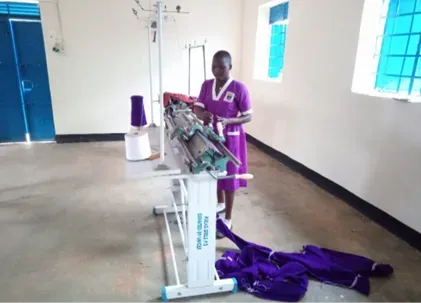
At Kalas Girls Primary School, students make sweaters, scuffs, necklaces and bracelets for sale to raise money to buy basic needs such as soap, sanitary towels and scholastic materials. School administrators expressed the need for students to experience life beyond Karamoja.
According to Sister Prossy Nantege, the Head Teacher at Kalas Girls Primary School, girls in Karamoja are conditioned to accept Female Genital Mutilation (FGM) and early marriages as normal which she argues will no longer be the case if they are exposed to a life different from what they have been accustomed to.