Playful beginnings
Transforming early childhood in Karamoja

While in Karamoja the first week of June 2025, I was delighted to witness screams of children on a swing, a mother clapping in rhythm, a rope skipping to the beat of laughter, and a teacher singing the alphabet. This is where learning begins – in play.
Across the nine districts of Karamoja: Karenga, Kaabong, Kotido, Abim, Napak, Moroto, Nabilatuk, Nakapiripirit and Amudat, 32 new playgrounds are redefining what early childhood development (ECD) looks like. Thanks to a partnership between UNICEF and Play Action International with funding from Education Cannot Wait, these spaces are not merely colourful clusters of metal, rubber and wood. They are arenas of growth, healing, connection and hope.
“Before…, children were weak and dormant…”
At Nakwanga ECD Play Lab in Nakapiripirit District, Judith Ileny, a 34-year-old Head Caregiver, smiles as children chase one another through the playground. “Before the playground was established, children were weak and dormant,” she recalls. “Now, they are sharp and playful. They can dance, lead the play, even without us.”
She gestures to a group of children in the playground. “We used to have about 30 children. Now we have 308.” The rise is not just in numbers but in engagement, confidence and joy.
The transformation has not gone unnoticed. William Iwuala Abura, the District Education Officer for Nakapiripirit, confirms, “We now have 30 ECD centres, up from 15. The three centres with playgrounds supported by UNICEF each has over 300 children. Others without [playgrounds] have fewer than 100. That is the power of play.”

Children learn how to learn
But behind every swing is a story, and behind every story is a parent. The rise in attendance and development is rooted not just in infrastructure but in people, particularly the caregivers and parents empowered through UNICEF’s comprehensive parenting programme funded by the Ireland Government.
Anna Ochonga, a 45-year-old mother and grandmother from Namalu Parish, shares her journey. “I was not educated, but I have learned many things,” she says proudly. “I talk with my grandchildren about school, cook with them, and ensure they brush their teeth.”
She marvels at how they now speak English, count confidently and skip rope while singing. “They’re doing things I never imagined. I wish I had had these opportunities. I want every child in our village to experience this.”
Parents are more involved
One of the most profound shifts has been in parental involvement. “Before, children would come alone,” Judith notes. “Now, parents bring them, even waiting at the gate during lunchtime. And many join in; they swing, skip, run.”
The parenting programme, delivered in collaboration with Moroto Core PTC and local governments, tackles key areas: child rights, positive discipline, hygiene, nutrition and the core responsibilities of parenting. In 2023 alone, 1,853 parents were trained in Nakapiripirit, Napak and Kotido.
Simon Peter Achingun, a Trainer of Trainers, explains, “We train caregivers to engage parents, not just in theory, but in daily practice. Parents are beginning to see themselves as co-educators, not just caretakers.”

“…ECD is still new in Karamoja”
Yet, the journey is only beginning. “The concept of ECD is still new in Karamoja,” says Iwuala. “Many parents believe education starts at six or seven. But a child’s brain is developing fastest between zero and five; that’s when learning really begins.” The gap remaining in espousing ECD and play is noted by John Robert Opio, Head Teacher of Namalu Mixed Primary School: “In future, if the parents could fully embrace the playgrounds, own them, and dance the tune of the needs of the ECD centre, we shall be guaranteed of their sustainability.”
Of the 208 villages in Nakapiripirit, only 30 have functional ECD centres. The need for more playgrounds, classrooms and trained caregivers is urgent. “UNICEF has planted a seed,” William reflects. “Now we must nurture it.”
He highlights the importance of synergy: “What happens at school must align with what happens at home. That’s why parenting programmes are crucial; they create continuity.”
A joyful revolution: Karamoja Sub-region Play Day
That joyful spirit was on full display during the Karamoja Sub-region Play Day, celebrated under the theme “Choose Play, Every Day” organized with funding from the Ireland Government.
The air buzzed with music and energy as children from across the sub-region gathered for the first time in Amudat to showcase their talents. Rehema Nankoma, Head Caregiver at Amudat Muslim ECD Centre, beamed with pride. “This day is important because it reminds the community that caregivers matter. We are shaping the next generation of doctors, teachers and leaders.”
Five-year-old Joyce Naumbe, in Top Class at the same centre, was eager to shine. “I have come to show my talent,” she declared. “Through play, I am able to understand and learn what the caregiver is teaching us. We feel happy when we are playing.”
Her mother, Beatrice Ademun, stood nearby. “She wakes up early, eager for school.”

“Let the children play”
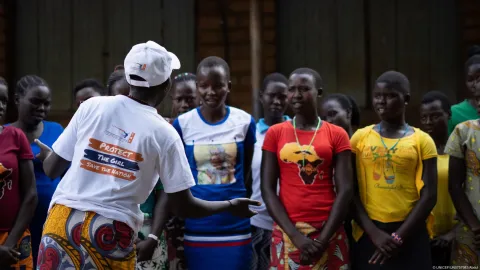
The lessons of the day extended beyond the playground. Through skits, songs and games, children conveyed themes of responsibility, resilience and the importance of education. They filled bottles with water carried in their mouths, a humorous but meaningful performance symbolizing patience and endurance.
Beatrice urged fellow parents: “I want to tell parents across the country not to punish children because they are playing. I ask all parents to give children freedom. Through play, they get knowledge.”
Rehema echoed the message: “Let the children play. Some are getting sponsorships because of their talents in singing or athletics. This increases their importance.”
Joyce, wide-eyed and earnest, offered her own insight: “My message to all children in Uganda is that through play, you can study freely. You can also become happy. Through play, you enjoy and you are able to understand what the caregiver is teaching.”
Integrated impact: Health, learning and joy
Back at Nakwanga, Judith points to another benefit. “When children register, we capture data that health workers can use to track nutrition and immunization. It’s a full-circle model – health, education, parenting.”
However, challenges persist. “Imagine 100 children in a 4x4-metre classroom,” Judith sighs. “We need more space, more caregivers. Some leave because they’re overwhelmed. But we continue, with support from Compassion and porridge from WFP.”
UNICEF’s Rosemary Alwenyi emphasizes that play does not require expensive toys. “Simple materials can make play possible. Play is not a luxury; it is the pathway to growth.”

Beyond the classroom: A community movement
What is emerging in Karamoja is not just an education initiative, but a social movement. Playgrounds are acting as hubs of community connection – places where children thrive, parents learn, and traditions adapt.
ECD is no longer seen as an imported idea, but as a local solution to long-standing challenges. It honours cultural rhythms while equipping children with the tools for a future filled with possibility.
Message to policymakers and donors
Karamoja stands on the edge of a brighter future. With continued investment, this momentum can be sustained and scaled.
“We’ve seen the transformation,” William says. “We just need help to sustain it, to build more playgrounds, train more caregivers and reach more children.”
He is joined by Emmanuel Alinga, District Education Officer, Amudat District, who thanked UNICEF “for recognizing the vital role of the child and the teacher. Growth begins here.”
From the hot hills and plains of Karamoja, a chorus is rising, not just in songs or skipping games, but in the confident voices of children, the supportive hands of parents, and the steady guidance of caregivers.
Because in Karamoja, learning begins with laughter, thanks to the Ireland Government and Education Cannot Wait for making this happen. And when children play, entire communities grow.