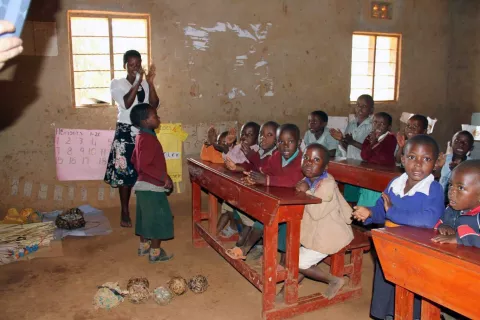
Play and learning materials develop children’s creative skills
Learning through play

Reception Centre 1, Bright Early Childhood Development (ECD) centre is a lively place with happy children engaged in outdoor games such as sliding, skipping, netball, football and swinging. It is also one of the thirty UNICEF-supported ECD centres operated by Plan International in the West Nile region.
These ECD centres offer early learning services for refugee children and those from host communities. The children, who frequent the centres, are exposed to early learning activities and play materials such as counting circles, jigsaw puzzles, building blocks, puzzle blocks, chain puzzles, dominoes and puppets, provided by the caregivers, to promote the children’s holistic cognitive, physical, social, emotional and moral development. For instance, playing with puppets helps children develop their language skills.
49-year old Rosemary Kute, who serves as Center Management Committee Treasurer with Plan International’s Reception Centre 1, Bright ECD, observes that when children listen to stories or invent their own while playing with animal puppets,
“they build on their language and communication skills”,
UNICEF with financial assistance from the LEGO foundation is providing the centres with ECD kits that contain fifteen play materials namely: 1) memory game playing cards2) cardboard picture books 3) sort and stack sets 4) shape sorters 5) string beads 6) hand and finger animal puppets 7) handballs 8) counting circles 9) jigsaw wooden puzzles 10) building blocks 11) puzzle blocks 12) chain puzzles 13) board puzzles 14) modelling clay and 15)dominoes set. However, because the materials are not enough, parents with support from caregivers and training from tutors of St. John Bosco Core Primary Teachers College (PTC)-Lodonga are making similar play materials using locally available materials to replicate the Kit. This has gone a long way in changing perceptions from thinking that instructional play and learning materials must always be purchased to appreciating that the play materials can actually be made from locally available materials within the environment.
Mercy Wenepai and Faidah Susan, aged 3 and 6 respectively, attend Bright ECD centre. The girls together with their 8-year-old brother Jeremiah Edward Igitunga are among the children that visit the ECD centre daily to enjoy the outdoor and indoor games that the centre offers. Their home is a five-minute walk from the centre. Their father, Jeremiah Igitunga Simon explains that he allows the children to go to the centre because the games they engage in help them to learn.
“If I leave them to play from home, it will not help them much yet at the centre, they engage in play that benefits them because they learn numbers, drawing, songs and interact with other children.”
Jeremiah Edward Igitunga, now a Primary three pupil at Rockland school previously attended nursery school at the centre, but despite moving to a bigger school, he still enjoys the activities at the centre.
“I enjoy playing all the outdoor games that include football, swings and slides”,
While picking up different coloured blocks, Jeremiah Edward explains why he likes playing with blocks; “the blocks help me identify colours such as yellow, green, pink, blue, black and red”, he mentions while pointing out each colour. He also adds, while eagerly picking out different shapes of the blocks and naming them, that the blocks help him identify shapes. “Counting puzzles helps me to understand mathematical concepts because I not only identify different colours but am also able to read the number on the board and count the corresponding dots attached to it.” This, he says enables him to establish where to place that missing piece on the counting puzzle.
For a child who has experienced trauma from war and conflict, Jeremiah’s command of the English language and his mathematical skills are commendable.
Asked how else he has applied the knowledge gained through play, Jeremiah Edward responds that playing with the building blocks has helped him build a pigeon house. Looking from the distance of their home, a pigeon could be seen standing at the entrance of the pigeon house door.
Their mother Joy Neema, explains that while her son enjoys playing with building blocks, her daughters Wenepai and Faidah enjoy drawing, modelling using clay and playing with puppets. She says they often come up with interesting shapes and figures when playing with modelling clay.
Neema says that when she is not busy, she participates at the ECD centre in making play materials such as puppets because she has seen how play materials boost the creativity of her children.
The Igitunga family fled their home in South Sudan, when war broke out in 2016. Jeremiah Igitunga Simon says that compared to the nursery school which they attended while in South Sudan, his children have benefited a lot from the play and learning materials found at the centre.He explains that play has helped to develop his children’s creativity because they have not only been able to build a pigeon house, but they have also made a motor vehicle out of wire.
Motivated by the positive impact that the play activities have on his children, the 43-year old Igitunga promised to use his platform as a church leader to encourage men to support the work done at the Centre by encouraging them to replicate the ECD Kit materials for children. “I have observed how my children’s participation in the games has helped to develop and strengthen their creativity, imagination, mathematical and emotional intelligence and even inspired their building and motor skills,” he mentions.
At the ECD centres, parents are trained in Key Family Care Practices (KFCPs) such as encouraging children to play, showing them affection, handwashing, proper nutrition, early learning, among others, which promotes positive parenting at home. This is aimed at strengthening the demand and utilization of Integrated ECD services.
Igitunga adds that he shows his children affection by making time to play with them. “Yes, we have time at night, after supper where we sit with them, chat with them, sing a song and play with them,” he says. “I enjoy playing dominoes with my children because it strengthens our family bond and develops the children’s mathematical skills and sometimes the children beat me at this game,” he adds. Igitunga concludes by saying that he is going to encourage parents to send their children to the centre and to support the centre in play material replication because he has realized that play is important for children’s cognitive, physical, social and emotional well-being. He says it is especially important for refugee children because,
“these children have gone through trauma, and that is why they are sometimes violent because of effects of the violent environment they experienced. Coming to an environment of peace and one filled with play materials, helps them deal with the effects of trauma and stress.”