‘Now we can’
What capacity strengthening looks like from the inside of community-based organisations in Uganda

Muwala Asobola translated from Luganda, a local language commonly spoken in Kampala, means Girls Can. The founder of the community-based organisation (CBO), however, believed that they could not do some things.
Faridah Nalumansi grew up in the slums of Bwaise suburb in Kampala District. She was fourteen when she became a mother, and childbirth cut short her schooling long before she was ready to stop learning.
"The world never looked at the fact that I was a victim," she says. "I was judged, isolated and missed so many opportunities."
Faridah started Muwala Asobola Community Initiative for at-risk teenage and adolescent girls, running for five years on passion and volunteers, until they joined a CSO capacity-strengthening initiative in Kampala. Launched in 2025, the joint initiative draws on the shared expertise and resources of 20 United Nations agencies, international non-governmental organizations and other partners, to strengthen the institutional capacity of local civil society organizations (CSOs) in Uganda. Through practical training, peer learning and networking, participating CSOs strengthen their governance, financial management and resource mobilization. They also strengthen monitoring and evaluation, safeguarding, inclusion, humanitarian principles, digital innovation and use of the United Nations Partner Portal (UNPP). A total of 112 CSOs in over 20 locations across the country have so far been trained.
Since joining in 2026, two things have already changed for Muwala Asobola.
The first is a board. Faridah and two co-founders had drafted a plan for one in 2024 but never acted, because a board seemed to belong to bigger organizations. "Actually, we thought a CBO can never have a board," Faridah says. "But we realized we can." They are now recruiting an advisory board for accountability and guidance. The second is internal discipline. A CBO is almost a sole proprietorship, Faridah says; one decides when a policy applies and when it does not. A session on systems check-ins changed that. She is meticulously reviewing all her policies, especially on safeguarding and financial reporting, noting that an organization should not be led by passion alone.
Across town, Sarah Kisitu returned from the same training with a different set of gaps to close. Her organization, Teens and Tots, is a neurodevelopment centre offering therapy, rehabilitation and specialist education to children with specific needs. Her safeguarding and child protection policies were so incomplete that she sat with peers in the training room and compared drafts until she had a comprehensive but simple policy that her staff could read, understand and sign. She also installed cameras in the centre's rooms so that staff could always monitor the children. Furthermore, Sarah met contacts in Jinja, Luwero, Masaka and Kalangala districts and they are now forming an umbrella body of organizations working in disability. "If I sit in my office alone, there are so many gaps," she says, adding, "the only way to fill them is to find out how other people do it. If I hadn't attended, I wouldn't be having those connections."
Over 450 kilometres away, in Arua District, Northern Uganda, John Daniel Andruga leads West Nile Community Action for Rural Development, a youth-led organization working across community health, climate, protection, education and WASH. Their safeguarding policy was a two-page checkbox, with no clear route for reporting sexual exploitation and abuse. After the training, his team rewrote the referral and reporting pathways and named the structures responsible. The organization also corrected an incomplete profile on the United Nations Partner Portal and built a proposal that yielded an ongoing partnership project with UNICEF on Ebola preparedness.
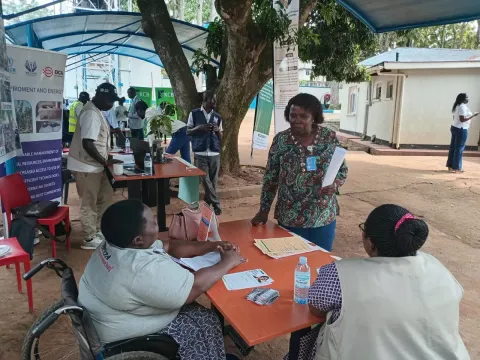
At the marketplace, an added programme initiative to bring CSOs closer to various potential funders and partners, John’s team made new partnership contacts, Sarah received a vocational skills training offer, and Muwala Asobola sold UGX 130,000 (US$34) worth of beads made by the girls they work with and was offered adolescent counselling by Naguru Teenage Information and Health Centre.
Muwala Asobola is also preparing to register on the United Nations Portal. Registration requires audited financial statements, which they had never bothered to have, Nalumansi says, because they assumed an organization their size “cannot belong up there.”
"Now we know that our work and our systems are what matter."