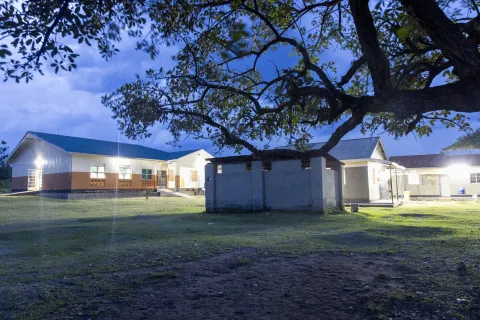
Medical workers in West Nile now manage chronic illnesses, COVID-19 with HDU equipment
High Dependency Units improving hospital emergency preparedness to handle critical cases

Pawo Acwera village in Nebbi District was stunned when one of theirs, Gladys Amia, was taken to hospital in critical condition.
Amia, 45, was pregnant for her eighth child when she suffered a throat irritation that morphed into a cough, then a fever that rendered her immobile.

“I was on the floor unable to move so I sent my daughter to call our Village Health Team (VHT) member. When he saw my state, he said we needed to get to the hospital immediately,”
Luckily, the VHT, Innocent Odaga had a motorcycle. Amia was whisked to Padwot Midyere HC III where, even without testing her, it was concluded that she had COVID-19. She was given a referral letter to Nebbi General Hospital, some 35 kilometres away.
Amia was stuck; she had no means of transport and had just found out she had the dreaded virus. The VHT also had second thoughts about helping her for fear of being infected.
“I thought of abandoning her and running for my life, but I knew she would die if I didn’t take her to the hospital as she was also heavily pregnant,” he says.
Odaga and Amia hit the road again to Nebbi General Hospital, where she confirmed her fears. She was positive for COVID-19.
“Due to the infectious nature of the virus, we couldn’t admit her to the High-Dependency Unit (HDU). Instead, we brought the HDU equipment to her isolation room,” said Peace Onen, the Hospital’s administrator.
After a few days of close treatment, Amia delivered a baby girl through an emergency C-Section and was discharged three days later.
When the UNICEF team visited her at home after five months, both Amia and her baby were in good health. She takes precautions to protect her family from COVID-19. She has a handwashing tippy-tap in the compound, stays mostly home and wears masks whenever she steps out. She has even received the first dose of the AstraZeneca vaccine.
Nebbi General Hospital is one of the nine hospitals in the West Nile region where the AVSI Foundation, with support from UNICEF through the Swedish International Development Cooperation Agency (SIDA), set up HDUs to improve the hospital’s emergency preparedness to handle critical mothers’ complications.
The other hospitals are Arua Regional Referral Hospital, Moyo General Hospital, Adjumani General Hospital, Koboko General Hospital, Maracha Hospital, Kuluva Hospital, Nyapea Hospital in Zombo district and Angal, St. Luke Hospital.

The sickle cell battle
Grace Edea, 32, has been battling sickle cell anaemia for as long as she can remember. Pregnant five times before but with no living child, the disease has taken everything from her.
She is now three months pregnant and has been a regular at Moyo General Hospital’s HDU since her initial referral from Metu Health Centre III, where she almost lost her life.
Edea was carried from home in critical condition. She does not remember much about that afternoon, but her husband, Robert Anyanzo, recalls that half her body was paralysed, and could neither walk nor talk.
“The ambulance picked her from Metu HC III; I followed them on my bicycle for 25 kilometres to Moyo General Hospital. I found her in the nice room, with tubes everywhere. The doctor told me she was put on oxygen to stabilise her. I was amazed to find a government hospital where nurses and doctors are available and do not ask for bribes to work,” he said.
When Anyanzo remembers how swollen his wife was while in the HDU and how she looks now, he gets renewed hope that the family’s firstborn is around the corner.
Embroiled in a similar battle is Joyce Diane who was admitted to Moyo General Hospital with a bad cough, but all COVID-19 tests were negative. According to Dr. Isaac Newton Ojok, Diane is 26 weeks pregnant and a high-risk mother because her previous three pregnancies have also yielded no live baby.
“We suspect she has severe pneumonia because her breathing difficulties are synonymous with the disease’s symptoms. But while we carry out further tests, we are keeping her on oxygen because the life of her foetus depends on its supply,” Ojok said.
While oxygen is not a resource Ojok’s hospital has plenty of, he is determined to do everything to save both the mother and her baby. He is confident that when Diane’s pregnancy gets to Week 28, he can deliver her baby and monitor it from the neonatal intensive care unit (NICU), which was also set up with support from UNICEF.