Kibumba goes beyond the braille bricks to enhance learners’ experiences
On every desk is a box with LEGO braille bricks. The learners wait in anticipation to learn to write the days of the week using braille bricks.

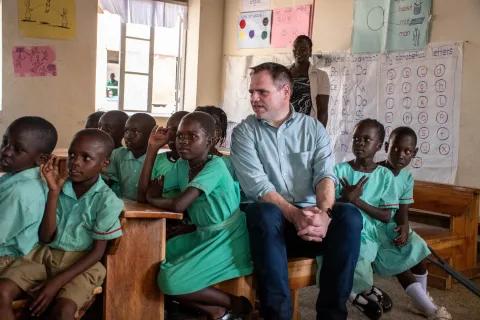
It is a typical weekday in the serene rural setting of Kiwolera Army Primary School in Kamuli District in eastern Uganda. The learners of Primary Two are settling down for the morning lesson. The subject – literacy. It is an inclusive class where the visually impaired sit and learn together with the sighted children.
“Today, we are going to learn the days of the week,” calls out their teacher, Faith Namukose.
They chant out the days one by one. Namukose then asks one of the visually impaired children to tell them what the first day of the week is. In this Primary Two class, there are three visually impaired children and Namukose is keen to choose them to participate in the lesson.
On every desk is a box with LEGO braille bricks. The learners wait in anticipation to learn to write the days of the week using braille bricks.
In the class, assisting Namukose is Jude Kibumba, a teacher who is partially visually impaired Before they get to use the braille bricks, Kibumba gets a braille cell made of wood. The wooden braille cell is a large slate with six holes in it. There are also balls made of clay that represent dots found on a braille brick. One of the balls is coarse with an indent while the others are smooth to help a visually impaired child know that it is different. This is an initiative he spearheaded, with the support of the school administration, as an innovative way to learn braille.
Kibumba is a teacher of Primary Two, Three and FourIn May 2023, Kibumba was privileged to be part of a training on the use of LEGO braille bricks in play-based learning. The training was sponsored by the LEGO Foundation in partnership with UNICEF, Ministry of Education and Sports, and Kyambogo University. Kiwolera Army Primary School was one of nine inclusive schools chosen to participate in the pilot project.
Kibumba asks Gabi to spell a letter using the braille cell. There is silence as he begins to work. When he is done, the sighted children next to him confirm that he has placed the bricks correctly to spell the word. There is applause.

“The braille cell is a way to improvise and enhance the learners’ skills,” says Kibumba. “After the training in May, we were challenged to take our knowledge of braille bricks further. So, we came up with this portable, wooden braille cell.”
He says it is a way to involve all the children in the learning process, unlike before, when there was a separation of the visually impaired children from their sighted peers.
“It is exciting to see the teachers’ competencies, for example with the innovation of the braille cell in helping learners conceptualise the use of braille,” says Esther Akwii, an education officer and focal person on inclusive education with UNICEF Uganda.
It is now time to use the braille bricks. Excited chatter fills the classroom as the learners begin to form letters and words using the braille bricks. Unless one knows for sure, it is hard to tell that there are visually impaired children in the class.
“The sighted children help the visually impaired children because they can see the small print of letters and numbers on the brick,” says Kibumba.
He adds that the inclusive learning setting has improved the learners’ experiences.
“There is gradual change in the performance of the children, especially in numeracy,” he says. “Learning to use braille bricks also helped me find new ways to work with foundational learners.”
There is also a change in the behaviour and attitude towards children with visual impairments. “Now, the children with sight can see that their friends have as much potential as them,” he says.
A point the head teacher of the school, Juliet Namulondo, reiterates, “Before, it seemed that the sighted children did not want to interact with their friends. Now, you see the children working together, we give them tasks and they are able to help each other, improving the social skills interaction.”
“The inclusive setting lessens the stigma and encourages sighted children to realize the potential of the visually impaired children,” says Akwii.
While Kibumba experiences some challenges, for example, sometimes finding it hard to accurately assess an individual learner within the group tasks, he is optimistic that with continuous training, practice and change of attitude, learners with visual impairment have a bright future.