Beneficiaries of cash plus programme in northern Uganda get second chance to stay in school.
“If UNICEF and the European Union were not here to support us, my granddaughter would not be in school because I am old as you can see me. I do not work. I am unable to afford the fees or buy everything she needs for her school.”

By 7 a.m. on 6 August 2025, parents and guardians of beneficiaries of the European Union, Germany and Belgium governments co-funded Cash Plus Initiative had arrived at Padibe Girls Comprehensive Secondary School in Lamwo District.
The parents and guardians were at the school to join their adolescent girls as they received the second disbursement of the cash transfer implemented under the Gender for Development Uganda (G4DU) Programme that was launched by the European Union in 2023 to address several barriers to education among the most vulnerable adolescent girls in West Nile, Acholi, and Lango sub-regions.
The majority of the benefiting girls, all in Senior One (S.1), clad in blue t-shirts tucked in navy blue long skirts patiently waited for their turn to undergo the processes including verification of details alongside their parents, guardians or caregivers up to the last stage of receiving the cash.
“We have come here to receive support that will see my daughter stay in school. My wife and I are weak. I always emphasize that the future of the girl child is education. In the old days, fewer girls attained education. Right now, girls can do anything boys do. They are all equal. I really appreciate UNICEF and the donors that have given us this rare opportunity to keep our girls in school."

In her own words, Linda, who smiled throughout the interview, could not hide her excitement. According to her, UNICEF is a saviour. “Without UNICEF and the donors (European Union, Germany and Belgium governments) that have given us this money and mentorship sessions, I would be at home now.”
Franka, who walks eight kilometres every day to and from Padibe Girls Comprehensive Secondary School was excited too.
“Part of the money I receive is for my fees. I use the remaining money to buy key essential items. Not many girls can afford these materials. I am happy and grateful to be part of this programme,” says Franka standing beside her 80-year-old grandmother, Aber Jenny.
“If UNICEF and its partners were not here to support us, my granddaughter would not be in school because I am old as you can see me. I do not work. I am unable to afford the fees or buy everything she needs for her school,” reveals Aber.
UNICEF aims to improve inclusive access and participation in schools for adolescent girls, including their transition to and retention in lower secondary level.

Led by the Ministry of Education and Sports, the Cash Plus Programme developed through a co-creative process will benefit 5,000 adolescent girls in seven districts in West Nile, Acholi and Lango sub regions (Adjumani, Yumbe, Nebbi, Kitgum, Madi-Okollo, Oyam and Lamwo districts) from Senior one (S.1) – Senior four (S.4) for a period of four years.
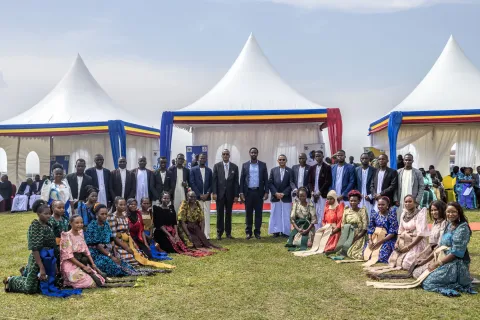
At Padibe Comprehensive and Lokung Secondary Schools, UNICEF Representative to Uganda Dr. Robin Nandy and Rosette Nanyanzi from the Ministry of Education and Sports witnessed the disbursement of funds and handed over certificates to the girls benefiting from the programme.
Nandy interacted with the beneficiaries, their parents/guardians/caregivers and passed on words of encouragement as a father.
“Please take care of yourselves. You are responsible for your own future, your protection. Education is going to help you as you grow up. So, stay in school. It is a safe space. You will have time to do everything later, like going to work, getting married. It is not the right time now."

Before receiving their certificates, the girls at Padibe unanimously mentioned five examples of trouble that they need to stay away from to remain in school. These are: early child marriage, pregnancy, poverty, peer pressure/bad influence, dropping out of school.
At Lokung Secondary School, Robert Ochola the Board Chair briefed a team from UNICEF, Ministry of Education and Sports and Trailblazers Mentoring Foundation (TMF) about the progress and some challenges of the programme. TMF is a UNICEF partner supporting the implementation of the programme in the targeted secondary schools.
“This programme has accelerated enrolment, retention, and reduced school dropouts. All the children registered in the school as beneficiaries returned for second term lessons apart from three who re-located to nearer schools,” Ochala reveals. He requested to have eighteen vulnerable girls in the school benefit from the programme too. Ochola also called for increased parental engagement to change their mindset regarding the cash transfers they receive. “They think the money is to help them meet other domestic needs. When some parents receive the money, they walk away without paying the school fees,” he further reveals.
To address this challenge, UNICEF, TMF and partners involved in the implementation have devised means to ensure that school bursars are available on the pay day to receive the school fees as soon as the learners and their parents/guardians receive the money.
Nandy appealed to the parents and guardians to do “everything you can to keep your girls in school.” He pledged UNICEF’s continued support together with other partners but reminded them of their primary obligation, to take care of their children.

Rosette Nanyanzi, from the Ministry of Education and Sports congratulated the board of Lokung Secondary School for their involvement in the programme and the affairs of the school. Nanyanzi took note of the challenges raised by the board chair Robert Ochola including increased enrolment amidst limited school infrastructure and teachers, menstrual hygiene management. She advised the school administration to write to the Permanent Secretary in the Ministry of Education and Sports to follow up their request of including more teachers on the payroll.
Regarding infrastructure and WASH (water, sanitation, and hygiene) facilities for girls in the school, Nanyanzi explained that since the school is also benefiting from a World Bank funded programme, there is hope that these facilities shall be provided. On the menstrual hygiene management, Nanyanzi explained that the ministry will explore collaborations with other partners to deal with the issue which affects several schools across the country.
The Cash Plus Programme does not operate in isolation, but is part of a broader education initiative, of the G4DU interventions implemented by other partners, particularly Enabel, Spotlight Initiative and KfW. To complement the cash support, the programme specifically delivers two critical plus interventions delivered through TMF. These include peer-to-peer mentorship and referral to services in the areas of health and protection.
As beneficiaries and their parents/guardians lined up at Lokung Secondary School to clear their school fees after receiving the second disbursement, it was clear that this support is making a difference in the lives of the most vulnerable girls.
Irene Anioo, 18, a beneficiary at Lokung says she is happy to continue receiving the money because she can stay in school. Her dream is to study hard to become a nurse to “help her family and country.”