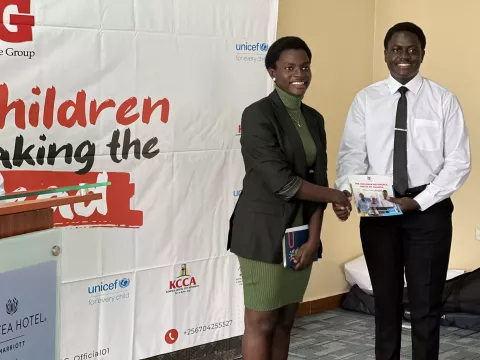
Adolescents launch campaign to support peer mothers to return to school
Peer mothers share their return to school experience

“Being a child mother has been a very hard thing for me to bear that I wouldn’t wish on any other girl. The father of my child, who is also a teenager, would beat me up every day. I am glad that I have the opportunity to return to school. As a peer advocate, I will use my experience as a teenage mother in school to encourage adolescents not to fall into the same trap that I did. In my community, I am encouraging fellow girls like me who have gotten pregnant and given birth, to go back to school,”
It all began in April 2022 and progressed to July, when campaigns were launched with the goal of social and behaviour change. The intent was to involve adolescents in taking centre stage in influencing their communities and leaders to create a more enabling environment for their fellow adolescent girls, especially those who are pregnant or mothers.
For six weeks between July and August 2022, 540 adolescents from 10 districts in the Karamoja, Tooro, Bunyoro and Buganda sub regions, alongside their district local government leadership and in partnership with UNICEF, launched a six-month campaign dubbed: “Protect the Girl, Save the Nation.” The community-level campaign is aimed at encouraging adolescents who dropped out of school due to teenage pregnancy to return to school or pursue alternative learning pathways after giving birth. A United Nations Population Fund (2021) study shows that over 32,000 teenage pregnancies were recorded monthly during the long 2020/21 school break induced by the COVID-19 pandemic.

The adolescent-led journey to address the challenge of teenage pregnancy started on 3 December 2021, when National Goodwill Ambassador for adolescents, Honourable Janet Kataaha Museveni, who is also the First Lady and Minister of Education and Sports, launched the national campaign. Alongside her was the Vice President, Her Excellency Jessica Alupo, and Prime Minister Right Honourable Robinah Nabbanja.
The initiative was a result of meetings between government and civil society officials that discussed the prevention and management of a spike in defilement, child marriage, and teenage pregnancy. The decision to have adolescents take ownership and actively engage in providing solutions culminated in a participatory strategic process that began in April.
Adolescents were involved in various stages of research, planning, and development of key campaign messages. This was followed by the systematic community-level identification of adolescents who could serve as volunteer advocates. They were subsequently orientated on child rights, volunteerism, peer education, advocacy and the value of education.
As a mother and minister responsible for the education of children in Uganda, I feel that the current situation of increased cases of defilement, child marriages, teenage pregnancies and failed parenthood in the last two years is alarming,”
“I want to applaud the Government of the Republic of Uganda for allowing teenagers that are pregnant and mothers to go back to school. This shows a level of commitment and as leaders we all need to offer support by lobbying Parliament for the re-enrollment of all teenage mothers,”
Of the 14 districts implementing the campaign, 10 — Mubende, Kasese, Kyegegwa, Kikuube, Kamwenge and Isingiro in the Western region, and Kaabong, Abim, Moroto, Amudat in the Karamoja sub-region — participated in the July campaign launch.
Each of the 10 districts’ cohort of volunteers led the campaign launch in a selected town centre by mobilizing other adolescents, leaders and caregivers to join them in marching around the towns, marketplaces and communities while displaying key advocacy messages for the re-entry of pregnant girls and child mothers in school. The social mobilization drive in the communities, which was preceded by home visits, radio, and church announcements, was followed by a gathering of the masses at a central town location.
The peer advocates, all of them volunteers, at the campaign launch venues passed on more behaviour change and advocacy messages to community members, leaders, caregivers, health workers, and teachers to rally their support in ensuring that all adolescents complete school, protected from teenage pregnancy and supported to reenroll in the event they get pregnant and give birth.
They used drama, music, poetry, speeches, and testimonies from child mothers, and sports events, such as football and netball matches, to attract more young people to the cause. The Karamoja sub region launch alone involved 1,502 stakeholders who included the Woman Member of Parliament for Kaabong, Resident District Commissioners, Chief Administrative Officers, Local Council V Chairpersons, District Education Officers, District Health Officers and District Community Development Officers. Also present were the Police Child and Family Protection Unit, Local Council III Chairpersons, Village Health Teams, Savings and Credit Cooperative Societies, Community Development Officers, Civil Society Organizations, religious leaders, cultural leaders, parents, guardians, caregivers and community members.
Alongside them were the 2278 adolescents, present to hear the promises renewed and commitments made and to contribute to the discussion of the day, seeking to be heard and helped to realize their productive future.
"On behalf of the Government of Uganda, I reiterate support towards the campaign and rallied all government structures to contribute to ending harmful practices. Religious leaders, the Judiciary, ministers, members of Parliament, district leaders, resident district commissioners, police, local council and all leaders, it is your duty and responsibility together with government to protect and save ‘our girls’ and to create an environment in which they can grow and explore their full potential,"
During the 10 district launches, the Deputy Resident District Commissioner of Abim, Mr. Fardosa Ahamed; the representative of the Chief Administrative Officer (CAO), Mr. Hannington Atugonza and Ms. Rebecca Kwagala, the Chief of UNICEF’s Moroto Zonal Office, which supports the Karamoja and Sebei sub-regions, made calls to action. They urged school directors, community, religious and cultural leaders and other stakeholders to support the re-entry process at the grass root level. They also pledged to commit more resources to protect girls from all forms of violence that impede them from maximizing their potential.
The district and community leaders made commitments to popularize existing policies, guidelines and by-laws in line with the campaign messages, that would protect and provide for adolescents that drop out of school and get pregnant and give birth. They also urged the adolescents to avoid risky behaviour, choose to be part of progressive peer groups, seek support and stay in school until they achieve the highest level of education. The launches were crowned with key stakeholders signing commitments on community boards provided by the adolescents as accountability tools.
These launches marked the first part of the countrywide community-based interpersonal efforts to prevent and manage teenage pregnancy in Uganda following the surge in the number of teenage mothers last year. To date, the volunteers are utilizing their free time to speak to their peers, refer them for services and seek support from leaders. The campaign shall be complemented by mass media and national-level advocacy efforts spearheaded by Honourable Janet Kataaha Museveni.
“Being picked as a peer advocate has motivated me to go back to school. I wanted to be an example to other pregnant girls and child mothers that it’s not too late to go back to school, I want to show them that you can start school again even when you are pregnant or after giving birth, so they should take the second chance. Now that I Am back to school, I will study very hard to become a nurse because in our health centers I don’t see anyone who is a Pokot working there,"
It is anticipated that through the peer-to-peer creation of awareness for action and the change approach used, each of the adolescent advocates and district leaders shall engage between 30 and 50 peers in their communities. At least 27,000 adolescents and 9,000 community stakeholders are expected to be reached in the six-month period.
The end result is to ensure that not less than 400 child mothers and out-of-school adolescents return to school in the 29 focus districts. This, will, in turn, have a ripple effect on the rest of the country. More teenagers that are pregnant and mothers, alongside their parents, guardians and community leaders, are expected to be reached with the goal of their return to and retention in school or enrolment in a life skilling venture. It is hoped that this will be realized when the districts in the northwestern and northern regions join the campaign trail next month.