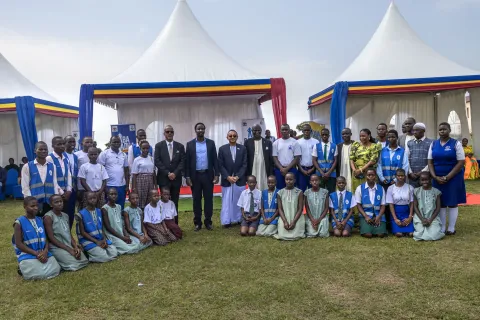
World Children's Day Media Round Table: Reimagining the Future of Learning
Statement attributable to Mr. Shadrack Omol, UNICEF Uganda Representative a.i.

You, children, are the reason we are gathered here today – to celebrate World Children’s Day, a day of action for children, by children. This month we also celebrate the (31st) anniversary of the Convention on the Rights of the Child, a treaty that explains who you are and what your rights are.
Now in its fourth year, World Children’s Day 2020 is taking place under very different circumstances due to the coronavirus pandemic. One of the most unique and challenging moments in our history, this health crisis may become a child-rights crisis without urgent action. Disruptions to Ugandan society have a heavy impact on you – our children: on your safety, your well-being, your future, and your rights. COVID-related school closures, for instance, have affected over 15 million children in Uganda alone, with devastating consequences across the country.
Therefore, under the theme ‘Reimagining the Future of Learning’ we wish to raise awareness and amplify the voices of young people speaking out on the impact of COVID-19 on education, while highlighting short-term and longer-terms solutions for learning, to commemorate this special day.
Under our COVID-19 ‘Reimagine’ campaign, UNICEF calls on government, partners, and businesses to imagine a Uganda where the rights of all children are fulfilled. Building a better post-pandemic world will be a first step towards making that imagination a reality. It also calls on children and young people—you (point towards the children)—and that’s where World Children’s Day comes in. The coronavirus pandemic has laid bare the deep inequalities in our societies that leave some children at far greater risk than others. At this critical moment in history, millions of children in Uganda are missing out on basic healthcare and are cut off from education.
Marginalized children pay the heaviest price as inequalities in learning widen. Many young people, including yourselves most likely, may not have access to mobile networks, the internet, radio, or newspapers for remote learning.
I wish to congratulate the Ugandan Government for its bold steps to prioritize the reopening of schools for candidate classes, while taking all possible measures to do so safely. I also wish to thank the private sector for their valuable contributions to the COVID-19 response. While schools are scheduled to reopen for all students early 2021, we must do more to ensure that all children have equal access to quality learning.
You, the children, have a unique and unparalleled ability to reimagine a more equal, just, and sustainable Uganda. With this in mind, for our World Children’s Day commemorations, we will listen to how you and other young people want to reimagine the future. We will highlight your dreams, your questions and solutions, and amplify your voices speaking out on how we—all of us together today—can reimagine the future of learning.
Ladies and Gentlemen, and dear children,
We have all asked what has to be done to respond and recover. The main questions is: What if?
What if we seize this opportunity to reimagine new ways of learning? To revolutionize education and leapfrog into the future?
What if we finally bridge the digital divide and scale up world-class digital learning solutions? To give every child, including the most marginalized, equal access to quality education?
It can be done, and we are determined to do it.
First, to modernize education, we must build the foundational, job-specific, and entrepreneurial skills that young people need for work, including digital skills.
Second, we need individualized content and digital platforms, learning that is tailored to each child, including those with disabilities and in refugee settings, providing what they want and need to learn in languages that they understand.
Third, we need to reach every child, wherever they are. This means more hybrid solutions to learning, maintaining low-tech and no-tech options even while we rapidly scale-up digital learning solutions.
And finally, we need leadership from the government and help from all stakeholders at all levels. Unlocking change at this scale will take collaboration and creativity. UNICEF is now working with public- and private-sector partners worldwide to disrupt education and achieve this ambitious vision—a bold idea that could be the great equalizer in education, making it possible for every child and young person to reach their full potential.
Join us in asking ‘what if?”
I thank you.
###
Media contacts
About UNICEF
UNICEF promotes the rights and wellbeing of every child, in everything we do. Together with our partners, we work in 190 countries and territories to translate that commitment into practical action, focusing special effort on reaching the most vulnerable and excluded children, to the benefit of all children, everywhere.
For more information about UNICEF and its work for children, visit www.unicef.org/uganda