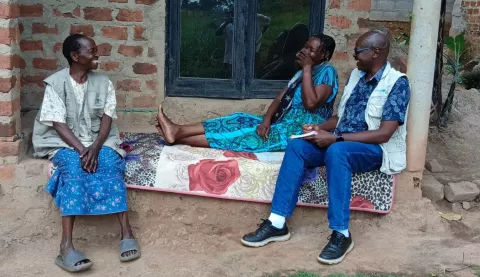
Get the facts right. Trusted information is critical to keep you and your family healthy and safe from COVID-19
Op-ed by Catherine Ntabadde, Communication Specialist, UNICEF

The Coronavirus pandemic is not the only crisis the world is fighting. A second epidemic that broke out at the same time as COVID-19, poses a related and deadly peril.
‘A global misinfo-demic is spreading,’ the UN Secretary General António Guterres warned at a recent public briefing. Rumours, misinformation and conspiracy theories have flourished on social media and WhatsApp over the past months, touting unproven claims about the origins, transmission, and cure for the Coronavirus disease.
These rumours have also spread in Uganda. In March, a document was widely circulated on social media and via WhatsApp; it claimed that exposure to the sun and washing clothes would kill the Coronavirus. It also purported that the virus was large in size and not airborne, thus any mask would prevent entry through the nose and mouth.
With over 6 million cases of COVID-19 infection already reported globally, can such reports cause any more damage?
Misinformation can have a profound effect on public health measures being instituted to stop the spread of the disease leading to non-compliance with recommended guidelines.
Rumours and conspiracy theories have been known to hamper response to Ebola outbreaks in West Africa and the neighbouring Democratic Republic of Congo.
In Uganda during the 2019 mass immunization against Measles and Rubella and recently during the 2020 Africa Vaccination Week, there was a lot of debate on social media as many individuals offered their opinions, shared conspiracies about immunization. So, what can be done to effectively respond to such rumours and misinformation during health outbreaks like the on-going COVID-19 pandemic?
Alongside the medicine and science deployed to fight COVID-19, risk communication is one of the oldest and most reliable pillars of public health, which informs people of the risks of a public emergency and how to protect themselves. Risk communication is arguably the most cost-effective response to a public health emergency.
Even as the Government of Uganda eases the lockdown measures instituted in March, the coming months present an even more urgent need to accelerate the dissemination of factual information that will prevent undue exposure and a possible new spate of infections.
To promote facts over fear, UNICEF is working with the Ministry of Health to provide trustworthy guidance to children, their parents, caregivers and educators through nearly three million information, education and communication materials, audio mobile vans, social media platforms, radio and television programs in 30 local languages.
With combined efforts, UNICEF together with the Ministry of Health and World Health Organization, have utilized a mix of channels to reach audiences across the country through different platforms with timely information about COVID-19, its origin, how it spread, who is at risk, what the symptoms are, how to manage someone with COVID-19 at home, information on whether there is a vaccine or not and how COVID-19 is treated.
As this information is disseminated regularly, Uganda has managed to reduce the spread of false information about COVID-19. We therefore should not relax. In every emergency, information is critical, but of equal importance is community response.
It is our individual and communal responsibility to fight COVID-19, not only by wearing protective equipment, washing hands with soap and clean water and following the government directives, but also seeking and sharing only credible and factual information from reliable sources.
Before you hit send or share with others, ask yourself this question: Is the information in my possession fueling discrimination and stigma, is it promoting or fighting the spread of COVID-19? Is it accurate, reliable, proven and from a trusted source?
UNICEF is committed to providing accurate information to ensure safety for every child and their families.
So, let us remember to continue to regularly wash our hands with soap and water, wear face masks when we are out in public, keep a distance of at least 2 meters (6 feet) from another person and adhere to the guidelines issued by the Government of Uganda
Collectively we need to act now, join forces and curb misinformation. We are in this crisis together.
Media contacts
About UNICEF
UNICEF promotes the rights and wellbeing of every child, in everything we do. Together with our partners, we work in 190 countries and territories to translate that commitment into practical action, focusing special effort on reaching the most vulnerable and excluded children, to the benefit of all children, everywhere.
For more information about UNICEF and its work for children, visit www.unicef.org/uganda