Promoting menstrual hygiene management through provision of toilets
Creating safe, hygienic and private spaces for girls to freely manage their menstruation

Manufahi, 23 August 2024 - Menstrual hygiene as a practice is important for every woman to learn, especially young girls. For girls who have either begun menstruating or are about to, it is essential that they have the assurance that they will be able to properly take care of themselves during the days of menstruation. However, in Timor-Leste, lack of appropriate toilet facilities at schools, often makes it difficult for young girls manage their menstruation in a safe, healthy, and hygienic manner.
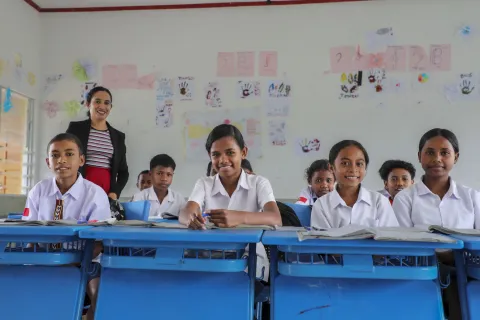
The same can be said for young Berta, who at only 12 years old, is aware that she will soon start menstruating. She goes to EBF Freik Sare school in Manufahi municipality and lives close to her school. Despite the fact she has not begun menstruating, Berta is already apprehensive about what menstruation would mean for her as a girl and how to manage this process, which older girls have told her is painful, uncomfortable and often requires one to spend days away from school so that they manage their period in the privacy of their homes.
“I have heard about menstruation, but my family calls it “monthly coming”, and they will not really describe what it is. People usually talk about it when it happens, and you only find out how to deal with it once it starts,” says Berta, who says her friends experience a lot of discomfort, shyness and absenteeism from school during the “monthly coming,” because it is not easy to manage this natural process in the absence of a safe and secure toilet at the school.
In Timor-Leste lack of basic services such as toilets and sanitary products is a major barrier to the safe and hygienic management of menstruation by female students. More than 46 per cent of schools do not have separate toilets, meaning girls and boys are expected to share the toilet facilities.
In addition, menstruation is still considered a “taboo” topic for many families and the costs of commercial pads is often prohibitive for many. This means that girls like Berta often are not prepared for their menstruation and may begin practicing poor menstrual hygiene. For Many young girls, education on menstruation may only happen once menstruation has started and is often based on myths and taboos which have been inherited from previous generations.
Berta and her friends highlight that they have been told not to wash hair during menstruation and that they should not stand close to boys during this period, or this will increase the flow of menstruation blood.
And, because menstruation begins at different stages of a young girl’s development, some girls may feel alone in their struggles with menstruation when it does come.
However, things are beginning to change for menstrual hygiene and health in Timor-Leste. Berta’s school is among those that have new toilet facilities, where she and 145 other girls will benefit. These have been built with the assistance of the Government of Japan and are at the frontline of providing a safe environment for young girls’ health. The facilities are built with accessible entrances for people with disability and include private cabinets for girls to store sanitary products.
Berta said that “We used to have only two toilets. This meant very long queues waiting to use the bathroom, and as girls we didn’t feel as safe. We also never used to have handwashing sinks.” Together with the other --- girls at the school, Berta is excited that her school has proper sanitary facilities now, which will assist them in practicing proper hygiene in school.

“The new toilets make us, as girls, feel much safer. As part of our routine activities, we clean our toilet and the boys also get to clean their own toilets”, said Berta.

The Timor-Leste Ministry of Education, with support from UNICEF, has created booklets, aimed at girls like Berta, focused on giving essential information about menstrual hygiene, what to expect with the first menarche and how to safely dispose of menstrual pads. It is aimed at breaking down stigmas around menstruation in Timor-Leste. The booklet also encourages girls to not feel ashamed or scared of menstruation, as it is something everyone goes through.
Rather, Berta and her friends are already encouraging other girls in their class who have already begun menstruating. “We all will go through menstruation, so there’s no reason to be shy!”, is what Berta and her friends all said. They hope that with this new information booklet, further training from their school, and their safe toilet facilities will ensure that all girls can go through their journey with menstruation.
With thanks to the Government of Japan, girls like Berta and her friends are happy that they now have a chance to get on top of managing their menstruation in a safe, healthy, and hygienic manner. This ensures a continued access to quality education and access to safe, hygienic spaces for all young girls in schools.
###Ends