Youth Skills Day
Flexible pathways help build the skills and competencies of out-of-school adolescents

At 18, Floriana felt her dreams slipping away. After disappointing Form IV results, she stayed home, dependent on others and uncertain about her future. Today, she’s a thriving entrepreneur, running her own “events services” business, and mentoring youth in her community.
Her turning point came when she joined the Integrated Programme for Out-of-School Adolescents (IPOSA), a government initiative supported by UNICEF that offers a second chance to young people who missed out on formal education.
“IPOSA changed how I see myself. I used to feel like a failure. Now, I’m a businesswoman,” Floriana says.
Launched in 2019 by Tanzania’s Ministry of Education, Science and Technology, with support from UNICEF through the generous support from the Global Affairs Canada, IPOSA (and its Zanzibar counterpart, ZIPOSA) has reached over 80,000 adolescents, 68 percent of whom are girls. These are youth who never attended school, dropped out, or were unable to transition to secondary education. Through a blend of literacy, life skills, entrepreneurship, and vocational training, the programme is transforming thousands of young girls’ and boys’ lives.
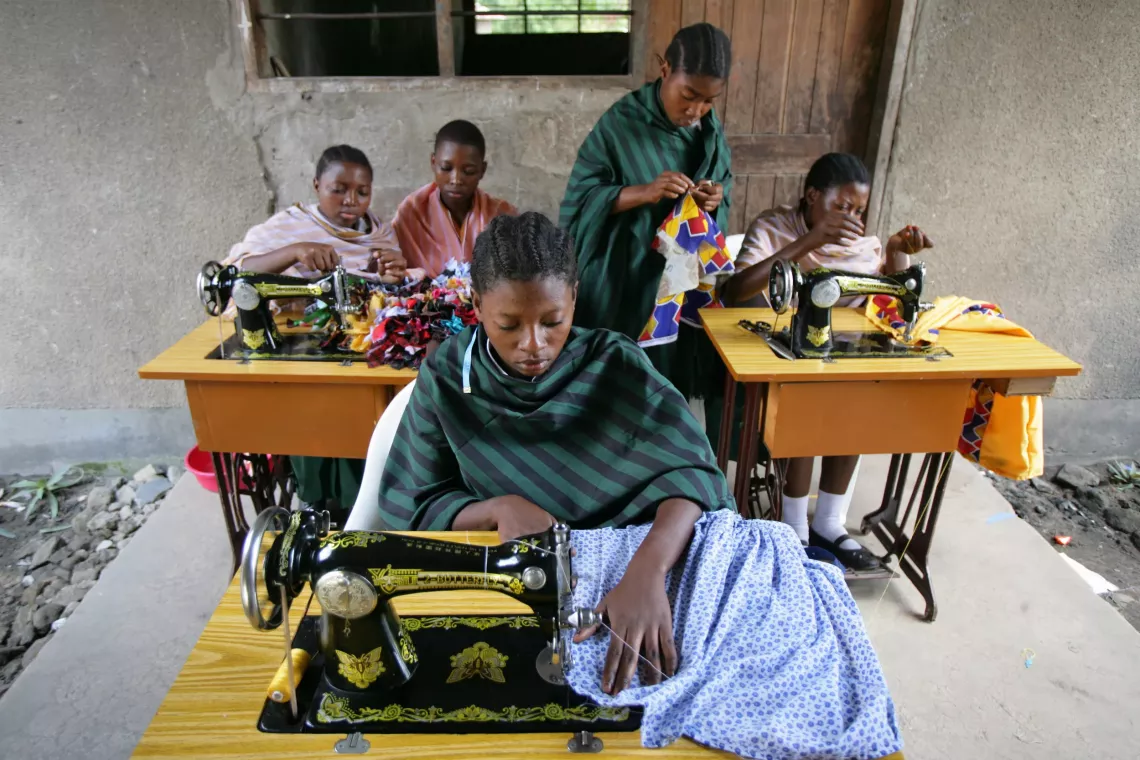
Floriana being one of the beneficiaries of the programme, was trained in tailoring, decoration, and cookery while also gaining life and business skills. These didn’t just help her earn an income, but they reshaped her identity.
Today, she earns most of her income by decorating and catering for events. She’s also building a supply chain by raising poultry and growing vegetables and uses her tailoring skills to save money by sewing clothes at home.
“I want to grow my business and help others grow too. That’s why I take on apprentices—I want other youth to learn what I’ve learned,” she says.
IPOSA’s flexible 6–18 months curriculum meets learners where they are—whether it’s teaching basic numeracy to a 15-year-old or equipping a teenage mother with vocational skills. It’s inclusive, empowering, and future-focused.
As Tanzania moves toward Vision 2050, which envisions a skilled and empowered generation, Floriana is proof that with the proper support, setbacks can become stepping stones for the youths of Tanzania who are entering the labour market.

According to the 2022 Census, in Tanzania, youths aged 15–24 make up 19 per cent of the population, with 9 million adolescents aged 13–19. Yet employment opportunities remain limited. The 2021 Five-Year Development Plan estimated that 1 million youth enter the labor market annually, but only 200,000 find jobs, making entrepreneurship a vital path forward.
“I’m not just working for myself! I’m building something that helps my family, my apprentices, and my community,” Floriana says.
Since 2019, IPOSA has expanded from six to 21 regions across mainland Tanzania and Zanzibar, with over 150 learning centers. The programme has exceeded its original target of 10,000 youth by 2025 reaching 18,000 by 2022 alone. Today, over 70 per cent of IPOSA graduates are employed or self-employed, a testament to the program’s real-world impact.
UNICEF, with support from Global Affairs Canada and other partners, is now equipping centers with digital learning tools, preparing youth for a future shaped by technology and innovation.