“But You’re Just a Girl”
How a 20-Year-Old Girl Opened a Language Center in Rural Tajikistan

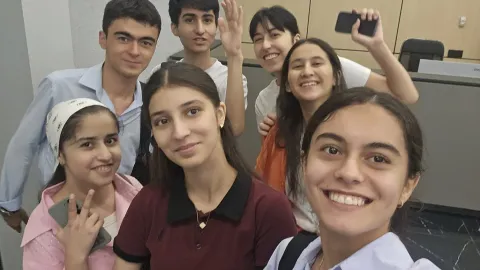
When Zebuniso was 17, she started an English club in her home village for primary school children. She wanted them to learn a foreign language with enthusiasm through interactive lessons, communication and practical activities. At the time, she had no idea how significant that decision would become. Today, at 20, she runs her own language center, where children and teenagers can study foreign languages and develop modern skills.
“I grew up in a rural area in northern Tajikistan and saw talented girls stop studying after finishing school. Often, it was because there was no one nearby to support them. Their parents might say, ‘You don’t need that.’ I wanted to help these girls find a path towards better opportunities,” she says.
For Zebuniso, the language center became a way to share her knowledge and give other children access to things that can be difficult to find in rural communities: learning opportunities, support and confidence in their own abilities.
At the beginning, her biggest challenge was convincing people that, at just 17, she could independently organize classes and take responsibility for her students’ progress.

UNICEF/Tajikistan/Shukrona Mirzoeva

UNICEF/Tajikistan/Shukrona Mirzoeva
“People doubted my abilities because I was so young. But after the first year, when they saw how much my students had achieved, their attitudes began to change. My father was a great source of support,” she recalls.
Her participation in UNICEF’s Young People’s Advisory Group (YPAG) also played an important role in her personal development. Starting as a group member, Zebuniso gradually became more actively involved in consultations and events, bringing forward the views and interests of girls from rural communities. Being part of YPAG helped her build self-confidence, strengthen her communication skills and learn how to share her ideas with different audiences.
In 2026, during the celebration of International Day of the Girl Child, she addressed representatives of government institutions, the private sector and international organizations. She shared ideas on how to expand the participation of girls from remote areas in decisions that affect their lives and create more opportunities for them. Today, Zebuniso has become a YPAG mentor herself, supporting new group members and helping them develop their skills and express their views with greater confidence.

Her story unfolds against the backdrop of a wider challenge. According to the 2025 Labor Force Survey, 712,900 young people aged 15–29 in Tajikistan were not in employment, education or training, accounting for 28.4 per cent of all young people in this age group. Nearly 78 per cent of them were women. Among all women aged 15–29, 45 per cent were not in employment or education. Behind these figures are different circumstances: limited access to education and employment, family responsibilities, early marriage and societal expectations. For girls in rural areas, their educational and career choices may also depend on whether they have people around them who support their aspirations.
One day, a mother brought her daughter to the center and shared with Zebuniso what she hoped for her child.
“She said, ‘I have only one daughter, and I want her to become as active in society as you are, so that both my son and my daughter can find their place in life.’ Hearing those words, I realized that I had chosen the right path,” Zebuniso recalls.
For her, the results of education can also be seen in the way her students change. She has noticed that girls become more confident, express their thoughts more freely and participate more actively in lessons. Education helps them see more possibilities for their lives and make decisions based on their knowledge and skills.
She believes that when a girl has the opportunity to study, learn languages, acquire professional skills and eventually earn her own income, she gains greater independence in choosing her path.

“I want girls to have a choice”
Zebuniso believes that social attitudes are among the main barriers facing many girls. She has often heard the phrase “But you’re a girl” used to explain why certain opportunities are supposedly out of their reach.
“Sometimes the obstacle is not even the lack of internet access or a computer. It is society’s attitudes and the words that a girl gradually begins to believe,” she says.
In her view, family support starts with simple but meaningful actions: giving a daughter the opportunity to study, providing access to learning materials and the internet, helping her find a mentor and telling her: “My dear, I believe in you, and I will always be by your side.”
Zebuniso wants parents to see their daughters as individuals with their own abilities, interests and goals. She wants girls in rural communities to be able to dream of a profession, continue their education and choose their own path in life.
“I want to see a Tajikistan where rural girls are asked not, ‘When are you getting married?’ but ‘What profession have you chosen?’”
For Zebuniso, the language center is a way to give girls something they may often lack: belief in their own abilities and the confidence to dream bigger.
When girls have access to education and support to develop their potential, they, their families and society as a whole benefit. Creating these opportunities is a shared responsibility of parents, communities, educational institutions and the Government. Every girl deserves the chance to become who she dreams of being, regardless of where her story begins.