Restoring Care in the Highlands
How a Remote Hospital in Murghab is Transforming Health Services for Thousands

Within six hour ride from Khorog, in the high-altitude district of Murghab, where winters are long and distances vast, access to quality healthcare has long been a challenge. For the more than 17,000 people who live here, over 6,000 of them children, the Central District Hospital is not just a medical facility; it is a lifeline.
For pediatrician Mamadumarov Samiddin, the hospital has been both a workplace and a witness to change over the past 13 years.
“I have been working here for 13 years,” he says. “Previously, the pediatric department still had renovations dating back to the Soviet era.”
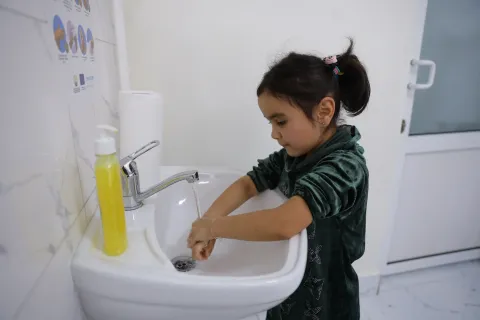
The aging infrastructure, combined with limited access to safe water and sanitation, made delivering care difficult. Across Tajikistan, only 36 per cent of healthcare facilities had access to basic water services, and just 1 per cent met basic sanitation standards. Handwashing stations with soap were available in only 12 per cent of facilities, leaving both patients and healthcare workers vulnerable to infection.
But today, things look very different in Murghab.

UNICEF/Tajikistan/Manucher Ruziev

UNICEF/Tajikistan/Manucher Ruziev
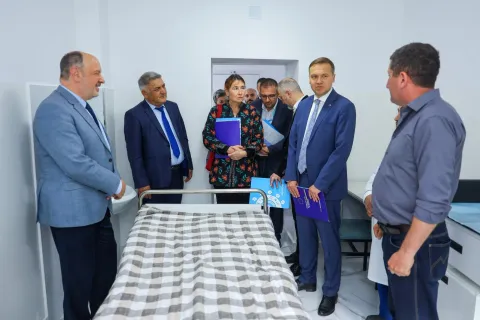
“Recently, with the support of UNICEF, the European Union, and the Ministry of Health and Social Protection of Population, better conditions were created for our hospital,” says Dr. Samiddin. “The pediatric department underwent a complete renovation. Now it has become much easier for us to work.”
Within the framework of the European Union-funded Health Development Program, UNICEF Tajikistan, in partnership with the Ministry of Health and Social Protection of the Population, carried out a major modernization of the Central District Hospital. The pediatric and surgical departments were fully renovated, transforming the environment where care is delivered.
Every room is now equipped with hot water and water heaters-something that was once unimaginable in this remote setting. Clean water supply systems, improved sanitation, and hygiene facilities ensure safer conditions for both patients and staff. New medical equipment and modern furniture have also improved diagnostics and patient comfort, while the renovated kitchen, laundry, and sterilization unit strengthen infection prevention and control.
A critical addition to the hospital is the newly installed oxygen generation station, which has transformed emergency and inpatient care. Previously, the hospital relied on transported oxygen cylinders, a costly and unreliable solution in such a remote mountainous area, where deliveries could be delayed for days. Now, the on-site station produces medical-grade oxygen continuously and supplies it directly towards through a central pipeline. This ensures immediate access for patients in need, especially newborns and children with respiratory illnesses, reducing response times and saving lives.


Equally important is the introduction of an improved healthcare waste management system, including a dedicated facility equipped with a modern incinerator. In the past, safe disposal of medical waste was a major challenge, increasing risks for health workers, patients, and the surrounding community. Today, waste is properly segregated and safely treated on site. Hazardous materials such as used syringes and contaminated supplies are securely destroyed, protecting both people and the environment while creating a cleaner, safer workplace.
In Murghab, the impact is already visible, not only for doctors, but also for patients like Mavlyuda, a mother who recently brought her child for treatment.
“Before, it was very difficult,” she recalls. “There was no hot water, and the conditions were not comfortable for children. Now everything is clean, warm, and safe. I feel more confident bringing my child here, and I am grateful for these changes.”

These improvements are part of a broader effort. Between 2021 and 2025, UNICEF Tajikistan implemented a €30 million initiative supported by the European Union, with €10.4 million allocated to improve water, sanitation, and hygiene services in 37 secondary-level and 1,500 primary healthcare facilities, reaching 1.8 million people, nearly half of them children.
Apart from the rehabilitated Murghab health care facility, UNICEF Tajikistan also rehabilitated the Khorog Infectious Diseases Department as well as the Vanj Infectious Diseases Department. The health care facilities are now equipped with everything necessary to provide quality health care.
For healthcare workers like Dr. Samiddin, the changes mean safer, more efficient working conditions. “Our work has become easier,” he says.

For mothers like Mavlyuda, they mean dignity, trust, and better care for their children. And for Murghab’s remote community, they represent a profound shift.
Tajikistan’s experience shows that improving WASH in healthcare facilities is not only about infrastructure, but also about people, systems, and resilience. These efforts are helping build a future where even in the most remote regions, clean water, safe sanitation, and quality healthcare are no longer a luxury, but a basic human right.