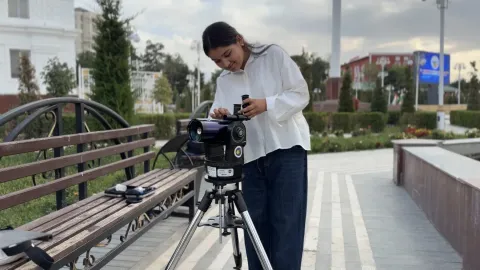
Coding with purpose: A 17-year-old girl from Tajikistan builds technology for inclusion
Marking International Girls in ICT Day

- English
- Тоҷикӣ
On International Girls in ICT Day, young women around the world are redefining what it means to work in technology. In Tajikistan, 17-year-old Madina Ghulomova is doing just that: using code not only to build applications, but to support those who need it.
Madina’s journey into ICT began with a clear intention not just to choose a profession, but to choose a tool for creating real solutions.
“I always wanted to create things that can be used here and now,” she says. “In grade 11, while others were choosing a profession, I chose a tool - iOS development.”
For Madina, the programming language Swift became more than just code. “Swift is a way to turn an abstract idea into a real application on the phone,” she explains. Through working with Xcode, Madina began testing her limits and building confidence.
“I came into this field to prove that in Tajikistan, a girl can be a full-fledged inventor of products at a global level,” she emphasizes.

UNICEF/Tajikistan/Anusha Ashurova

UNICEF/Tajikistan/Anusha Ashurova
At the center of her dedication and work is a project called “I am special” - a mobile application designed to support children with autism and their parents.
“My project is a way to create solutions that make people’s lives simpler and clearer,” Madina says. “I believe that through design, interface and logic, you can communicate support, care and understanding.”
The app aims to make complex information more accessible and create a space where technology becomes a helper, where challenges are simplified, and support is always within reach.
“For me, it is important to build something that will truly help someone,” she mentions.
Her approach reflects a growing understanding that technology is not only about innovation, but also about inclusion by ensuring that no one is left behind.

Besides, Madina’s learning journey goes far beyond school. She actively takes specialized courses from Apple and participates in hands-on training, where she studies Arduino to better understand how software interacts with physical devices. “I learn constantly and everywhere,” she says.
At the same time, she is exploring how artificial intelligence can strengthen critical thinking rather than replace it. “The use of technology and artificial intelligence today is not about finding ready-made answers,” she explains. “It is about developing a culture of critical thinking through the art of asking the right questions.”
Madina views platforms like Claude not as shortcuts, but as tools for intellectual growth. “We see them as an ‘intellectual trainer’ that pushes us to clearly formulate our ideas and analyze the logic of solutions before even starting the work,” she says.
Alongside her technical work, Madina teaches financial literacy classes and conducts research in fintech, exploring how human psychology shapes digital choices. “My path is a combination of technology, social responsibility and the desire to change the approach to IT education,” she explains.
On this year’s International Girls in ICT Day, Madina is taking her commitment one step further by leading a masterclass for other girls interested in technology.
“For me, this is an opportunity to share this drive with others and show that technology is the most powerful tool for compassion and real help,” she says.

Her message to other girls is clear and empowering:
“This is where the real freedom of technology lies the ability to turn any urgent problem into a working digital solution. Artificial intelligence is only an accelerator of your own vision and your will to create change.”
Madina’s story is a reminder that behind every line of code is human intention and that when girls are given the opportunity to learn, create, and lead, they can transform technology into a force for good.
On this day, her message stands strong: technology is not just about building apps; it is about building a more inclusive future.
It is important to note that this effort should not be limited to one day. Breaking stereotypes that technology is “not for girls” and expanding opportunities for girls to build in-demand digital skills must remain a continuous priority by ensuring that more young girls can shape the future of innovation.