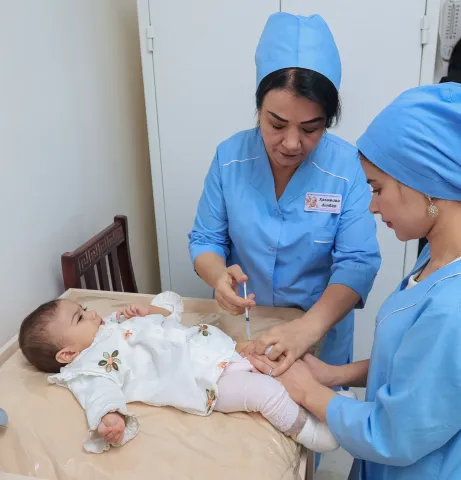
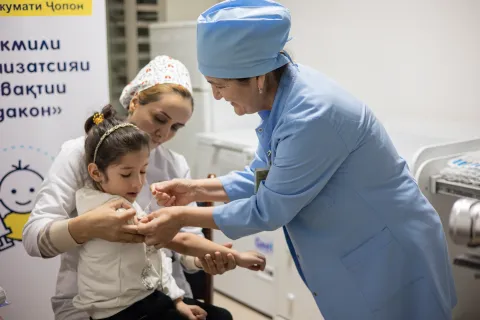
Tajikistan marks European Immunization Week with a press conference

Dushanbe, 16 April 2026 – A press conference was held today at the State Institution “Republican Centre for Immunoprophylaxis” to mark the 20th European Immunization Week, observed from 20 to 25 April 2026 across countries of the WHO European Region, including the Republic of Tajikistan, under the theme “Vaccines protect all generations.”
The event brought together the Deputy Minister of Health and Social Protection of the Population of the Republic of Tajikistan, Mr. Abdukhaliq Amirzoda, development partners, leadership and staff of the Republican Centre for Immunoprophylaxis, as well as heads of health centres in Dushanbe.
In his opening remarks, Mr. Amirzoda emphasized that since the early years of independence, the Government of Tajikistan has prioritized child health and the prevention of infectious diseases.
“As an active member of the World Health Organization, Tajikistan, with the support of international partners, including WHO, UNICEF, Gavi, the Vaccine Alliance, the European Union and others, continues to implement consistent measures to strengthen and expand the national immunization system,” he stated.
Participants highlighted that immunization remains one of the most effective and equitable public health interventions. Vaccines help reduce the incidence of vaccine-preventable diseases, prevent severe complications and deaths, and contribute to strengthening the country’s health security.
Tajikistan has achieved significant progress in protecting its population through immunization. Coverage for key vaccines, including those against polio, diphtheria, tetanus, pertussis, measles, rubella, mumps, Haemophilus influenzae type b, pneumococcal and rotavirus infections, exceeds 90 per cent nationwide. This achievement has been critical in maintaining the country’s polio-free status and advancing efforts to eliminate several vaccine-preventable diseases.
A major milestone in recent years has been the introduction of the human papillomavirus (HPV) vaccine. Since October 2025, the HPV vaccine has been included in the national immunization schedule, with routine immunization targeting 10-year-old girls. In addition, a nationwide catch-up campaign for girls aged 11–14 was successfully conducted. This initiative represents a significant step towards protecting girls’ health and preventing cervical cancer.
During the press conference, development partners also reiterated the importance of sustained investment in immunization and highlighted the strong collaboration with the Ministry of Health and Social Protection of the Population in advancing immunization outcomes in Tajikistan.
UNICEF reaffirms its commitment to working with the Government and partners to ensure that every child, everywhere, is protected by life-saving vaccines.
Media contacts
About UNICEF
UNICEF promotes the rights and wellbeing of every child, in everything we do. Together with our partners, we work in 190 countries and territories to translate that commitment into practical action, focusing special effort on reaching the most vulnerable and excluded children, to the benefit of all children, everywhere. UNICEF operates in Tajikistan since 1993.
To receive more information about UNICEF and our work in Tajikistan, please visit https://www.unicef.org/tajikistan/
Follow UNICEF on Facebook, Instagram and Twitter