Rebuilding hope
Children and families in Syria come together stronger one year after the deadly earthquakes

Damascus, Syria - In the face of adversity, children and families of Syria have displayed extraordinary strength and courage as they rebuild their lives, one year after the devastating earthquakes struck on 6 February 2023. In the deadly events, approximately 5,900 people, including children, in Syria were killed and more than 12,800 injured. An estimated 8.8 million people were affected, and the infrastructure already weakened by the conflict was severely damaged. Many families lost their main breadwinner due to death or injury, at a time when the economic situation was already dire, increasing the vulnerability of millions of people previously unable to meet their basic needs. Many children lost their homes and loved ones and have had to deal with unspeakable trauma added on top of dreadful years of conflict, economic hardship, and disease outbreaks.
The earthquakes shattered the sense of safety for many children.

UNICEF/UN0797355/Ameen Haddad
“I slept in the car! I was scared the building might fall. I want is to live in a better building. A building that would not fall,” said Tala, 4, at a shelter, days after the quakes.
With more than 2,000 schools damaged and 96,000 teachers impacted by the earthquakes, many children also lost a safe space to learn and cope in addition to losing their homes and loved ones.

UNICEF/UN0798499/Ameen Haddad
“My brother doesn’t speak at all,” said Shahed, 9, at a school-turned-shelter, days after the quakes. At the shelter, it is harder for my mom to help him, because he is not used to this situation,” Shahed added about her brother’s struggle to grasp the shock.
Even for young people and adults, the shock of the devastating earthquakes was hard to process.

UNICEF/UNI500665/Maher Issa
“I never imagined myself living in the school where I studied. It was tough,” said Yousef, 20, recalling how he felt after having been displaced.
> Read: Yousef fulfils his aspirations and turns his pain into success
After the earthquakes, children could no longer access many services, essential for their survival and growth. More than 200 health facilities were damaged, and water and sanitation infrastructure was impacted. According to estimates, the damages and losses, caused by the earthquakes, were estimated at the total value of US$9 billion.
Most of these basic services and facilities had already been damaged during the long years of conflict in Syria and children were living under unusual stress with limited access to social services. The earthquakes exacerbated the situation and had an adverse impact on children’s wellbeing, protection, and development.
Since the early hours after the quakes, UNICEF has been at the forefront, working tirelessly to give vital assistance to children and families affected. The challenges were immense, but the spirit of hope has persisted.
>> Read: Devastating earthquakes impact infrastructure, displacement, and education in Syria

UNICEF/UN0781277/Muhannad Al-Asadi
“I’m responsible for keeping my little ones safe and I felt equally responsible to help other children in need. To support my team members, I must manage how I feel and stay in good spirits despite everything. It’s not easy! We have lost a member of our team. May her soul rest in peace. And a couple of our team members lost their homes,” said Hiba, days from the earthquakes.
Hiba is a UNICEF-supported mobile health team leader in Aleppo city, north Syria. “Uncertainty is everywhere, but we keep going to support the people who need us,” she added. She left her 6 and 8-year-olds at home with their father just hours after the earthquakes to help respond to families’ needs.
Rana facilitated parenting sessions at a UNICEF-supported centre in Lattakia, north Syria, after the quakes.

UNICEF/UNI497726/Maher Issa
“We explained to families how shock can affect their health and their children’s. We also offered case management services, including specialized help when needed. Parents needed to release the pressure they experienced during their time in shelters so it would not be transmitted to their children,” Rana explained.
“Many parents, who attended the sessions, have become more aware of how their psychological state can affect their children. They know they are the source of their children’s safety,” she said. “As a mother of two children, I also benefitted from the content of the parenting sessions,” added Rana. She is also an earthquake survivor.
Despite the adversity, children in Syria are displaying remarkable resilience, finding solace in safe spaces provided by UNICEF-supported initiatives. Zakaria, 4, benefitted from psychosocial support sessions in Aleppo.

UNICEF/UNI488046/Adel Janji
“We are learning how to achieve our goals. I want to become a tailor in the future to make pyjamas like my father,” Zakaria said.
>> View: UNICEF supports children in Aleppo through child protection services
24-year-old Mohamad is a child protection worker at a UNICEF-supported centre in Aleppo.

UNICEF/UNI488039/Adel Janji
“A lot of the children here carry trauma with them, because of the conflict and the recent earthquakes,” Mohamad said. “We teach them how to manage their emotions and express how they feel in a healthy manner.”
Alma, 10, attended a session with other earthquake-affected children at a collective shelter in Misyaf, Hama, west central Syria. Together with the others, she learned how to manage her emotions after traumatic events.

UNICEF/UNI437345/Muhannad Hazori
“I felt calm when I tried this exercise. I learned how to combine things that make me angry then get rid of them in one go,” Alma explained.
Many schools damaged by the earthquakes have undergone maintenance. Educational programmes and innovative initiatives are helping children to cope with trauma and regain a sense of normalcy.

UNICEF/UN0829127/Ameen Haddad
“When I come to class and listen to the teacher, I forget everything that bothers me,” said Fatme, 7. She participated in a mathematics class as part of UNICEF’s leaning cinema at a school-turned-shelter.
To help the children continue learning, UNICEF reached impacted children with its learning cinema, a part of UNICEF’s new digital learning programme in Syria. It benefits children in crisis and in places where the education infrastructure has been damaged.
The provision of necessities, such as clean water, nutrition, and healthcare, has been a lifeline for families struggling to rebuild their homes and lives.
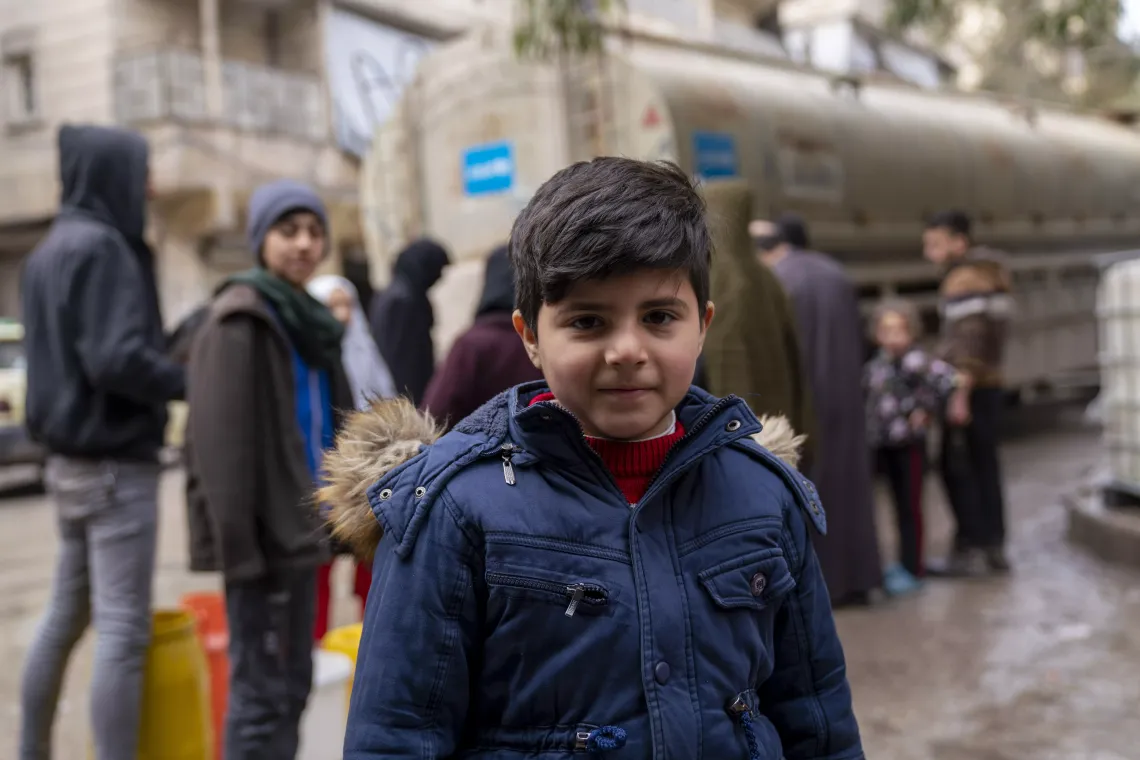
Mohammad, 9, stands in front of a water truck at a distribution point in Aleppo city to fetch water with his father. Water and pumping stations were disrupted by the earthquakes, affecting several of the city’s neighbourhoods and preventing people from accessing water. UNICEF trucked water to the most affected areas.
Health remains a top priority. Mobile health and nutrition units are reaching remote areas, ensuring that even the most vulnerable are not left behind.

“This clinic is the only health care provider in the area. It is a real lifeline for this overwhelmed community. It provides free services, and it is within walking distance for the community,” said Dr Fidaa, 31, paediatrician at a UNICEF-supported clinic in northern Lattakia.
>> Read: Enhancing health care services in remote areas
UNICEF also continued to support vulnerable families through its integrated social protection programme.

It enabled families’ like Huzayfa’s to use a part of the emergency cash top-up they received to fix parts of their earthquake-damaged home and take care of Huzayfa’s needs.
> Read: Huzayfa waves hardships goodbye
As Syria marks one year after the earthquakes, the scars of the past are still visible, but so too is the unbeatable spirit of a community determined to rise from the rubble. UNICEF remains committed to supporting the children and families of Syria on their journey. In 2023, UNICEF with partners reached 5.6 million people affected by the earthquakes, 3.2 million of them are children, with lifesaving assistance.