Parenting sessions power change
Parenting support and social protection programmes changed the lives of Manal and Karam

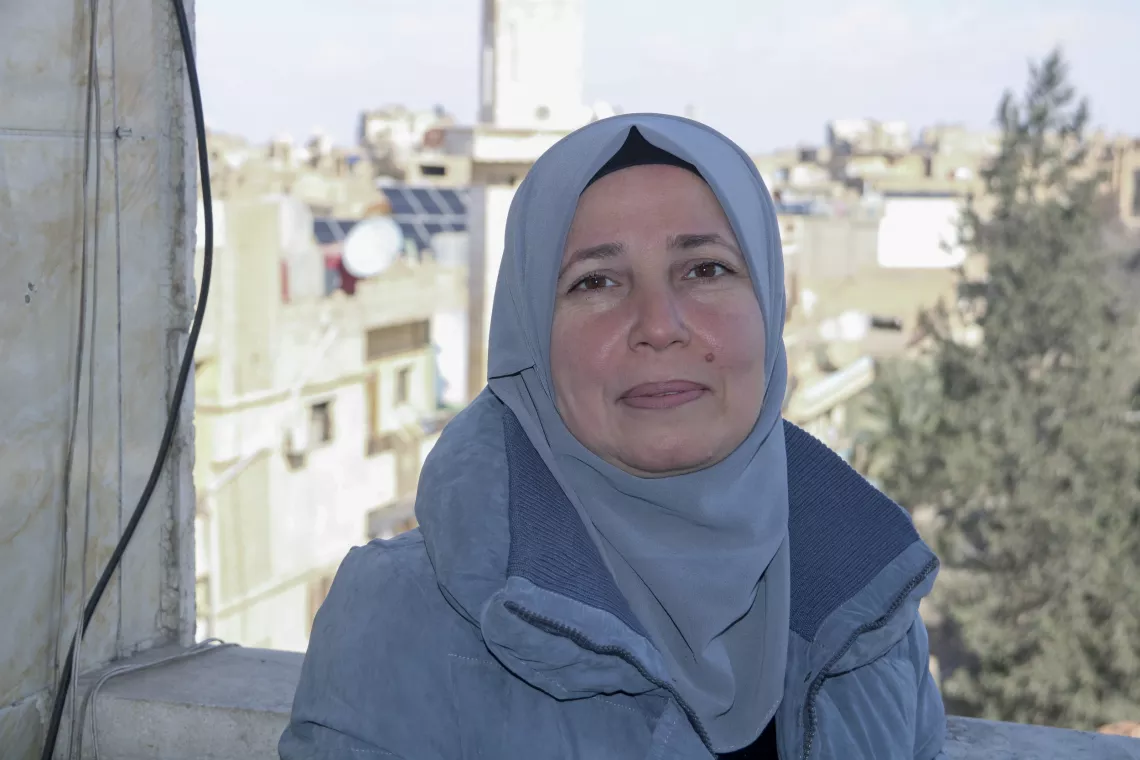
February 2024, Deir-ez-Zor, northeast Syria - “I was often exhausted and puzzled about why my son had autism,” said Manal, 43, from Deir-ez-Zor city. “With all the difficulties I had to overcome to raise him and try to help him fit in society, it was too much. I surrendered to sorrow.”
Amid the conflict, the family fled Deir-ez-Zor to neighbouring Al-Hasakeh in 2012. With respite in violence in 2018, they returned. As their home was severely damaged, they rented a small apartment on the roof of a building in Deir-ez-Zor city.
With the country’s deteriorating economic situation and after their displacement, Manal, a schoolteacher, and Wael, an employee, struggled to make a living for their children Mohamad, (now) 18, and Karam, (now) 13.
When Karam was only two years old, Manal noticed he was hyperactive, had difficulty sleeping, and sometimes moved in an unfamiliar way.
I took him to a doctor for a check-up, hoping my worries were unfounded. Following his examination, the doctor diagnosed Karam with autism. From that moment on, my life changed. A grim chapter began.
Manal was keen on helping Karam to learn and cope with his situation so that he would grow up to be able to live within the community. At the age of four, she enrolled him in a private institute for children with autism. There, he started learning how to read and write. The staff also helped Manal with some tips on how to communicate with young Karam. But reality hit hard when he reached the age of school. “No school would take him. ‘We lack the capacities and resources needed to support a child with autism’ they’d say,” explained Manal.
Not to deprive him of his right to learn, Manal got permission from the Directorate of Education to attend school with Karam, accompany him there, and make sure he was doing fine. “It was very difficult. I had responsibilities at work and home, but he was my priority,” said Manal, tearing up. “Some school staff were against me being there, but it did not keep me from going with him there every day.”
In 2023, Manal received a call from a volunteer working with a UNICEF-supported child protection mobile team. He invited her to a parenting session, held in her neighbourhood. “I took the call as a sign to keep going. I had been so depressed that day,” she said. UNICEF-supported parenting programme equips caregivers, like Manal, with tools to help them understand and interact with their children better. The caregivers are also provided with mental health support through the programme, enabling them to manage their stress.


Manal started frequenting the parenting sessions in March 2023. She made a new friend Om Asal, a mother of five blind children, there. “She simply inspired me to accept myself and my son’s situation with gratitude,” said Manal. During the sessions, Manal learned how to plan both her and her son’s schedule, gaining a clearer vision of how to support him best. She also learned how to take care of herself and interact with her teenage boy while maintaining her calm and strength.
In November 2023, Karam was registered in UNICEF’s Integrated Social Protection programme for children with disabilities, combining regular and unconditional cash transfers with referral and case management services. The support Karam and his mother received through the UNICEF programmes was a turning point for both of them. The family used the cash to pay for private lessons to help Karam practice his reading and writing, buy some basics for the house and enrol Karam in a swimming course. “He’s always liked going to swimming pools, and now he’s a good swimmer,” his mother said. A dedicated case manager visits Karam to follow up on his progress and checks on his needs. He also referred Karam to a psychologist to get specialized support.

Karam is saving some money to buy himself a laptop and work on his dream of becoming a computer technician. “I taught him the value of money. I want him to become as independent as he can be. I want him to continue learning and have a job. I will not be here with him forever,” said Manal. “He’s become a flourishing flower in my life,” added Manal proudly about Karam.
In 2023, UNICEF supported more than 10,300 children with disabilities in Syria through its Integrated Social Protection programme. The activities were funded by EU Humanitarian Aid; the European Union and the Government of Norway under the UN Joint Programme on Urban and Rural Resilience; the Governments of Austria, Australia, Canada, Finland, Italy, Japan, Norway, Spain, and Sweden; Luxembourg National Committee for UNICEF; Swiss Agency for Development Cooperation; and UNICEF’s Global Humanitarian Thematic Fund. Over the same period, UNICEF reached some 72,300 caregivers with the parenting programme and some 388,000 girls and boys with mental health and psychosocial support. The activities were funded by the Bureau for Humanitarian Assistance (BHA/USAID); the German Federal Ministry for Economic Cooperation and Development (BMZ) through the KFW Development Bank; the Governments of Australia, Canada, Italy, Japan and New Zealand; the Global Humanitarian Thematic Fund, the Swiss Agency for Development Cooperation (SDC); the Swedish International Development Cooperation Agency (SIDA); the Foreign Commonwealth and Development Office (FCDO); UNICEF National Committees for Australia, Canada, Denmark, Germany, Ireland and UK; UNICEF Egypt, Singapore and UAE, and United Nations Central Emergency Response Fund.