Nourishing hope after displacement
UNICEF cash and nutrition support helps families protect children’s health and rebuild with dignity

Latmana, Hama – When Afraa, 26, returned home with her family after years of displacement, she found their house reduced to rubble. With nowhere else to go, they bought a tent and began rebuilding their lives from scratch.
Afraa is a mother of four. Jihad, 9, Bushra, 7, Sidra, 3, and Rajaa just one year old. While the older children attend school each day, Afraa spends her time caring for her children inside the tent. Her husband was without work for two months and now relies on daily labour, with no stable income.
Before receiving support, the family struggled to meet even their most basic needs. What little money they had was spent on staple foods, leaving no room for fruits, vegetables, or protein. For Rajaa, the youngest, this was especially concerning during a critical stage of growth.

That began to change when Afraa received cash assistance through UNICEF. For the first time, she was able to buy food based on her children’s needs. Fruits, vegetables, and protein meat returned to their meals, and Rajaa’s diet improved.
Soon, Afraa noticed a difference. Rajaa began to gain weight. She became more active, more responsive, more playful.
“The moment I saw my girl strong, able to walk and play, and gaining weight, I was extremely happy,” Afraa says.

At first, Afraa doubted the support would reach her.
“When they visited our tent, I thought they would register us and disappear,” she recalls. “But when I received the message to collect the money, I knew they were honest.”
Alongside cash assistance, Afraa also received guidance on optimal breastfeeding and complementary feeding, strengthening her confidence in supporting her daughter’s development.


Afraa’s story reflects a wider crisis across Syria. Three out of four children under the age of two do not have access to the diverse diet they need to grow and develop. Without timely support, they face increased risk of malnutrition and long-term developmental setbacks.
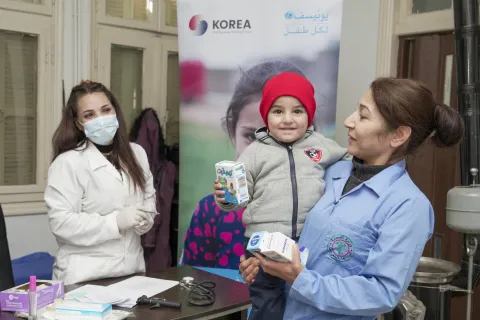
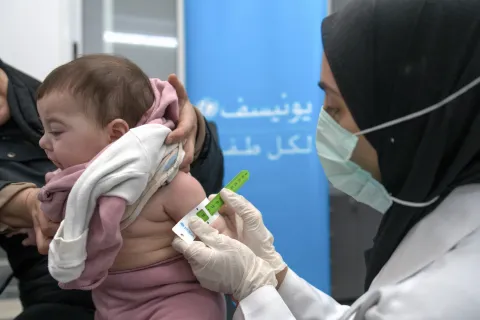
To address this, UNICEF provides integrated cash and preventive nutrition services to the most vulnerable families with children aged 6 to 23 months. The package combines cash assistance, preventive nutrition supplies, counselling on complementary feeding, and improved access to health services, helping families meet immediate needs while strengthening longer-term wellbeing.

For Afraa, the impact goes beyond food. She has returned to education and is now studying for her high school certificate, determined to help rebuild her family’s home and secure a better future.
“When I was young, I dreamed of becoming a doctor,” she says. “Today, my greatest hope is that my children will achieve what I could not.”
Despite the hardship, Afraa remains hopeful.
“I’m still young. I’m learning new things,” she says. “The future is ahead of me — for me and for my children.”
Since the beginning of 2025, UNICEF has reached nearly 87,000 people through its broader Integrated Social Protection Cash+ programme. This support helps ensure that vulnerable children receive the care they need to grow and thrive. These efforts were made possible with vital contributions from the European Civil Protection and Humanitarian Aid Operations (ECHO), the Foreign Commonwealth and Development Office (FCDO), the Governments of France, Australia, Spain, Estonia, and Canada, the Syrian Humanitarian Fund (SHF), and the United Nations Central Emergency Response Fund (CERF).
With the right support, families like Afraa’s are not only surviving — they are giving their children the chance to grow healthy, strong and reach their full potential.