What does it take to get vaccines to children in Darfur?
Convoys carry millions of doses and supplies across rivers, valleys, and borders to protect children from deadly diseases.

A race against time to protect children
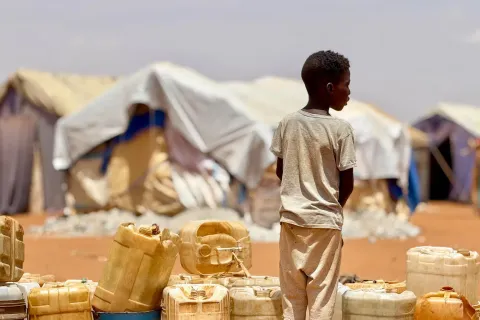
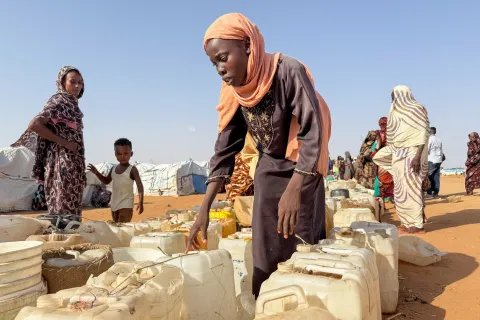
Reaching children with lifesaving vaccines in Darfur is no easy task. Years of conflict, insecurity, and access constraints have made it almost impossible for millions to receive critical health services. Thousands of children under five remain un- or under-vaccinated, missing out on essential protection against deadly but preventable diseases such as polio, measles, diphtheria.
Frequent vaccine stockouts and shortages of syringes and safety boxes have only made it harder to sustain routine immunization. With supply routes unsafe or completely blocked, the time required to move vaccines into Darfur has more than doubled.
Despite these immense challenges, the relentless efforts of the Ministry of Health, with support from UNICEF and partners, are helping to turn the tide- proving that where there is a will, there is a way.
An extraordinary mission
Abdulaziz Adam, UNICEF Health Officer, recounts how close collaboration made a delivery to Sudan’s west area possible. The operation began with an assessment of vaccine needs and careful mapping of routes. With most traditional pathways blocked, teams turned to innovation — charting a cross-border route from Chad to the Geneina subnational supply hub, from where vaccines would be dispatched to the rest of Darfur. In Chad, more than 3.4 million vaccine doses were loaded onto refrigerated trucks and flagged off to Geneina. Every kilometre counted as the truck raced against time to ensure no vial was lost.
After a risky month-long journey across rivers, rough terrain, and insecurity, the convoy successfully delivered vaccines to four main key hubs: Geneina, Nyala, Zalingi, and El Daien.
Meanwhile, from Post Sudan, another convoy with 5.9 million syringes and over 37,000 safety boxes embarked on its own arduous journey through Ad-Dabbah in Northern state before finally reaching Darfur. Without these essential supplies, immunization world simply not be possible.


From the cold chains to children’s arms
But the arrival of vaccines in Darfur was only half the battle. The real mission was to reach children in their communities and health facilities.
In Central Darfur, Immunization Officer Mohammed Afatih led a team determined to deliver. The rainy season made roads impassable- vehicles were stuck in mud and valleys were flooded. Yet the team did not stop. They carefully transferred vaccine carriers, cushioned with ice packs, onto donkey carts, and trudged on foot, rolling up their trousers and wading through waterlogged terrain.
Along the way, women and community members joined, pushing carts and guiding the mission through rough paths until the vaccines reached health facilities safely.

The smiles that make it worthwhile
At Abata health centre, queues of mothers with their little ones stretched long. One by one, infants were vaccinated- finally shielded from deadly diseases.
“Hundreds of children under one year old received their routine immunization doses,” Mohammed said with a smile. “This makes the journey worthwhile.”
With vaccines and supplies in place, sensitization drives helped mobilize families. Caregivers were reminded of the importance of routine immunization, ensuring no child was left behind. For the first time in months, sufficient vaccine stocks were available to cover the coming months in Central Darfur.
Protecting children amid conflict
In Sudan, emergency after emergency has disrupted routine health services, leaving vaccination coverage dangerously low. Every missed dose leaves children at risk of deadly outbreaks.
With the government and partners, UNICEF continues to:
- Deliver lifesaving vaccines and supplies across borders and conflict lines.
- Support health workers in restoring and strengthening routine immunization services.
- Engage communities to ensure parents and caregivers bring their children for vaccination.
These efforts are a lifeline for thousands of children — proving that even in the hardest-to-reach places, protection is possible.