Running on empty: a mother’s struggle to save her children in war-torn Darfur
Caught between violence and hunger, Hawa flees yet again as her severely malnourished son fights to survive

“We were in the hospital when it was hit.”
“We took our children and ran. All we thought about was our safety and that of our children.”
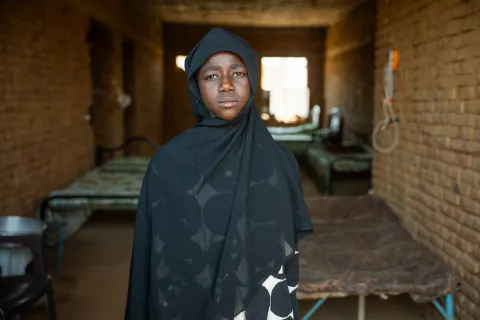
Hawa, a mother of three, recounts the terror of being inside a hospital during shelling in the Zamzam camp for internally displaced. Mothers, children, and health workers were killed. The attack forced Hawa to flee once again.
At the time, her youngest child, Waleed, had been admitted to a health facility for treatment of severe acute malnutrition — the result of prolonged food shortages and limited access to medical care.
Waleed’s health has sharply deteriorated since the conflict began in North Darfur. Now very weak and frail, the recent displacement threatens to interrupt his treatment entirely. He is too weak to cry and eats very little.
Hawa, originally from Al Fasher, has been displaced multiple times. Even before fleeing, life in the Zamzam camp was unbearable. Formerly a farmer, she could no longer grow crops - even when it rained. The seeds she purchased for the planting season were left behind during the hurried escape. For months, her family has survived on handouts from humanitarian organizations, but it is not enough - especially for Waleed.
“We have nothing. Nothing to eat or money to buy food for the children,” Hawa says.
“I don’t have enough breastmilk to feed my child, and he is getting worse every day.”
The lack of food does not only affect the children; it has impacted Hawa herself. Undernourished, she can barely produce breast milk rich enough to sustain her baby.

UNICEF 2025/Jamal
In Darfur, insecurity continues to escalate, displacing hundreds of thousands of families from places like the Zamzam and Abu Shouk camps.
The journey from Zamzam
With Waleed strapped to her back and her two other children in hand, Hawa fled the Zamzam camp and walked for three days to Tawila, where thousands have sought refuge.
“Since the problems started, we have been running for three days,” she recalls, occasionally staring off into space.
The journey took a heavy toll on her already weak children. But the situation in Tawila is even worse. Waleed’s condition is likely to deteriorate further as shelter, food, water, and medical care remain scarce.

“In the past, we had three to four meals per day. For the past two years, giving them one meal a day is a miracle,” Hawa reminisces.
This is the harsh reality of life after two years of relentless war.
Sudan remains the largest humanitarian crisis in the world, with millions uprooted from their homes. In Darfur, insecurity continues to escalate, displacing hundreds of thousands of families from places like the Zamzam and Abu Shouk camps for the internally displaced and disrupting both transportation and humanitarian access.
Children are paying the highest price.
“The bombs were falling on the hospital. The sick and their mothers were killed. Those of us who survived, left with only our children on our backs,” Hawa says.
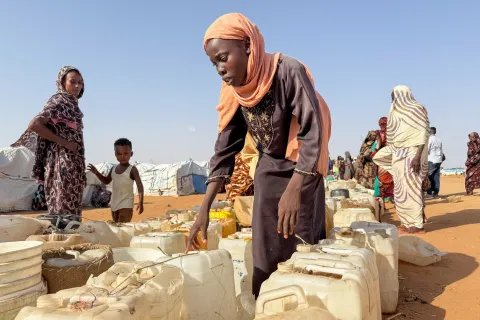
As families continue to arrive in Tawila, UNICEF and its partners are on the ground, assessing and addressing the urgent needs of the displaced people.
“We need everything. Our children need food, clothes, and blankets -anything you can think of. Right now, we wash old sacks we sleep on. We don’t even have plastic to cover ourselves. We need food and warmth -just something in our stomachs and something to sleep under,” Hawa pleads.

For little Waleed, it is a race against time.
Hawa's harrowing journey is not an isolated case but a reflection of the widespread crisis engulfing Sudan. With over 15 million children in need of humanitarian assistance, the scale of suffering is immense.
The ongoing war is disrupting treatment for millions of malnourished children like Waleed.
Every moment counts; delaying assistance could mean the difference between life and death for the most vulnerable children in Sudan.