Ezzeldin the vaccinator: Defending childhood in the heart of conflict
In Central Darfur, one man’s decades-long commitment to immunization is saving lives- one child at a time

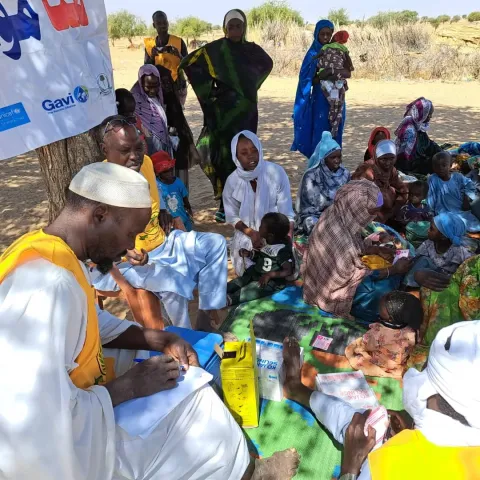
By 7 a.m., on a bright sunny morning, mothers sit on benches and mats under a shade in Al-Hamidiyah health facility, located in a displacement camp in Zalingi, Central Darfur.
Every Monday and Thursday, the shade becomes the immunization clinic. Some 30 mothers have arrived with their babies tucked under little warm blankets, while older children run around nearby. Some mothers come with two, three or more children – each under the age of five.
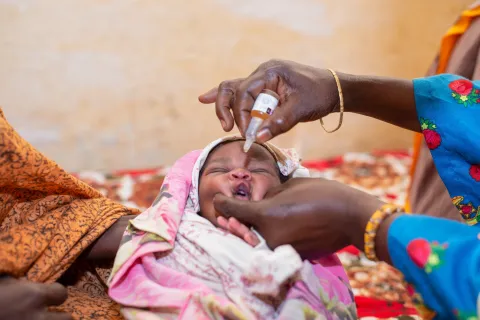
On this day, the facility provides routine immunizations against diseases like tuberculosis, polio, pneumonia, measles, rubella, diphtheria, pertussis, and more, diseases that threaten children’s lives.
These mothers are aware of the importance of immunization and will do whatever it takes to protect their children against vaccine preventable diseases.

Ezzeldin, the vaccinator for decades
Ezzeldin arrives early. He moves swiftly from one room to another, transferring vaccines from the refrigerator into a vaccine carrier cold box, preparing supplies before heading out to the shade to meet the waiting mothers and children.
He describes himself as an immunization technician, a role he has held for over three decades. Over the years, he has seen firsthand how vaccinations have helped curb preventable child deaths. This experience inspired him to return to the frontline when he was called upon after the war.
Since then, he is either at the health facility or moving though the camp, speaking with parents and caregivers about immunizations, now more crucial than ever.
“Vaccination is a must,” he asserts.
“Diseases are like a war - they can destroy an entire generation.”
Thanks to Ezzeldin’s relentless mobilization efforts, mothers and caregivers now come from far and wide, twice a week, seeking vaccines. Many travel from remote neighbouring villages with non-functional health facilities, enduring insecurity on the road. They come however they can- on donkeys, in trucks, or on foot.
“We vaccinate more than 30 children a day - the numbers have gone up,” he says.
“We have a good number of parents in the camp who never miss their children’s appointments.”
Today, he is grateful that most mothers understand the importance of immunization and that demand has increased. Some even come to the clinic specifically to ask for vaccines.
Yet even with these successes, Ezzeldin worries. Sudan registered the highest number of zero-dose children in the Middle East and North Africa (MENA) region in 2024, with over 900,000.
“Some children missed their vaccinations because of vaccine stockouts occasioned by the conflict,” he says with concern.
“But now we have enough vaccines, and children are getting their doses.”

Vaccinating children no matter what
In Sudan, the ongoing war has disrupted the delivery of essential health services, including immunization programmes. The movement of vaccines and supplies has been affected, and disease outbreaks have been more likely.
With millions of displaced families living in overcrowded shelters, unvaccinated and under vaccinated children face a heightened risk of contracting deadly diseases. Measles, for example, a highly contagious illness, can spread rapidly in such settings and be fatal for children.
But UNICEF is on the ground.
We are facilitating the procurement and delivery of vaccines for routine immunizations, catch-up campaigns, and responses to vaccine-preventable outbreaks including using cross border vaccine deployment approach. We are preserving and strengthening cold chain systems, constructing and rehabilitating cold stores and installing new cold rooms and refrigerators, raising community awareness, knowledge and understanding on immunization, and supporting frontline health workers like Ezzeldin through capacity building and providing communication materials.

At the Al-Hamidiyah health facility, vaccine stockouts are no longer an issue. While past security and access challenges impacted delivery, Ezzeldin confirms they now have sufficient supplies to support vaccinations against diseases like hepatitis, tuberculosis, meningitis, measles, polio and yellow fever.
In 2024 alone, UNICEF procured and delivered over 50 million doses across Sudan.
Amidst enormous challenges, UNICEF and its partners supported the Ministry of Health in conducting a measles-rubella (MR) catch-up campaign, along with cholera and polio outbreak response campaigns, reaching millions of children and families.
To tackle the alarming rise in zero-dose children, UNICEF also supported the Ministry’s Big Catch-Up campaign, reaching thousands of children under five with their first dose of the DPT-containing vaccine in 10 states.
But none of this would be possible without the commitment of health workers like Ezzeldin.
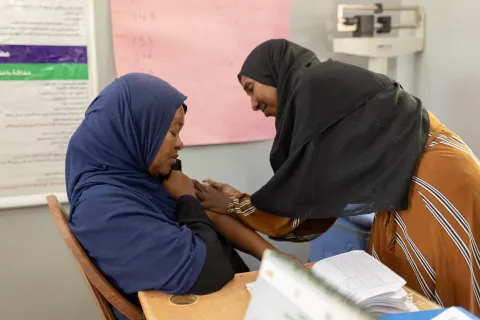
Every day, he administers life-saving vaccines, travels far and wide to reach families, and empowers parents with the knowledge to make informed decisions about their children’s health.
His unwavering dedication ensures that every vaccine given is a step towards saving a child’s life, even in the most challenging conditions.
When asked why he continues despite everything, Ezzeldin answers simply:
“Vaccination, or health in general, has nothing to do with war.
“We have a responsibility to keep going, no matter how difficult the circumstances.”