COVID-19 school closures worsen pupils’ access to learning
A teacher’s perspective from Khartoum State

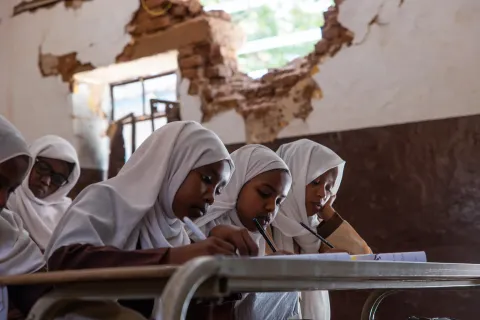
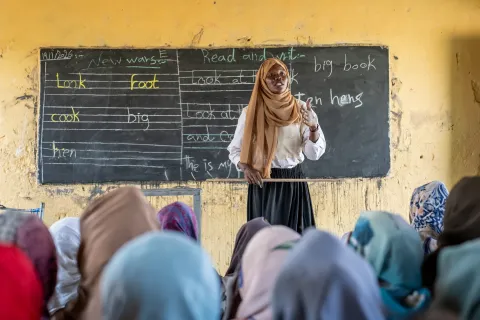
When Mahmoud Eisa Arbab, a mathematics and physics teacher came back to his classroom at the end of 2020, following the prolonged COVID-19 school closures, he noticed great changes among his pupils.
“Their comprehension had deteriorated and when we conducted mid-year examinations, less than 50 per cent of them passed,”
Children in Sudan were already struggling with learning. The 2018 National Learning Assessment (NLA) indicated that among grade three students many struggled to read simple familiar words and less than half could comprehend what they read. Additionally, less than half of them could solve level-one mathematics exercises. Sadly, this learning crisis was further exacerbated by school closures which spanned between 2019 and continued until 2022 due to COVID-19 pandemic and the volatile political situation.
In Sudan, approximately 8.5 million children between 5 and 13 years of age should be in school. However, even before the onset of the COVID-19 pandemic, an estimated 3 million children of them are already out of school and nearly 38 per cent of children in school are unable to read proficiently .
Following different waves of the COVID-19 pandemic, schools in Sudan remained closed for over half a year between March 2020 and January 2021, nearly a quarter longer than the global average, with additional disruptions throughout 2021. This was further worsened by the military coup in October 2021 that affected the continuation of learning for the academic year of 2021 – 2022, and further prolonged school closures and its associated effects.
With each school closure, teachers like Arbab witnessed the impact first-hand.

“Every time, I would notice less and less pupils. I know this happened in all public schools especially in the impoverished neighborhoods in my district, but in my classroom, out of 34 pupils, seven did not return after the last school closure,”
As their teacher, Mahmoud followed the absentees to better understand their plight.
He later found out that the school closures pushed many children into the job market and once they started making a living, it was difficult to return to school. Moreover, they felt the need to contribute to their family livelihoods.
The school closures did not only impact the pupils’ learning, but they also affected their mental health.
Mahmoud and other teachers noticed an increase in violent acts among students upon return.
“We realized that the closures had a psychological impact which caused more violence and bullying and even unhealthy habits such as smoking were spotted among the older students,” says Mahmoud.
Keeping schools open remains a priority for UNICEF in Sudan and globally. The risks of children being out of school outweigh those of being in school. Through its education programme, UNICEF continues to support schools to enhance preventive COVID-19 measures to ensure a safe learning environment during the pandemic.
Last year, UNICEF in collaboration with partners, launched the ‘Learning Passport’ which is a global digital learning platform that includes government-provided textbooks, interactive learning activities, video educational content, and assessments to measure children’s progress.
This platform is envisioned to assist in addressing the learning loss of children, as well as reach out-of-school children with educational opportunities while working to equalise the opportunities between Sudanese children. Learning Passport is expecting to reach half a million users by 2024.